Blue Paintings: 12 Famous Works and the Story of the Color

The most famous blue paintings run from a duke's ultramarine prayer book and Vermeer's blue jacket to Hokusai's Great Wave and Van Gogh's starry river.

Blue was once the rarest and dearest color in art, and its whole story is written in these twelve pictures.

Blue arrived late and cost a fortune, which is why painters used it so carefully and loaded it with meaning. I have picked twelve where blue is the whole point, and together they tell how the color went from priceless to everywhere.

Why blue is the strangest color in art:

  • The price. True blue once came from lapis lazuli, ground into ultramarine that cost more than gold.

  • The lateness. Blue arrived late in art, so several old languages barely had a word for it.

  • The mood. Distance, night, calm and sadness all read instantly as blue.

  • The breakthrough. A new blue, Prussian blue, was the first cheap synthetic color, and it changed painting.


Learn art the fun way. Free stories every week, no boring lectures.


Where this gets properly interesting

Three worth opening next:


1. The Limbourg Brothers, Les Tres Riches Heures (about 1412)

Limbourg Tres Riches Heures blue sky
The Limbourg Brothers, Les Tres Riches Heures, June, about 1412, Musee Conde, Chantilly

Turn the pages of this famous prayer book and the skies glow an astonishing, saturated blue. Around 1412 the three Limbourg brothers painted the calendar of Les Tres Riches Heures for the Duke of Berry, laying on so much ultramarine that the whole book seems lit from within.

That blue came from lapis lazuli, a stone dug from a single region of Afghanistan and ground into a powder worth its weight in gold. Spending it on a private prayer book was a way for a duke to show off a fortune, one page of sky at a time.

2. Titian, Bacchus and Ariadne (about 1523)

Titian ultramarine blue sky
Titian, Bacchus and Ariadne, about 1523, National Gallery, London

The sky in this picture is so intense it almost hurts. Titian painted Bacchus and Ariadne around 1523 and spent a small fortune on ultramarine to make that heaven glow behind the leaping god.

Patrons often wrote the exact weight of ultramarine into a contract, because the color was priced above the artist's own wages. Titian used it without restraint, which is one reason the sky still looks freshly painted five centuries on.

3. El Greco, View of Toledo (about 1600)

El Greco stormy blue Toledo
El Greco, View of Toledo, about 1600, Metropolitan Museum

A city crouches under a sky that looks about to split open, all bruised green and cold, charged blue. El Greco painted View of Toledo around 1600, one of the most charged early landscapes in the West, where the land itself seems to feel an emotion.

He drenched the whole scene in cold, stormy blue to make the town feel haunted and alive. Centuries later it looked so modern that painters of the twentieth century claimed him as one of their own.

4. Johannes Vermeer, Woman in Blue Reading a Letter (about 1663)

Vermeer woman in blue ultramarine
Johannes Vermeer, Woman in Blue Reading a Letter, about 1663, Rijksmuseum

A pregnant woman stands by a window, lost in a letter, wrapped in a jacket of the softest blue. Vermeer painted her around 1663, using precious ultramarine not only for the jacket but in the shadows and walls, so the whole room glows quietly in blue.

He was so devoted to the color that he ran up debts buying it, and died leaving his family poor. That soft blue light is now the first thing most people picture when they think of a Vermeer.

5. Caspar David Friedrich, Moonrise over the Sea (about 1822)

Friedrich blue evening sea
Caspar David Friedrich, Moonrise over the Sea, about 1822, Alte Nationalgalerie, Berlin

Three people sit on a rock watching ships come in as the sky deepens from gold to a vast evening blue. Caspar David Friedrich painted Moonrise over the Sea around 1822, turning a plain seascape into a mood of quiet longing.

For the Romantics, blue was the color of distance and yearning, of a horizon you can never quite reach. Friedrich let the blue swallow most of the canvas, so the tiny figures seem to dissolve into the coming night.

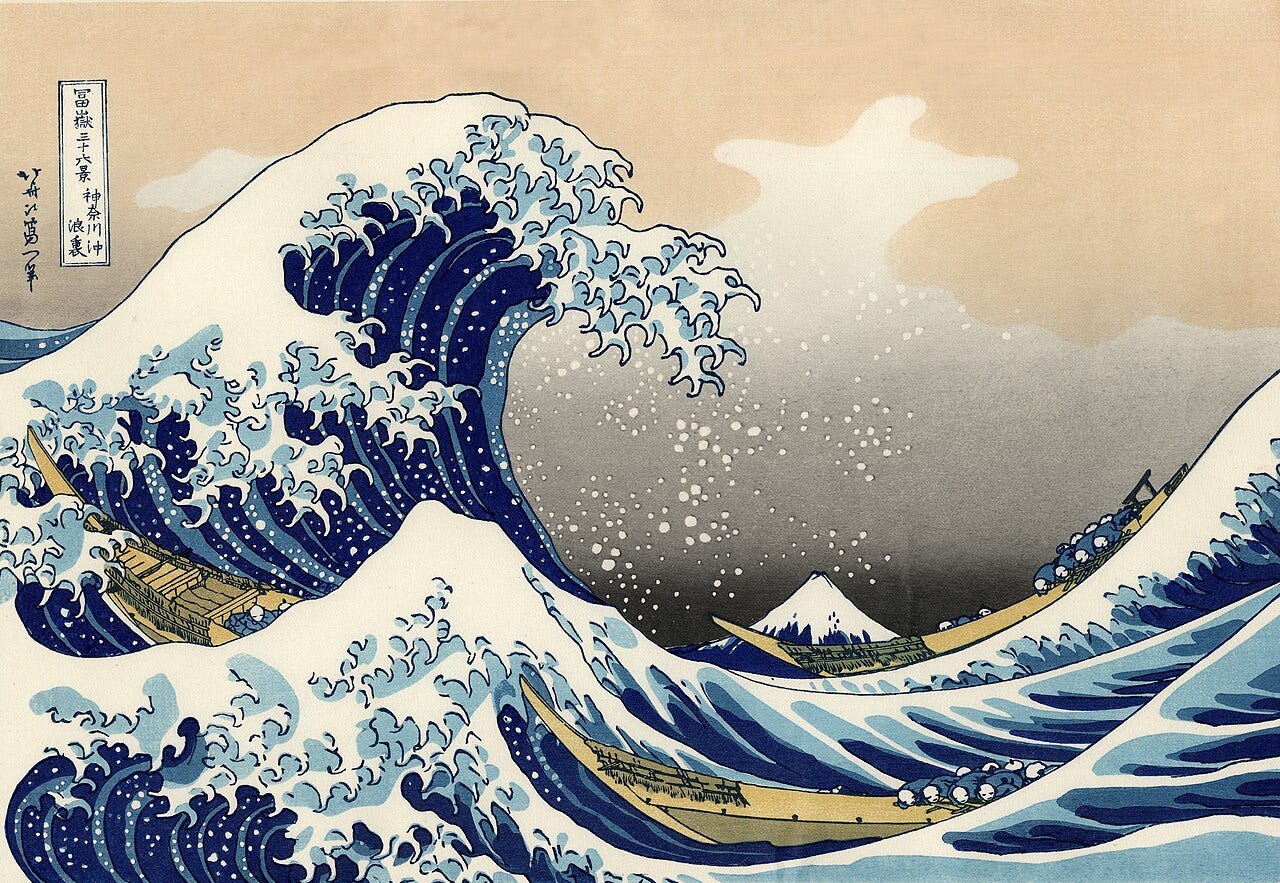
6. Katsushika Hokusai, The Great Wave off Kanagawa (about 1831)

Hokusai Great Wave Prussian blue
Katsushika Hokusai, The Great Wave off Kanagawa, about 1831

That giant curling wave is famous for its shape, but its real secret is the color. When Hokusai designed The Great Wave around 1831, he reached for a brand new blue that had just arrived in Japan, a cheap synthetic pigment called Prussian blue.

For the first time a strong, deep blue was affordable, and printmakers went wild for it. I tell the fuller story in the true story behind the Great Wave, since this one print helped set off a craze for blue across the whole country.

7. Utagawa Hiroshige, Sudden Shower over Shin Ohashi Bridge (about 1857)

Hiroshige blue river rain print
Utagawa Hiroshige, Sudden Shower over Shin Ohashi Bridge, about 1857

Rain slashes down in fine silver lines while people scurry across a wooden bridge over a wide blue river. Utagawa Hiroshige made this print around 1857, using the same new Prussian blue that Hokusai had made famous.

Decades later a young Van Gogh loved this exact print so much that he painted a full copy of it in oils. The Japanese use of flat blue and sharp cropping, an influence called japonisme, reshaped Western art.


Join 130,000 readers who get the secrets behind the paintings. Free.


8. James McNeill Whistler, Nocturne in Blue and Silver (about 1871)

Whistler blue nocturne night
James McNeill Whistler, Nocturne in Blue and Silver, about 1871

Whistler painted the night as a wash of blue and silver, a river and a far shore almost dissolving into dark. Around 1871 he began calling these pictures nocturnes, borrowing the word from music.

He wanted color and tone to work like a melody, with no story to tell, only a mood of blue calm. When a critic accused him of flinging paint at the public, Whistler sued and won a single farthing in damages, though the picture at the center of that fight was one of his darker, black and gold nocturnes.

9. Vincent van Gogh, Starry Night over the Rhone (1888)

Van Gogh blue starry river
Vincent van Gogh, Starry Night over the Rhone, 1888, Musee d'Orsay

A year before his more famous swirling sky, Van Gogh painted the night over a river in Arles, all deep blue water and gaslights reflected like falling stars.

He made Starry Night over the Rhone in 1888, working outdoors in the dark, reportedly by candlelight.

He set out to paint the night in color rather than black, filling the sky with blues from near violet to pale turquoise. To him the night was not empty but rich, alive and glowing blue.

10. Wassily Kandinsky, The Blue Rider (1903)

Kandinsky Blue Rider color
Wassily Kandinsky, The Blue Rider, 1903, Buhrle Collection, Zurich

A rider in a blue cloak gallops across a hillside, and already the world is starting to dissolve into pure color. Wassily Kandinsky painted The Blue Rider in 1903, and the picture later gave its name to a whole group of artists.

For Kandinsky, blue was the most spiritual color, the one that pulled the viewer inward and upward, away from the everyday. Within a few years he would drop the rider and the hill altogether and paint the feeling alone, in what became abstract art.

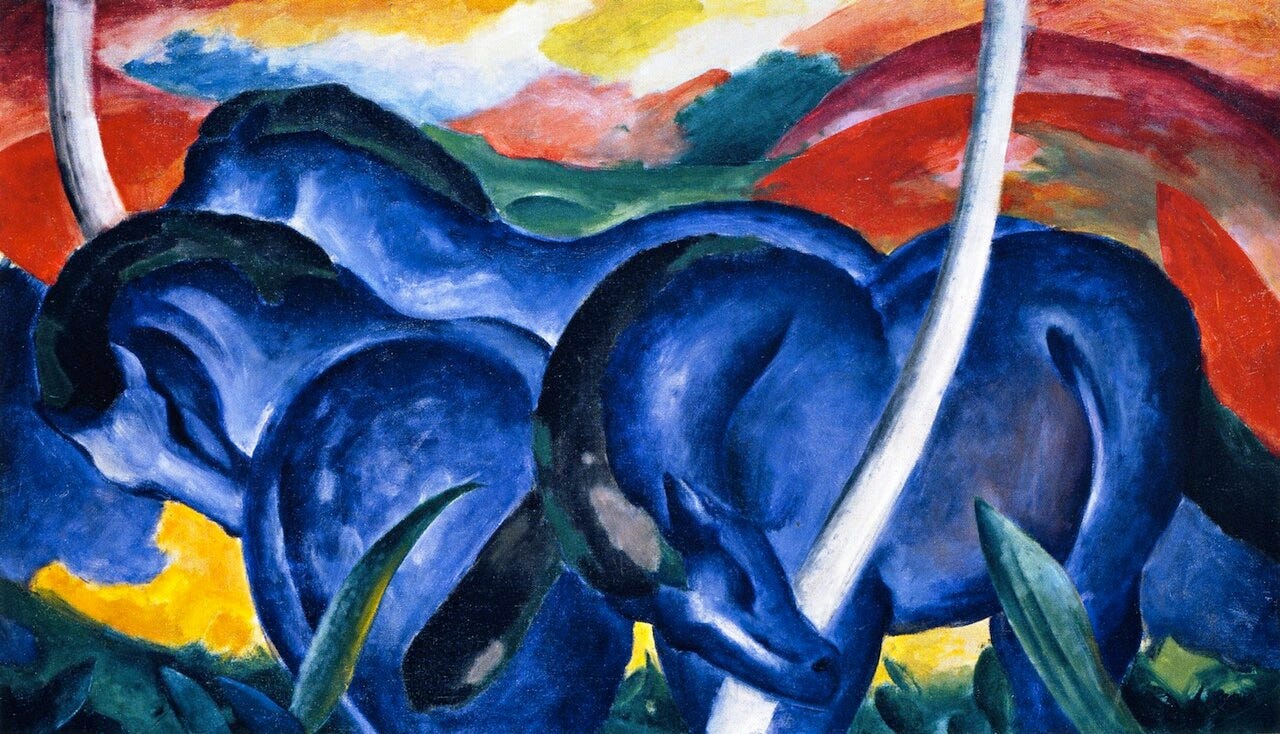
11. Franz Marc, The Large Blue Horses (1911)

Franz Marc blue horses
Franz Marc, The Large Blue Horses, 1911, Walker Art Center

Three round, powerful horses curve together across a red hill, painted a deep and impossible blue. Franz Marc made The Large Blue Horses in 1911, part of the same Blue Rider circle as Kandinsky.

Marc had his own private code of color, and to him blue stood for the spiritual and the calm, a serious and steady force. He painted animals as purer and nobler than people, and gave them the holiest color he had.

12. Maxfield Parrish, Daybreak (1922)
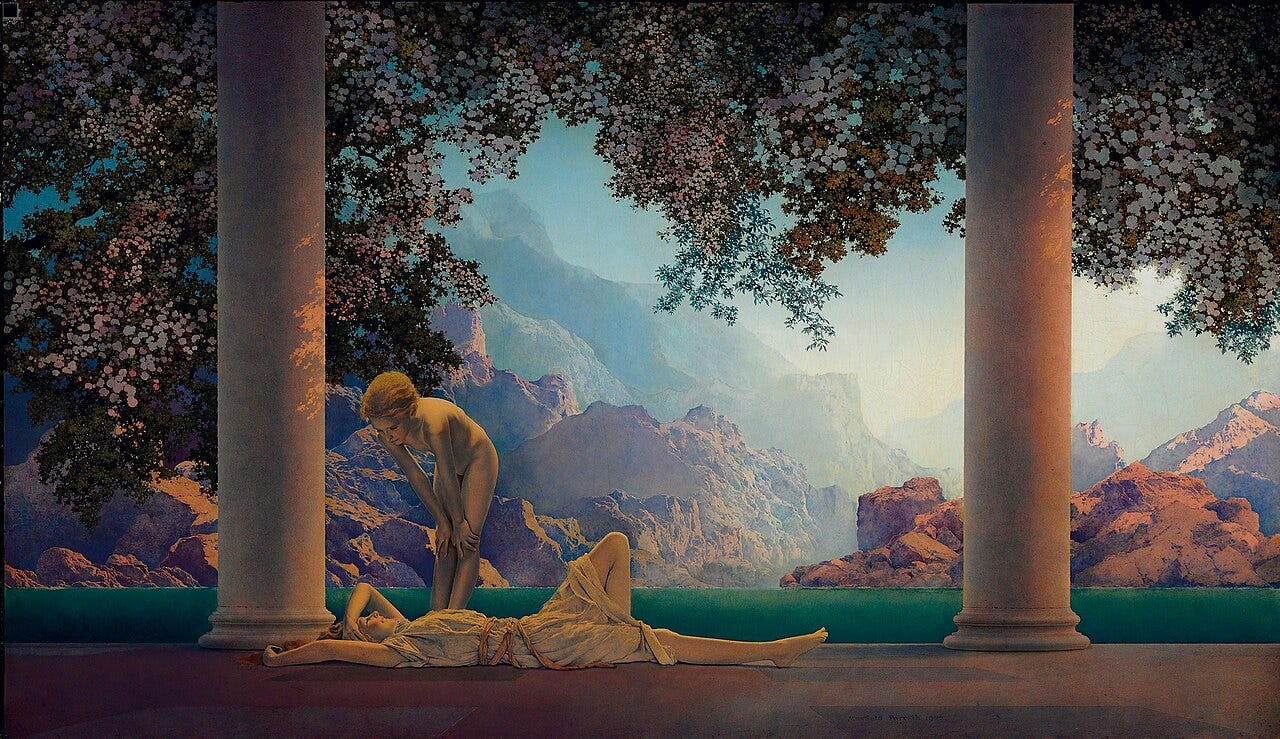
Parrish Daybreak blue dawn
Maxfield Parrish, Daybreak, 1922

By the twentieth century one man had made a blue so distinctive it carries his name. Maxfield Parrish painted Daybreak in 1922, its dawn sky a deep, glowing blue built from many thin glazes, and the tone became known as Parrish blue.

Daybreak was reproduced so widely that a copy was said to hang in one American home in four. Five hundred years after a duke spent a fortune in lapis on a private book of hours, a printed blue dawn had finally reached almost everyone.


Join 130,000 readers who get the secrets behind the paintings. Free.


Where the blues hang today

  • Giotto, the ceiling: the Scrovegni Chapel, Padua.

  • Titian, Bacchus and Ariadne: the National Gallery, London.

  • El Greco, View of Toledo: the Metropolitan Museum, New York.

  • Vermeer, Woman in Blue Reading a Letter: the Rijksmuseum, Amsterdam.

  • Van Gogh, Starry Night over the Rhone: the Musee d'Orsay, Paris.


If the color pulled you in, keep going:


Two new stories a week, 130+ secrets unlocked. Start free.


Blue in art, a few quick questions

  • Why was blue paint so expensive? The best blue, ultramarine, was ground from lapis lazuli, a rare stone that cost more than gold.

  • What is Prussian blue? The first modern synthetic blue, made by accident around 1704, cheap and strong, which changed printmaking and painting.

  • Why is blue linked to sadness? Blue reads as distance, cold and night, and over time the mood of longing became feeling blue.

  • What is the most famous blue painting? Hokusai's Great Wave and Van Gogh's Starry Night are the most famous pictures where blue rules everything.

  • What is International Klein Blue? A deep synthetic blue linked to the artist Yves Klein around 1960, so pure he made whole canvases of nothing else.

The color that cost a fortune, then reached everyone

Line them up and you are watching one color come down to earth. It starts as ground up gemstone in a duke's prayer book, so dear that patrons counted the grams, then a lucky accident in a laboratory makes it cheap, and a Japanese wave carries the new blue around the world.

By the time Maxfield Parrish is finished, blue hangs on the wall of an ordinary living room, printed by the million. The stone that the oldest of these blues came from, lapis lazuli, still comes mostly from the same remote mountains in Afghanistan it did six hundred years ago.