

180 000+ readers learn art the fun way.
This is a preview. Paid subscribers get the full story.
You’ll also get:
10 new stories / month
The full archive (130+ Art stories)
Your personal art guide. Comment, ask questions, DM me anytime
Apple user? Subscribe at coolstoriesabout.art, not via the app. Apple adds 30% to the price.
You may have already held it in your hand: the Italian 10 cent coin, the one whose national side shows a woman with long, loose hair.
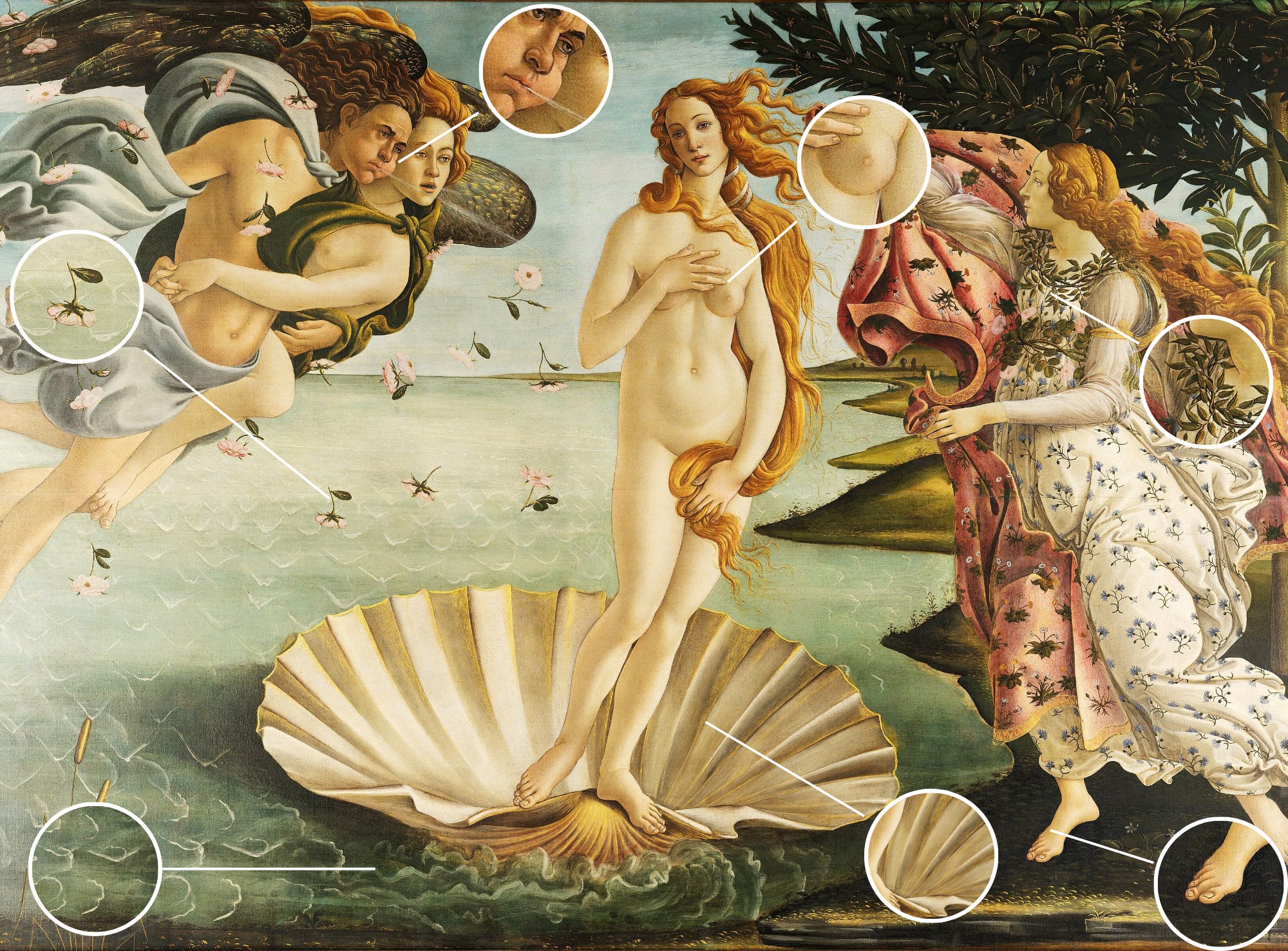
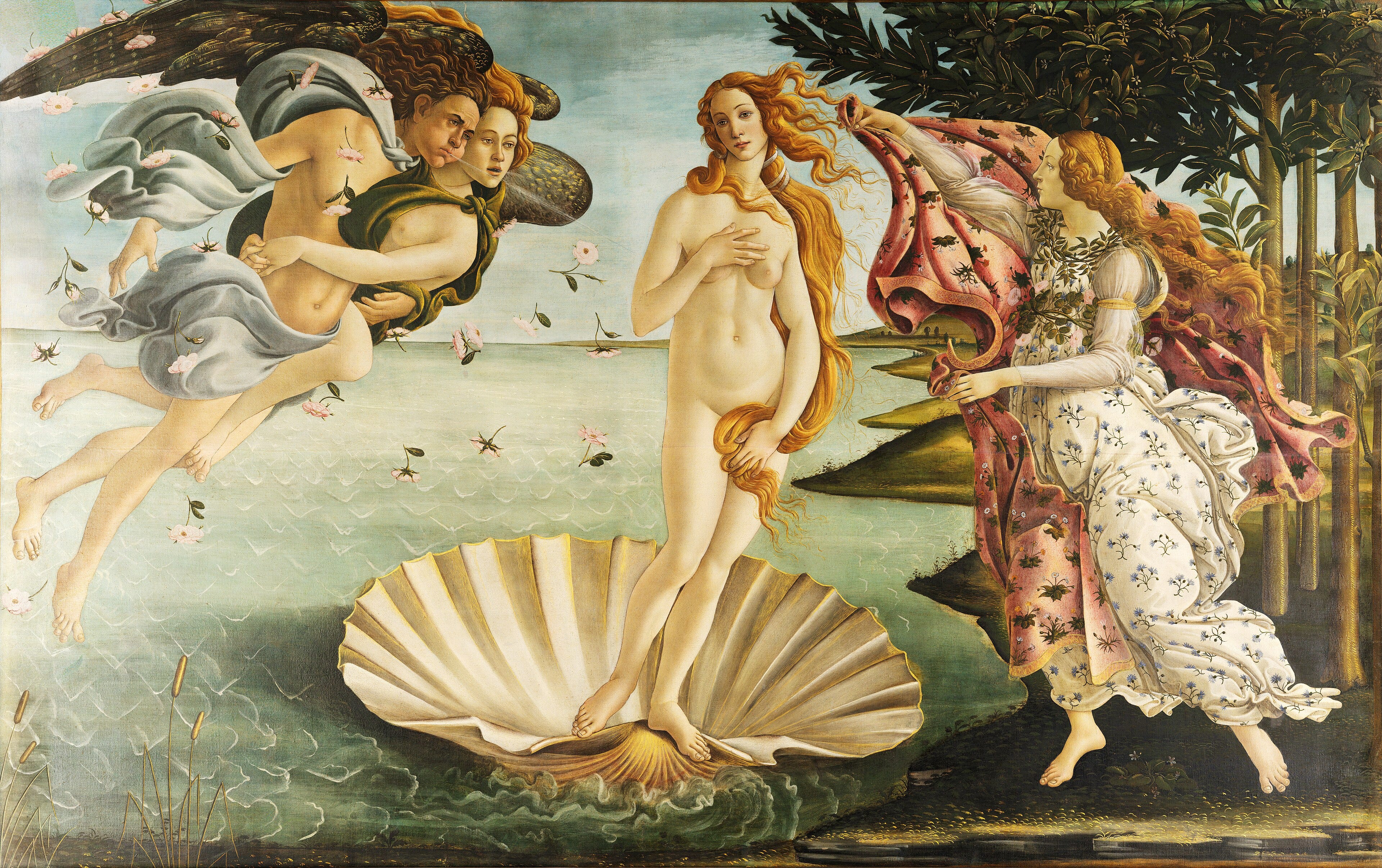
That face belongs to Botticelli's Venus. The Birth of Venus may be the single painting that best sums up the Italian Renaissance, the one that draws a crowd every single day at the Uffizi in Florence.
To just about everyone, that face is Venus, the goddess of love. And yet almost no one knows the real story behind this painting.
Let's look at it detail by detail.
The Foam

Start at the very bottom, with the sea, where a thin edge of white foam runs along the waves. For the Greeks, Venus's story begins right there, in that foam, and the oldest account we have comes from Hesiod, a poet who wrote down the origin of the gods in the 7th century BCE.
In the beginning, Uranus, the sky, rules over everything. His son Cronus, a Titan, a god of the very first generation, takes a sickle and castrates him, then throws the severed flesh into the sea.
White foam forms around the flesh as it falls into the waves, and out of that foam steps a young woman. The Greeks call her Aphrodite, from aphros, their word for foam, and the Romans call her Venus.
The waves then carry her to Cyprus, an island at the eastern edge of the Mediterranean.
This goddess is never a child: she emerges from the foam already a grown woman. Botticelli chose that exact moment: Venus newly born, standing on the waves, her foot about to touch land.
The title wasn't his. The Birth of Venus is the name the painting received long after his death.
The Shell
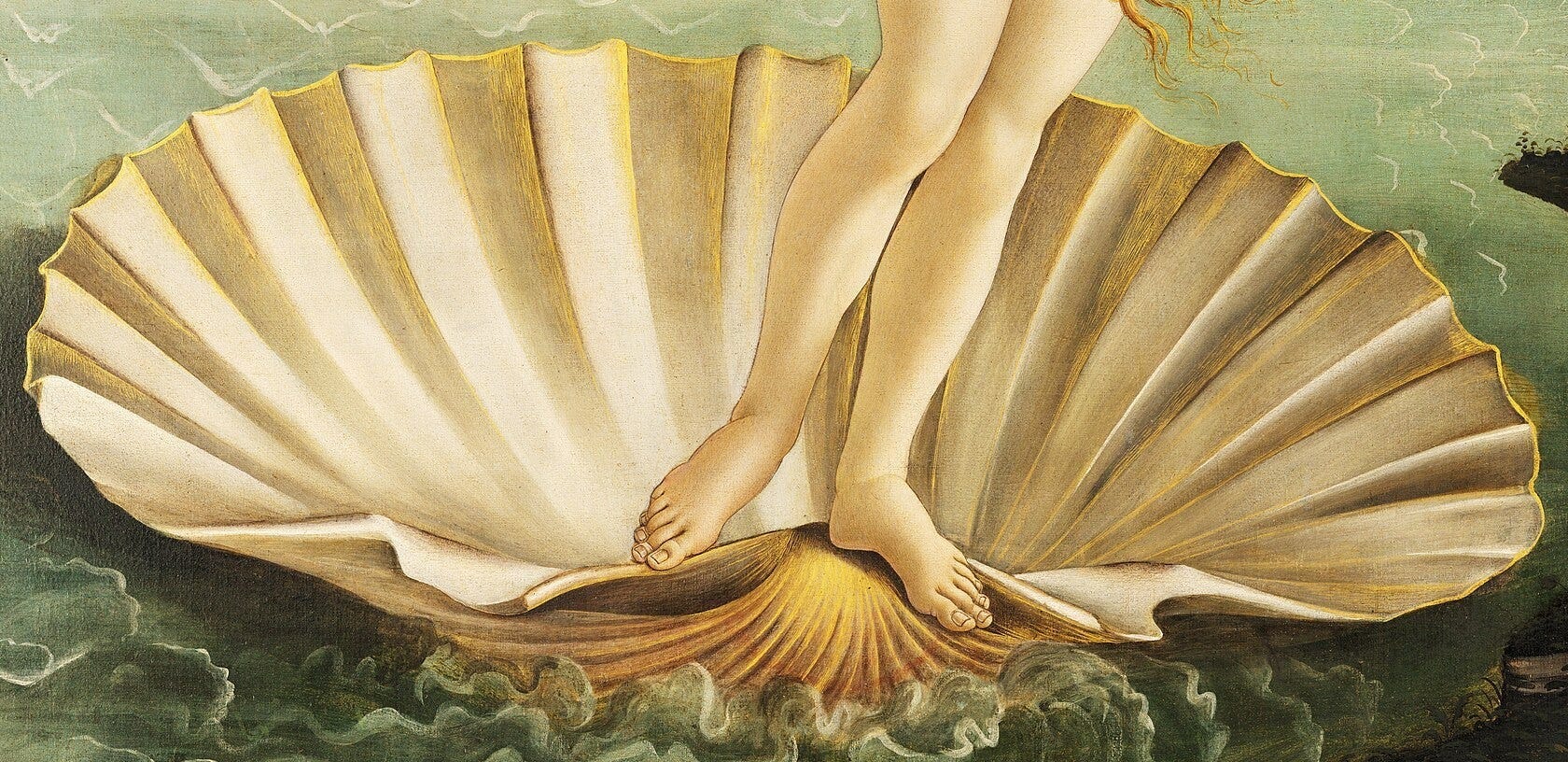
Raise your eyes a little. Venus stands on a ridged shell, a scallop shell, but an impossibly large one: in the Mediterranean, you can hold one in the palm of your hand, and this one is carrying a grown woman.
For the ancients, the symbol was obvious: that shape evokes a woman's sex organ, and with it fertility and love.
Yet no Greek text about the birth of Venus mentions a shell at all.
After Hesiod, the other major account of this birth is a hymn, a song in praise of the goddess, which the Greeks believed was written by Homer, the author of the Iliad. In the hymn, as in Hesiod, only the waves and the foam carry the goddess to shore.
Botticelli sets her down on a shell instead. Remember this choice of his.
The Hands
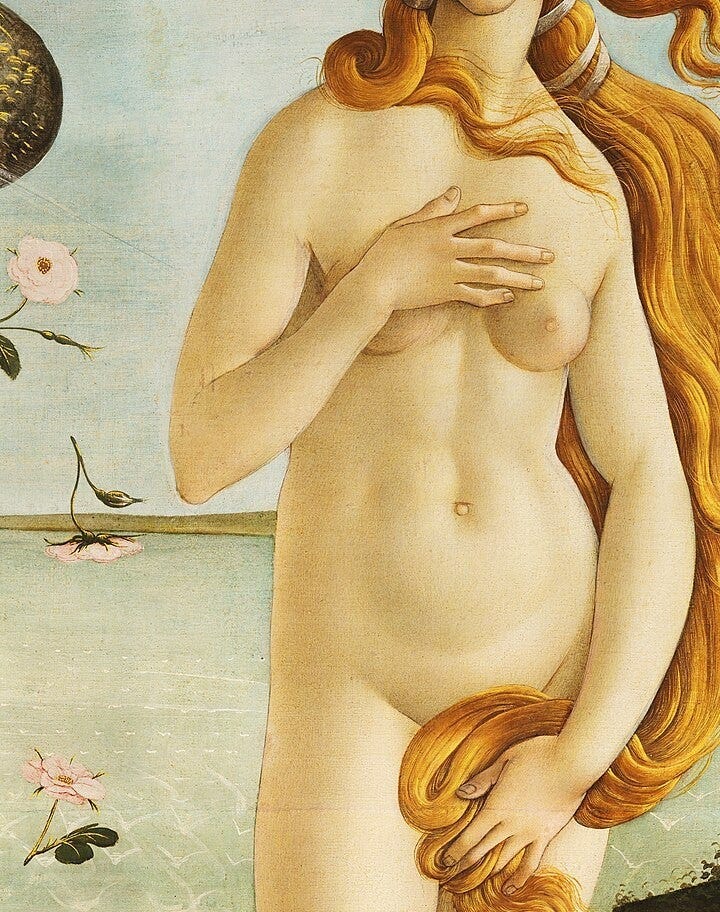
On the shell stands the goddess, and the first thing to notice is her hands: the right rests on her chest, the left draws a long lock of hair across her groin.
This pose has a name, the Venus pudica, the modest Venus, the one who covers herself, and it comes from Greek statuary. Around 350 BCE, the sculptor Praxiteles carved the first major statue of a fully nude goddess.
It was made for Cnidus, a city on the coast of what is now Turkey, and travelers crossed the sea just to see it; legend even tells of a young man who fell in love with it.
Sculptors after him give all their nude Venuses this same gesture with both hands, and Botticelli keeps the pose.
But he gives it to a young woman, and a desirable one: a long, supple body, pale skin, her head tilted slightly. That modesty then works against her, and the hands draw the eye to exactly what they are covering.
In Italy at the time, painting almost always told stories from the Bible or the lives of the saints. Since antiquity, nobody had painted a nude woman, close to life size, alone at the center of a large canvas, with no biblical story to give her a reason to be there.
The Hair
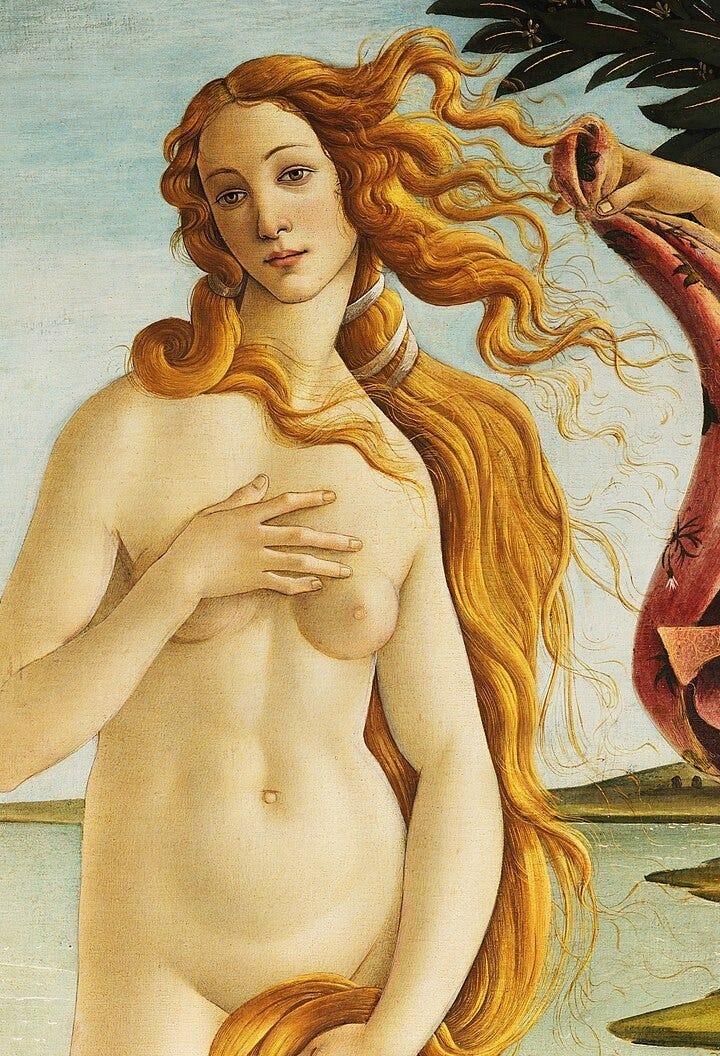
Move up to the hair, long and blond, lifted by the wind, and lean in closer: fine bright threads glint among the strands. That is real gold, laid down stroke by stroke with a brush.
In the Iliad, Homer calls her "golden Aphrodite." On the canvas she wears no jewelry at all, no necklace, no bracelet, no earrings: every bit of Botticelli's gold went into her hair.
The Winds
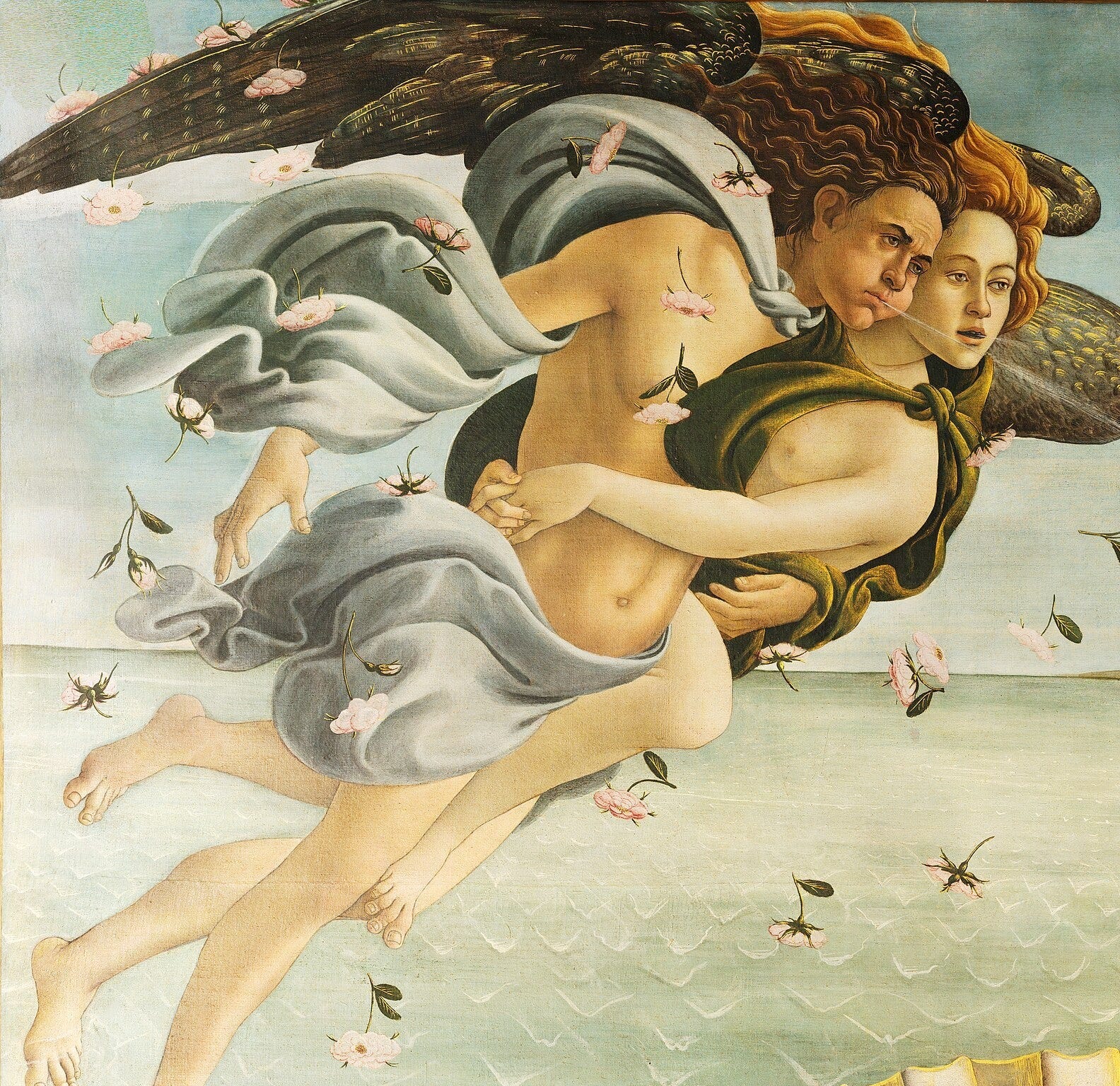
That hair streams to the right, and the wind lifting it is blowing in from the left. Turn that way: two winged figures fly there, pressed close together in a swirl of drapery.
The man, his cheeks puffed out, is blowing on Venus. This is Zephyr, the west wind, the one who, for the Greeks, brings back spring and makes the earth bloom again, and in the hymn it is his breath, his alone, that pushes the goddess all the way to Cyprus.
Look more closely, though: wrapped around him, a winged woman is blowing too, more gently: a mere breeze.
Botticelli drew this pair from an ancient cameo, a carved gemstone showing winds in flight, and that cameo belonged to Lorenzo de' Medici, known as the Magnificent, a great collector of antiquities. The Medici are the bankers who govern Florence, and Lorenzo is the head of the family.
One breath in the hymn; two on the canvas, wrapped around each other. Remember this second wind, too.
The Roses
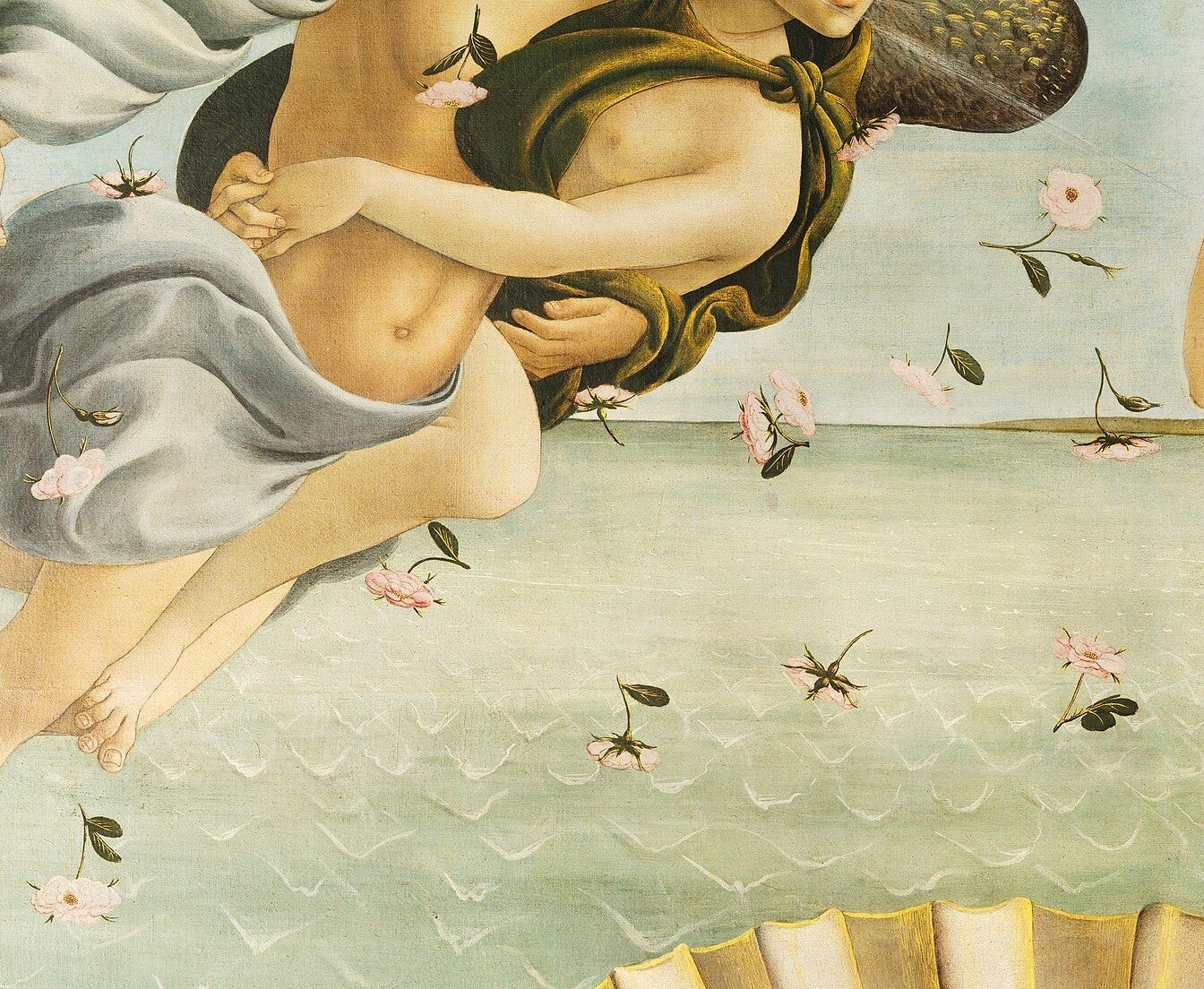
The breath of the two winds carries flowers, roses that fall like rain toward the sea, between them and the goddess.
Another Greek text, much later, one that celebrates the rose rather than the goddess, tells how on the day Venus rose from the waves, the earth brings forth a flower that has never existed before: the rose. These are also the flowers of spring, the ones Zephyr brings back with him every year.
The Shore
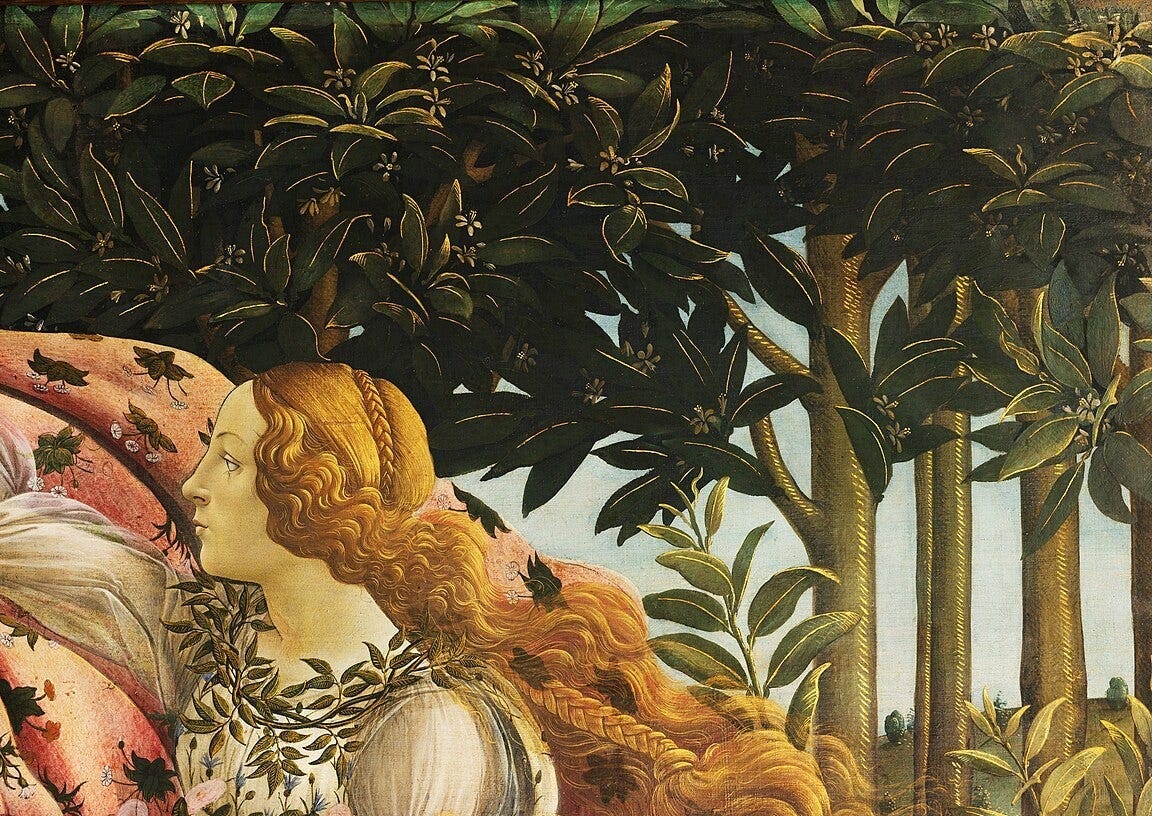
The roses fall to the right; follow them to dry land. A grove of dark trees lines the shore, gold flecks on their leaves and, among the leaves, small white blossoms: orange trees.
In Italian, Medici means doctors. Florentines liked to play on the word: they called the orange mala medica, the medicinal apple, and the orange tree came to be seen as the Medici family's tree.
Venus lands on the shore of Cyprus, and that shore is planted with trees that belong to Lorenzo's family. We'll come back to it.
The Woman with the Cloak
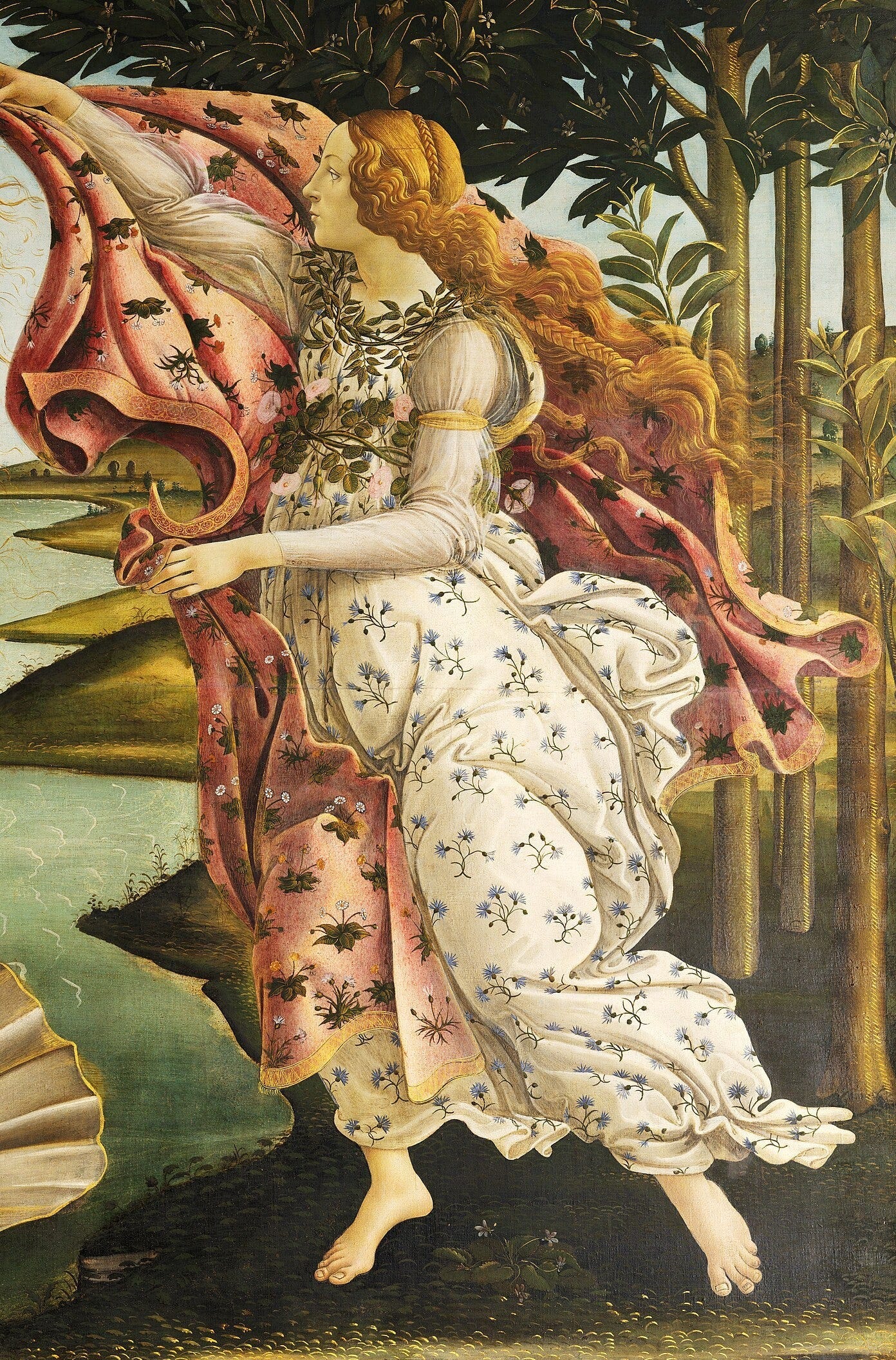
Beneath the orange trees, a barefoot young woman, her body leaning forward, steps toward Venus. She holds out a large pink cloak, filled by the wind like a sail, and she is ready to wrap it around the goddess, who arrives wearing nothing at all.
The Greek hymn tells this same scene. When Venus reaches land, women are waiting on the beach to dress her: the Hours. For the Greeks, these are goddesses, sisters who each bring back a season in turn, and their name has nothing to do with the time of day.
In the hymn there are several of them, and they cover Venus in gold: gold bands across their own foreheads, and for the goddess, divine garments, a gold crown, jewels at her ears, gold necklaces around her throat.
On the canvas there is only one woman, and not a fleck of gold: cornflowers on her white dress, roses at her waist, wildflowers scattered across the cloak she holds out.
Botticelli kept the scene from the hymn, the shore, the cloak, the welcome, but not the goddesses. And the hymn has no name for the young woman covered in flowers who takes their place.
The Face
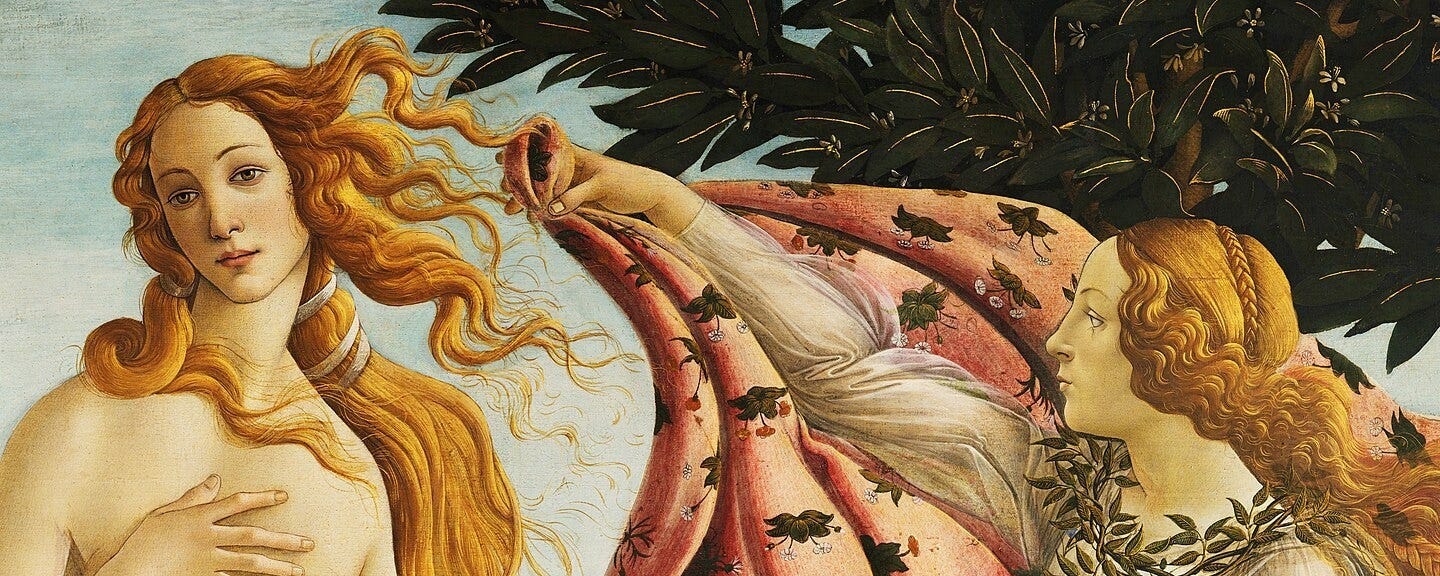
A shell, two winds, a shore lined with orange trees, a woman covered in flowers: none of this exists in the Greek texts. Now look at Venus's face, then at the face of the woman holding out the cloak: they are the same.
This painting does not celebrate the goddess Venus. It celebrates a woman..