
Genesis tells the first murder in a handful of verses. It leaves out nearly everything a painter needs: the words spoken in the field, the faces of the parents, what became of the body. For almost five centuries, artists filled those gaps, borrowing from medieval legend, from poets, and from Jewish and Muslim tradition, and no two of them filled the gaps alike.
Cool Stories About Art is a newsletter to learn art the fun way.
Join 200,000+ readers and get:
10 new art stories / month
The entire archive of content (140+ articles)
Comment, ask questions, and chat with other readers
What Genesis Leaves Out
Genesis gives the story only a few lines. Cain, the elder son of Adam and Eve, works the soil, and Abel keeps sheep. When God welcomes Abel's offering and turns away from Cain's, Cain kills his brother in a field. The text never names the weapon, so medieval legend handed Cain a donkey's jawbone, which Shakespeare's Hamlet still mentions.
Those silences left painters free. The murder gave them a sacred reason to show two nude men locked in violent motion, and painters in Italy and Flanders seized on it. Later artists turned to what the Bible barely tells: the parents, the body, the grave, the exile.
The twelve works chosen here keep the great Venetian and Flemish versions and make room for scenes rarely shown, so that together they run from the two offerings to the long walk into exile.
12. Fernand Cormon, Cain (1880)
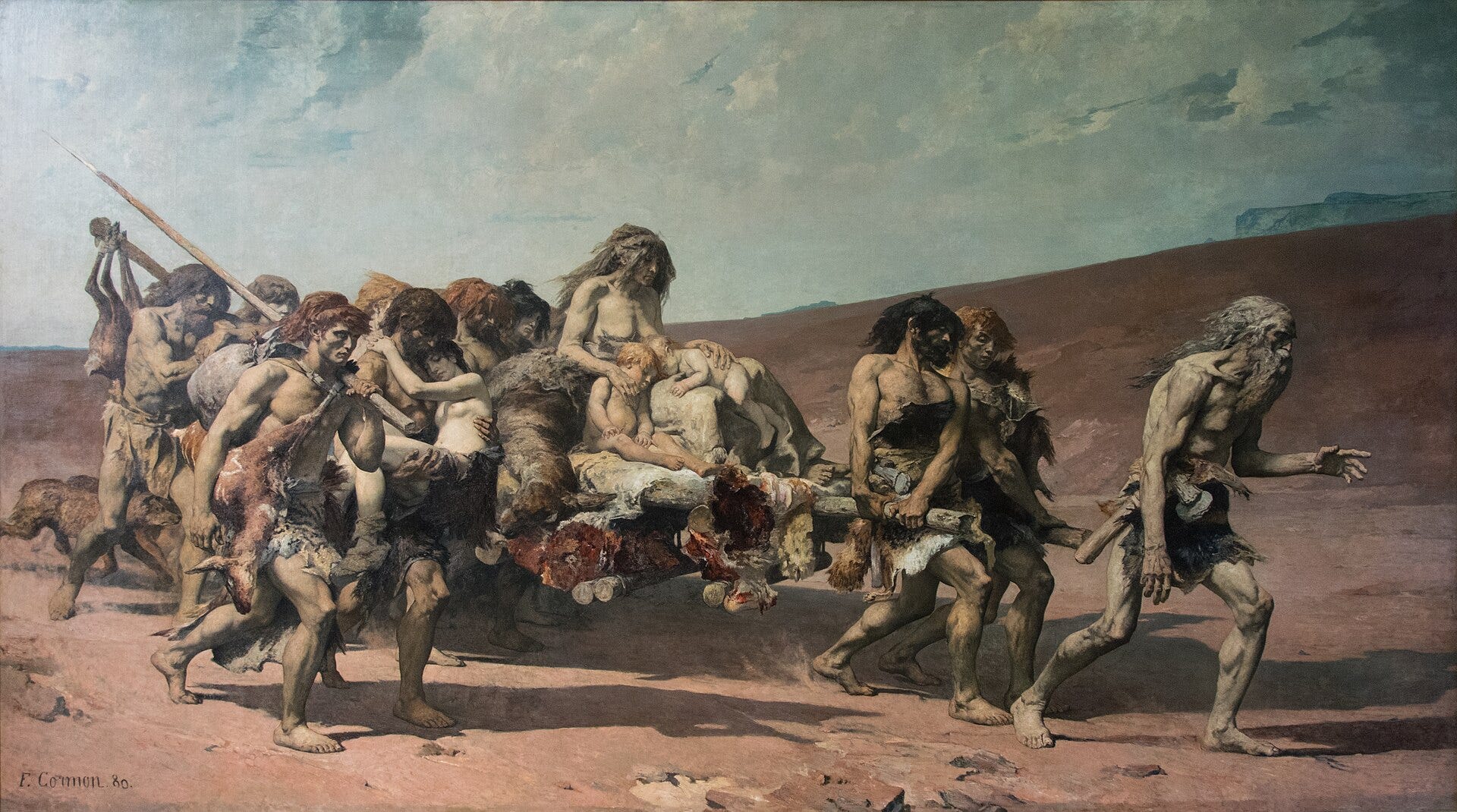
An old man with gray hair and hollow cheeks leads a long column across a bare, sunlit plain, bent forward as if walking into a wind. Behind him come men, women and children dressed in animal skins: young men carrying a wooden litter loaded with a woman and small children, hunters with spears, a dog. The canvas is seven meters long.
The old man is Cain. Fernand Cormon exhibited it in 1880 at the Salon, the huge official exhibition held in Paris every year, with a caption taken from Victor Hugo.
The caption comes from La Conscience, a poem in which Hugo has Cain flee God with his children, all wrapped in animal skins, until they reach the foot of a mountain at the edge of a plain. Cain cannot stop running. For years he sees an eye watching him wherever he goes, and in the end he has a grave dug and goes down into it to hide. The last line closes the trap: "The eye was in the tomb and looked at Cain."
Out of the whole poem, Cormon kept only the flight. He posed live models in his studio for every figure, and he imagined Cain's family as a prehistoric tribe, at a time when the first cave paintings of the Stone Age were coming to light.
That studio was also a school. Students came to Cormon to draw from plaster casts and live models, Toulouse-Lautrec among them and, in the spring of 1886, Vincent van Gogh.
Hugo's eye is nowhere in Cormon's sky. The shadows take its place, stretched long behind the walkers, as if the light itself were chasing the guilty man across the plain.
At a Glance
Artist: Fernand Cormon (1845 to 1924)
Painted: 1880
Medium: Oil on canvas
Size: 400 × 700 cm (157 1/2 × 275 5/8 in)
Where to see it: Musée d'Orsay, Paris
11. Persian painter, Qabil Taught to Bury Habil by a Crow, from a Qisas al-Anbiya (1580)
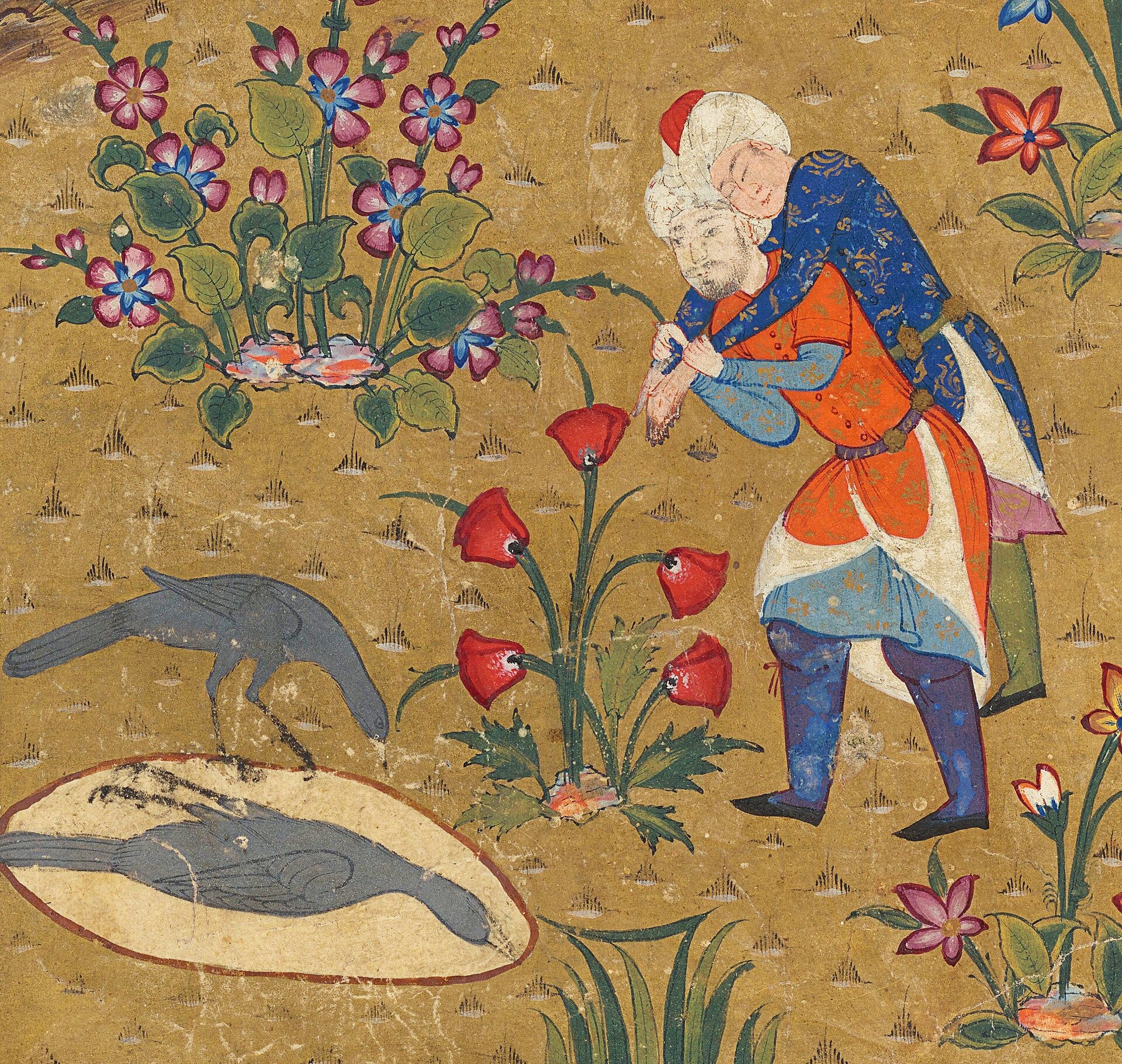
On a gold page scattered with red and blue flowers, a man in a turban and an orange robe carries another man's limp body on his back. His eyes are on two black crows below him. One lies in a small oval hole in the ground, and the other stands over it. The man with the burden has just killed his brother, and he does not know what to do with the body.