
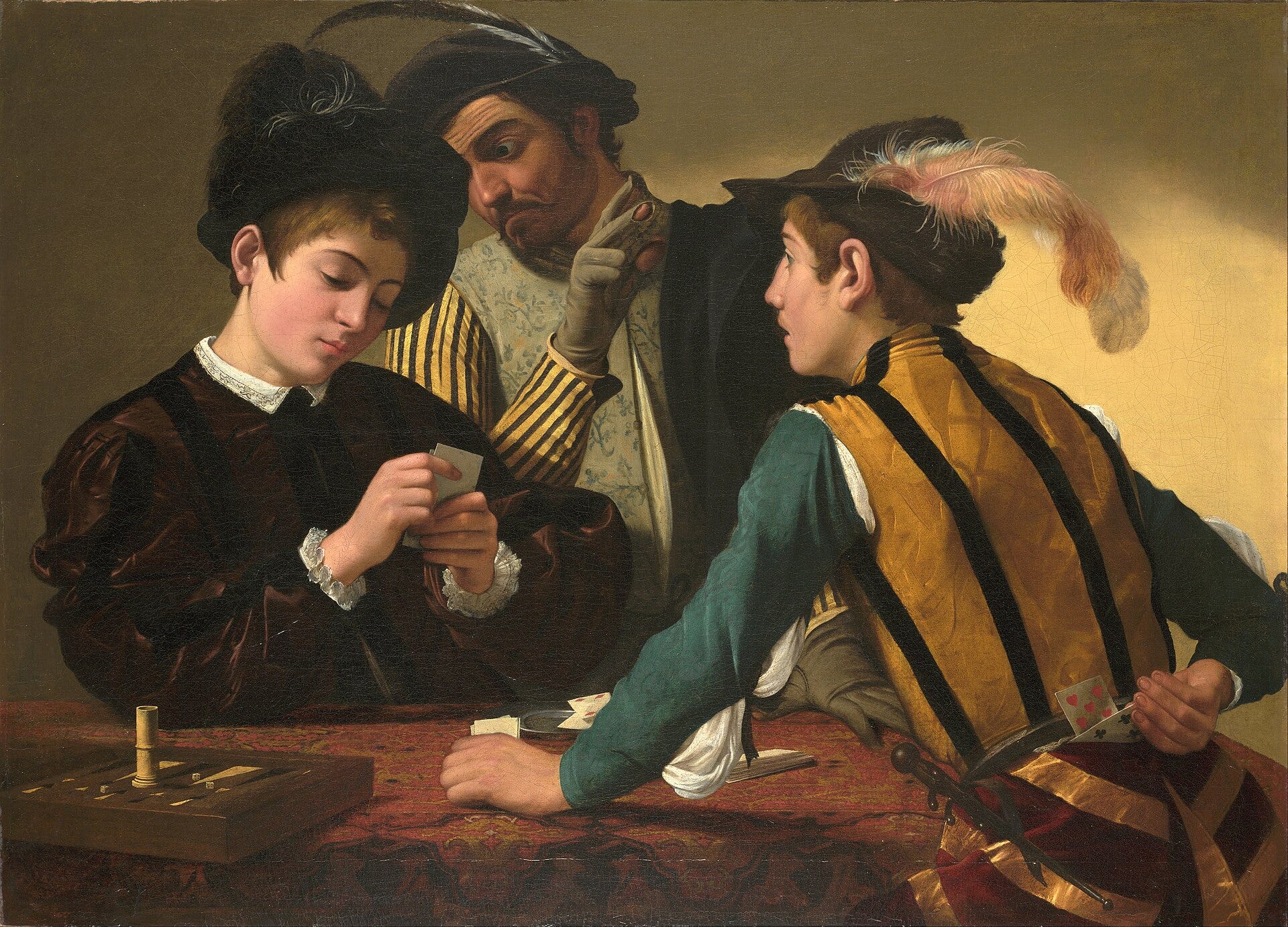
A card table seats people close together and asks each of them to hide something. Painters saw what that offered: a cheat working in plain view of the viewer, and a victim who is the only one at the table who cannot see him. Behind one of these pictures lies a painter's own certainty that a doubling system would beat the roulette wheel.
Cool Stories About Art is a newsletter to learn art the fun way.
Join 200,000+ readers and get:
10 new art stories / month
The entire archive of content (140+ articles)
Comment, ask questions, and chat with other readers
How These Were Chosen
A card table solves a problem painters know well. It seats several people side by side and gives them a reason to look anywhere but at one another. Since every player hides a hand, the drama moves to the eyes and the fingers.
The game also brings a plot, and the plot depends on who sees what. The viewer watches the cheat at work, while his victim does not. In the 1600s, that double view let one picture amuse its owner and warn him against gambling and drink.
Each picture here shows a game actually under way, across four centuries of painting. Cards come first, but dice, chess and roulette belong here whenever the table holds the same tension between the players.
12. William Hogarth, A Rake's Progress: The Gaming House (1734)
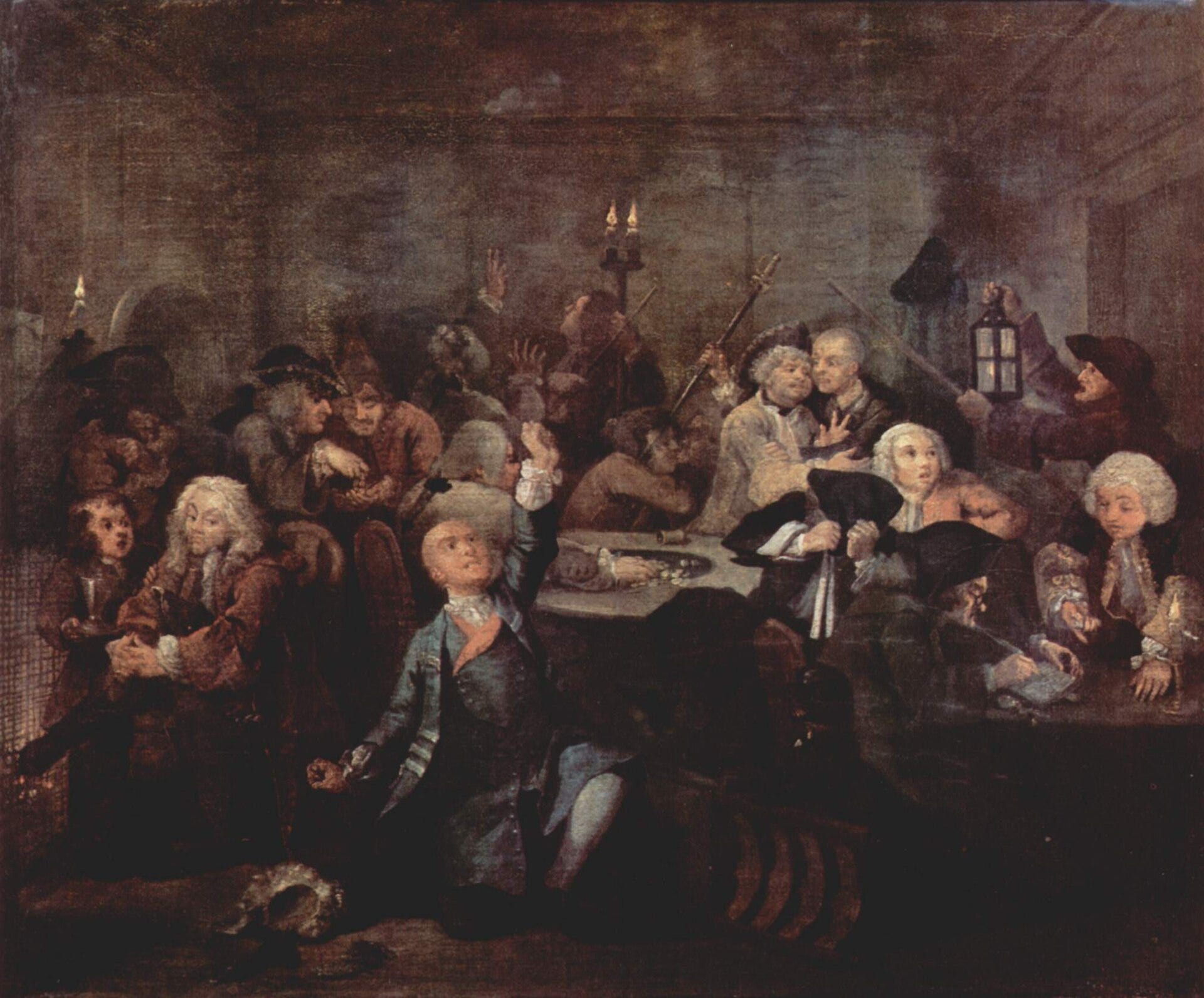
On the floor of a crowded London gambling room, a wig lies next to an empty purse. Its owner, a young gentleman in a blue coat laced with silver, has dropped to his knees beside an overturned chair, one fist raised toward the ceiling. On a throw of the dice, he has just lost a fortune.
The young man is Tom Rakewell, the hero of eight paintings that William Hogarth finished in 1734, each one a stage in his fall. Tom had married an old woman for her money, and the fortune vanishing on this table is the one he gained through the marriage.
What Tom has not noticed, and almost nobody else in the room has either, is that the place is on fire. Smoke curls out from behind the paneling, and a night watchman hurries in with his lantern. Of the eighteen people packed around the table, only two look up at the ceiling, one of them a croupier holding a torch and the rake he uses to sweep in the stakes.
Hogarth may have had a real blaze in mind. On April 28, 1733, fire broke out at White's club in London, starting in a gaming room known as Hell. Yet a dog's collar inscribed "Covent Gar..." places Tom's room in another district, among the gambling hells of Covent Garden.
The fire mostly shows how blind the room is, and Lord Cogg, the nobleman on the right, makes the point. While smoke gathers above him, a moneylender enters a new loan of £500 in his book so that the lord can go on playing. In the next canvas, Tom is locked in the Fleet, London's debtors' prison.
At a Glance
Artist: William Hogarth (1697 to 1764)
Painted: 1734
Medium: Oil on canvas
Size: 62.5 × 75.5 cm (24.6 × 29.7 in)
Where to see it: Sir John Soane's Museum, London
About This Painting
What is the main theme of William Hogarth's A Rake's Progress?
Ruin brought on by a young man's own choices. Extravagance, gambling and social climbing lead Tom Rakewell into debt, shame and madness. Sarah Young, the woman he deserted, offers him a way back, and he turns her down each time.
What is a rake's progress?
A rake was a fashionable young man who lived for pleasure. The progress is ironic. The Soane Museum calls it no progress at all, since the eighth canvas leaves Tom chained in Bethlem Hospital, London's madhouse, known as Bedlam.
When were Hogarth's Rake's Progress prints published?
Hogarth published the prints on June 25, 1735, the day the Copyright Act known as Hogarth's Act came into force. He sold them by subscription from his house, the Golden Head in Leicester Fields.
11. Hendrick ter Brugghen, The Gamblers (1623)
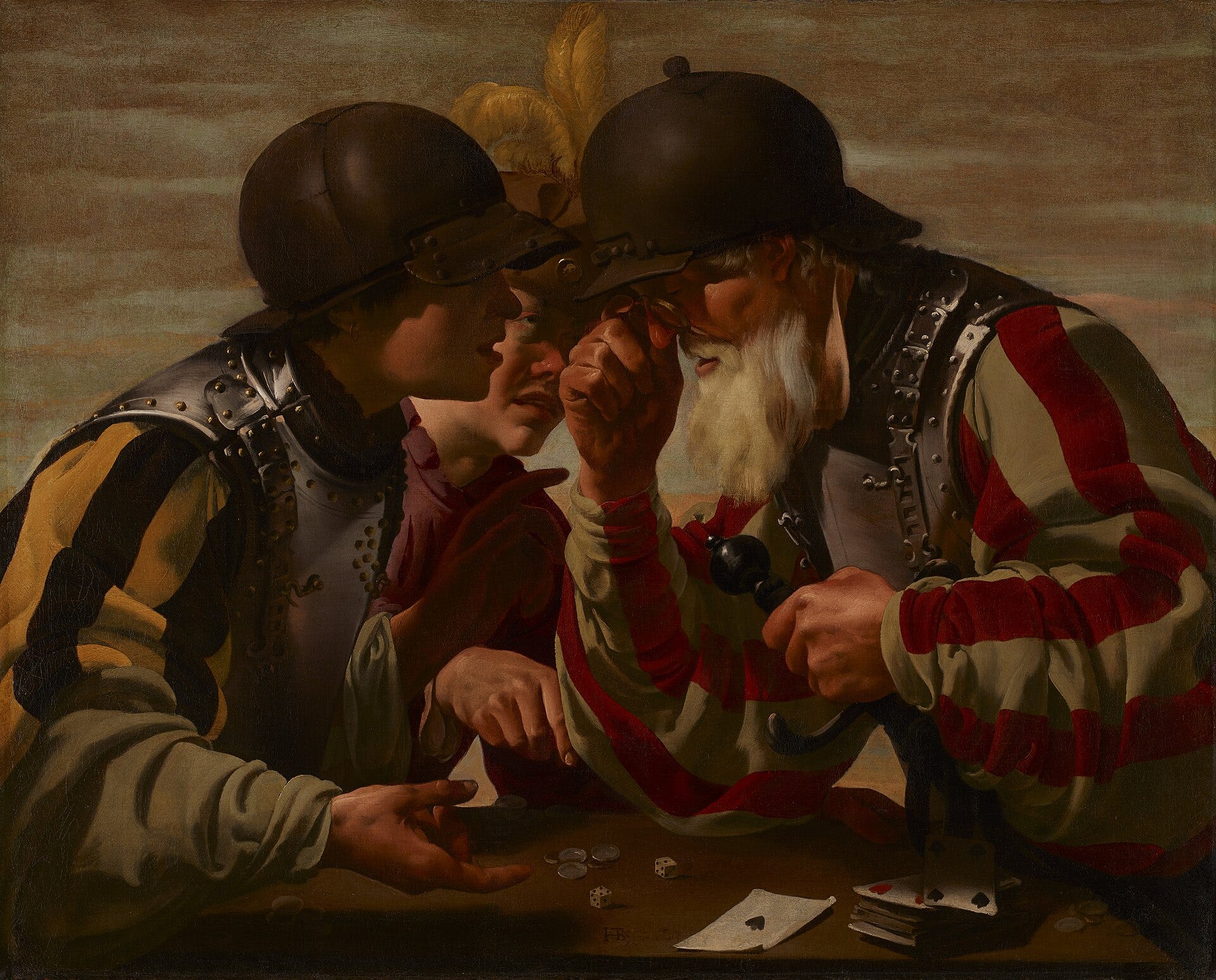
Through an eyeglass held up to his face, a bearded old soldier checks a throw of the dice, his left hand still gripping the hilt of his sword. Cards and silver coins lie between him and two younger men. One of them, a soldier, gestures to show him that he has lost.
The other, a youth in a feathered cap, leans in at his side and points at the dice. Hendrick ter Brugghen painted the scene in Utrecht in 1623. The old man studies the dice with great care, but the danger at this table is not on the dice.