
Carel Fabritius (1622 to 1654) was a Dutch painter, the most gifted pupil of Rembrandt, the greatest Dutch artist of his day. He died at thirty-two, when a gunpowder store exploded in the town of Delft and brought his house down on him.
Only about a dozen of his paintings are known today. For two centuries, several of them were sold under other painters' names.
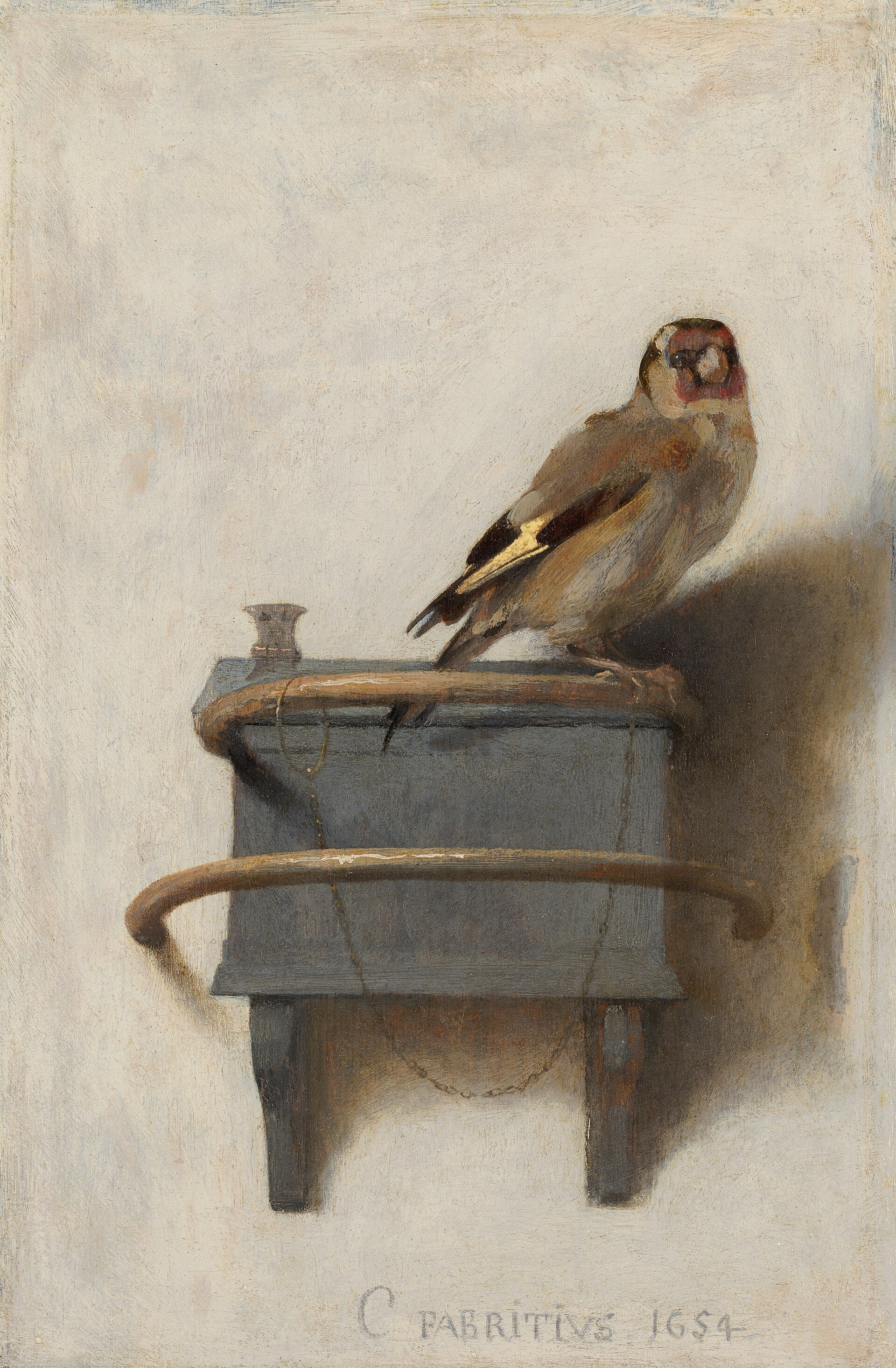
One of them is a little bird chained to its perch, painted in the last months of his life. Today it is one of the best-loved paintings in the Mauritshuis, the royal picture gallery of the Netherlands.
Cool Stories About Art is a newsletter to learn art the fun way.
Join 200,000+ readers and get:
10 new art stories / month
The entire archive of content (140+ articles)
Comment, ask questions, and chat with other readers
Carel Fabritius was baptized in February 1622 in Middenbeemster, a farming village north of Amsterdam, built on land the Dutch had pumped dry ten years earlier. His father was the village schoolmaster and painted in his spare time, and Carel learned to paint at home.
In September 1641, at nineteen, Carel married Aeltge Velthuys, the sister of the village pastor. Soon after, the young couple moved to Amsterdam, the richest city of the Netherlands, and Carel entered the workshop of Rembrandt van Rijn.
Rembrandt was then thirty-five and the most sought-after painter in Amsterdam. He lived and worked in a large house on the Breestraat, a broad street in the heart of the city.
His pupils paid to learn his method, copied his pictures and painted in his manner, and Rembrandt often sold their work. Among the other pupils was Samuel van Hoogstraten, a teenager who would later write a famous book on painting and remember Fabritius as his fellow pupil.
Carel Fabritius spent less than two years in Rembrandt's workshop. In those same months, his young family was destroyed. In the spring of 1643, Aeltge died, probably in childbirth. Within two years, Carel had lost his wife and his children.
By June 1643, he was back in his parents' house in the village, a widower of twenty-one. Eleven years later, an explosion would kill him and destroy many of his paintings, and for two centuries his name would be almost forgotten. How did his name come back?
In the rest of the story
The hidden name under a painting credited to Rembrandt.
The tiny view of Delft made to be seen inside a box.
The portrait Fabritius was painting on the morning of October 12, 1654.
The poem that tied his name to another painter of Delft.