
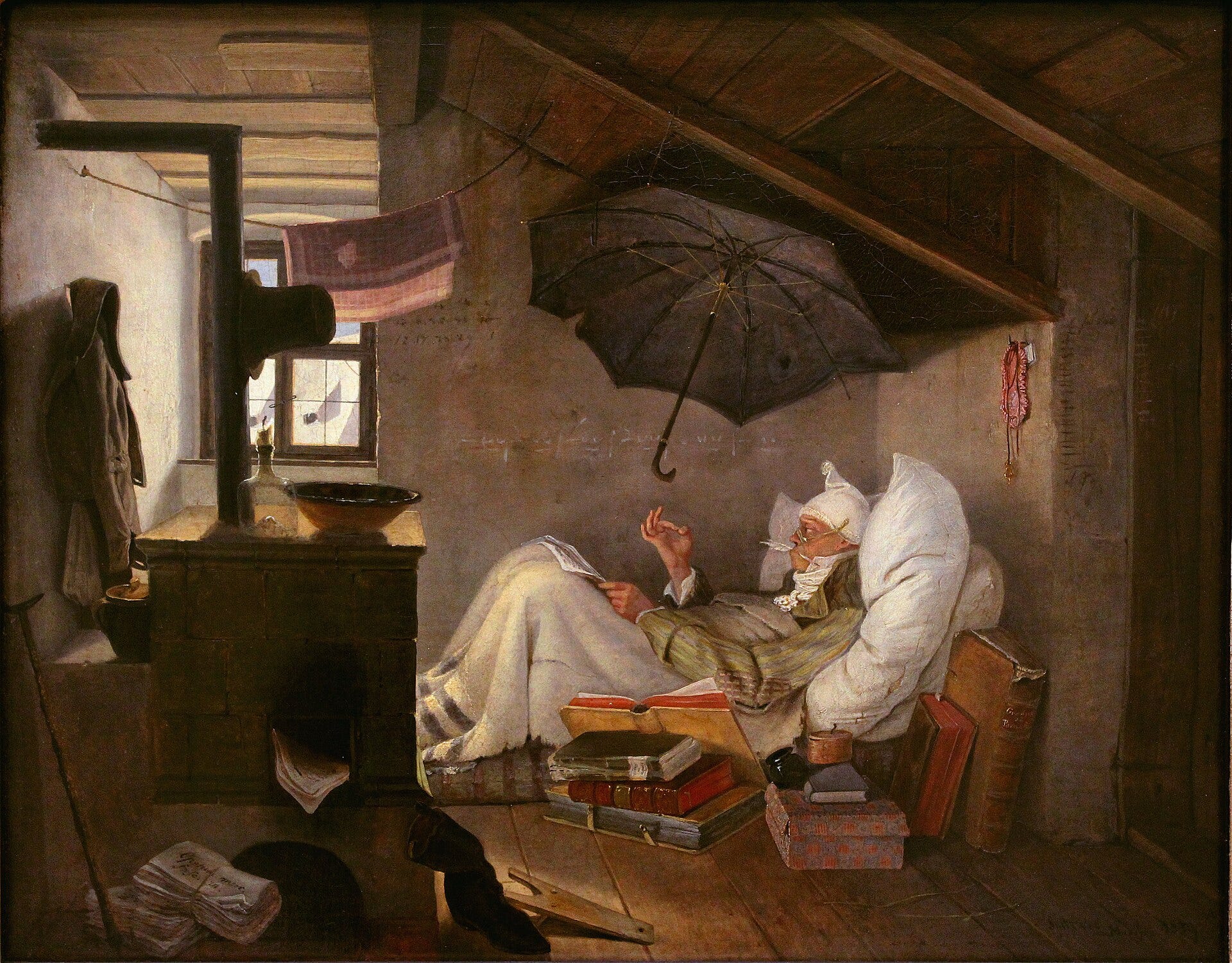
Carl Spitzweg (1808 to 1885) was a German painter from Munich, famous for gently funny pictures of dreamers and old bachelors. His best-known painting, The Poor Poet, now in a Munich state museum, shows a poet under an umbrella in a leaky attic.
Cool Stories About Art is a newsletter to learn art the fun way.
Join 200,000+ readers and get:
10 new art stories / month
The entire archive of content (140+ articles)
Comment, ask questions, and chat with other readers
Carl Spitzweg was a pharmacist who taught himself to paint. He lived on a family fortune, yet his most famous painting shows a poet too poor to heat his own attic.
Carl Spitzweg was born on February 5, 1808, in Munich, the capital of Bavaria. Germany was not yet a single country, and Bavaria, in the south, had its own king.
Carl's father, Simon Spitzweg, a wealthy grocer and spice merchant, chose a trade for each of his three sons: the family business for Simon, the eldest, medicine for Eduard, the youngest, and pharmacy for Carl, the middle son.
In 1825, Carl began his training at the royal court pharmacy, supplier of the Bavarian royal family. A pharmacist then made every remedy himself, weighing powders, distilling liquids and mixing them in a mortar.
Carl's father died in 1828, and his brother Simon a year later, leaving Carl enough money to live without working. Carl still graduated in pharmacy from the University of Munich in 1832, with honors.
The next year, a serious illness sent Carl to recover at Sulz, a spa in the foothills of the Bavarian Alps, and ended his plan to run a pharmacy in Switzerland.
At Sulz, Carl met a painter from northern Germany who had left another trade for art and urged him to do the same. Free to choose, Carl Spitzweg left the pharmacy in 1833 to paint.
Spitzweg then taught himself by copying Dutch and Flemish masters of the 1600s, painters of small scenes of daily life from today's Netherlands and Belgium.
In 1835, the young painter joined the Munich Art Society, a club of wealthy art lovers that bought new paintings and drew lots to decide which member took each one home.
In the late 1830s, Spitzweg showed the Munich Art Society a small picture of a poet in a garret, a room under the roof. The picture was coldly received.
How did a picture that left Munich cold become one of the best-loved paintings in Germany?
In the rest of the story
Which word for a whole era began in a joke magazine.
How one of his paintings reached New York in his lifetime.
Why a performance artist walked out of a Berlin museum with The Poor Poet.
What kept the painter awake at night once his name reached the newspapers.