

170 000+ readers. Learn art the fun way.
This is a preview. Paid subscribers get the full story.
You'll also get:
10 new stories every month
The full archive (130+ Art stories)
Your personal art guide. Comment, ask questions, DM me anytime
iPhone user? Subscribe at coolstoriesabout.art, not via the app. Apple adds 30% to the price.
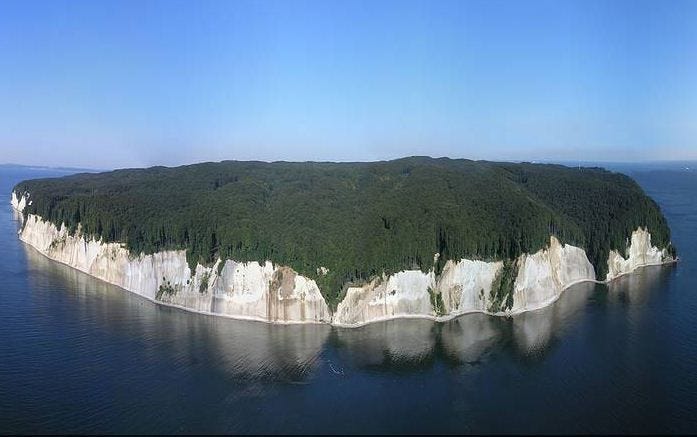
Every summer, more than a million people cross the German Baltic island of Rügen.
Almost all of them come for the same sight. Tall white cliffs plunging into the sea, the ones a painter made famous two centuries ago.
And all of that tourism started with a single painting.
Its creator is Caspar David Friedrich. He is a star again. In early 2025, the Metropolitan Museum in New York gave him his first major American retrospective. 300,000 visitors in three months.
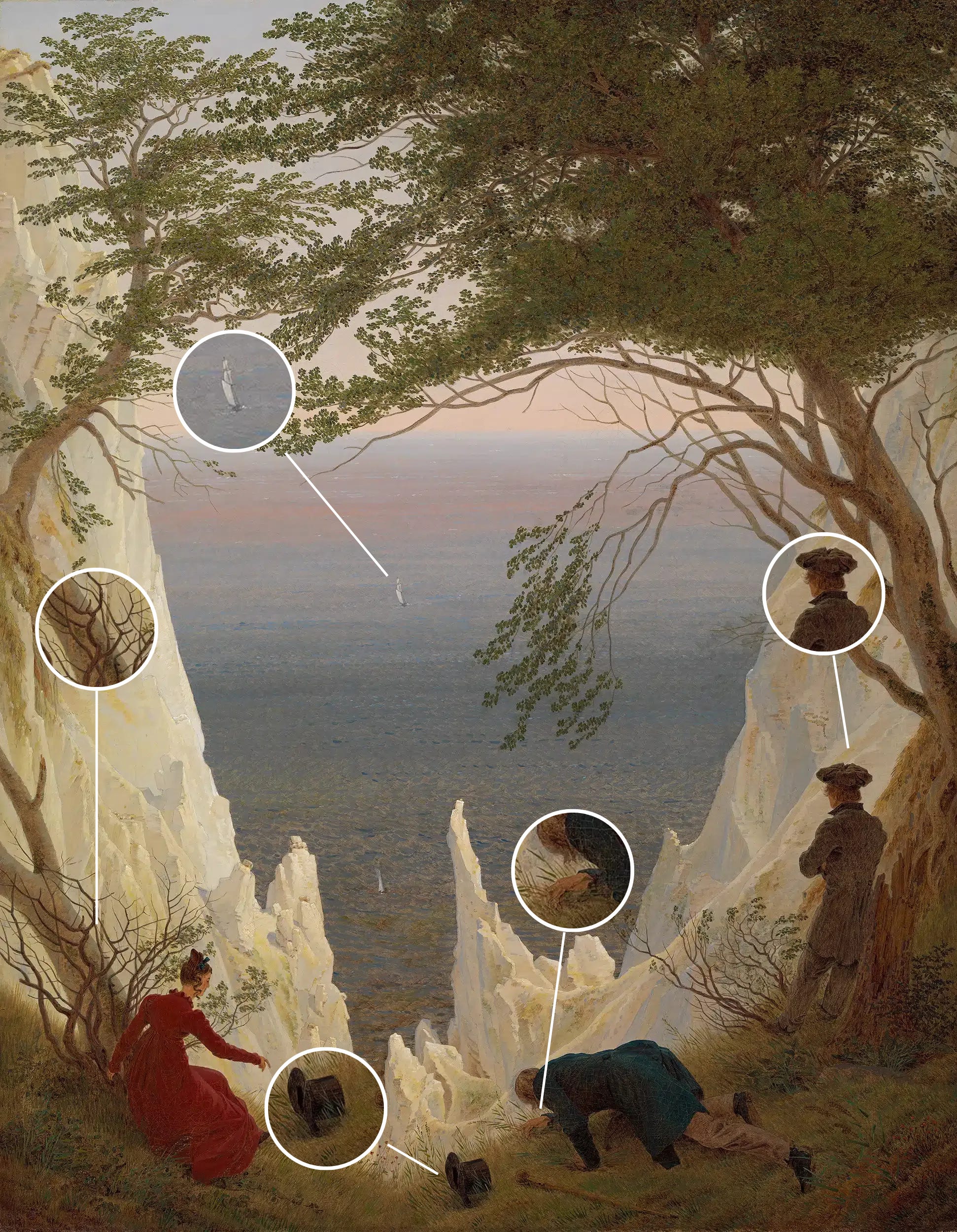
The painting itself shows three figures at the edge of a precipice, on a summer afternoon. It was painted around 1818, and it now hangs at the Kunst Museum Winterthur, in Switzerland.
Three walkers, a cliff, the sea. An ordinary scene, or so it seems.
We are going to look at it detail by detail.
The Setting
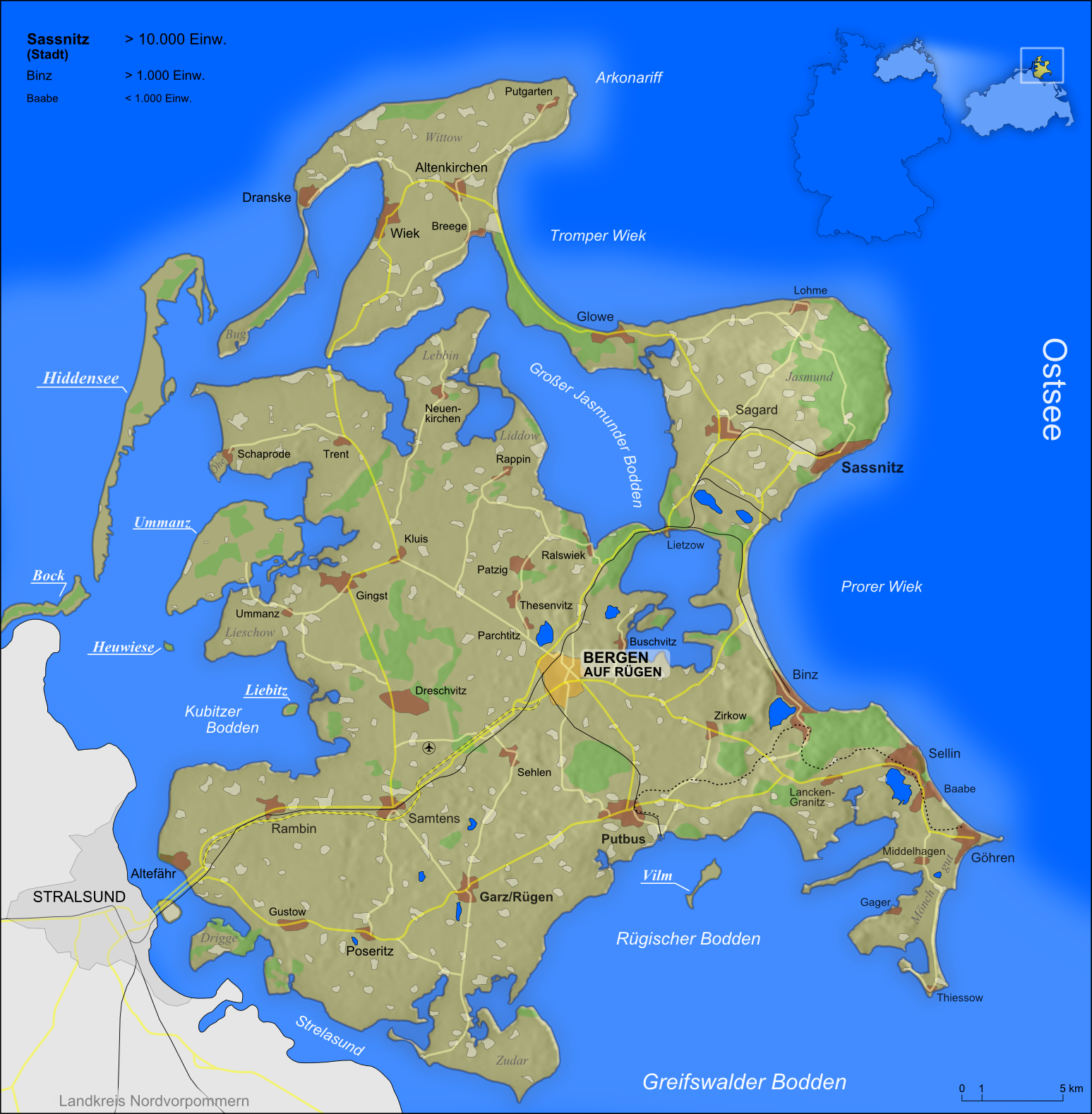
First, where are we.
Rügen sits in the Baltic Sea, off the northern coast of Germany, facing Scandinavia. From its harbors, ferries still leave today for Sweden and Denmark.
The cliffs in the painting are on its northeastern tip, at the Stubbenkammer, already one of the most famous viewpoints in the region in Friedrich's day. The chalk here dates back to the Cretaceous, 70 million years, and the rock face crumbles into the sea without stopping.
Friedrich was born just across the water, in Greifswald, on the mainland. He had known these cliffs since childhood, and he had come to walk them alone, several times.
And yet the landscape he paints does not exist.
No visitor will ever see this view. Friedrich took two different spots on the same coast and combined them on a single canvas, to build a precipice that cannot exist. He moves the rocks, straightens the walls, closes the cliff around his three figures.
This is no accident. Friedrich never paints from life. He walks for whole days along the coasts, stops for hours in front of a tree or a bank of fog, then goes back to the studio and composes, from memory, landscapes that exist nowhere.
His rule fits in a single line: a painter should paint not only what he sees in front of him, but what he sees inside himself.
Discover my new newsletter !

The Man in the Middle
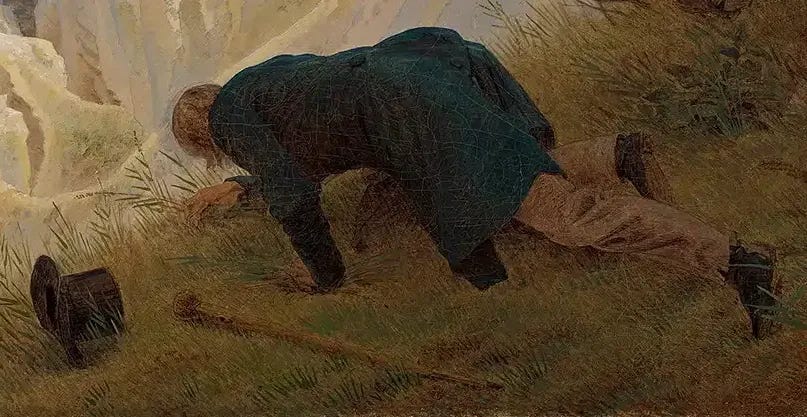
Look at the man in the middle.
He is bent forward, almost lying on the ground, his body tipped toward the drop. His left hand digs into the earth, his only anchor. His right hand reaches toward a shrub clinging to the very edge of the cliff. Beside him, in the grass, a hat has fallen.
It is the painter. Caspar David Friedrich, 43 years old, a man his friends described as gnawed by a sadness he never explained.
And Friedrich almost never paints himself. His figures are usually seen from behind, faceless, reduced to whatever they are looking at. To find him slipped into one of his own canvases is a rare exception in his entire career.
The Woman in Red

On the left, a little lower down the slope, a second figure.
A young woman kneeling at the edge of the chasm, in a red dress, a white bonnet on her hair. She is shown in three-quarter view, her right hand reaching toward a shrub clinging to the very brink.
Look closely at that shrub. It is almost entirely dry, gray, dead. Except around her head, where a few twigs are coming back to life, right at the level of her face.
Her name is Caroline Bommer, 24 years old, the daughter of a Dresden dyer.
In January 1818, six months before this painting, she married Friedrich in a Dresden chapel, almost in secret. The marriage stunned everyone around him.
Because Friedrich was a hardened bachelor. He lived alone in a bare room at the Dresden Academy, silent, difficult, the kind of man everyone assumed would never marry. At 43, he marries without telling a soul. His friends hear about it from other people.
The Man on the Right

On the right, the third figure.
A young man in a light green coat, leaning against the trunk of a dead tree, his feet on the thin branches clinging to the edge of the cliff. He is looking at the sea.
This is Christian, Caspar David's brother, five years younger. A carpenter, married as well.
Friedrich could have gone on his honeymoon alone with Caroline. He insisted on bringing this brother along.
So the three figures in the painting are the three people closest to the painter at this point in his life, gathered at the edge of the same void.
The Two Sailboats
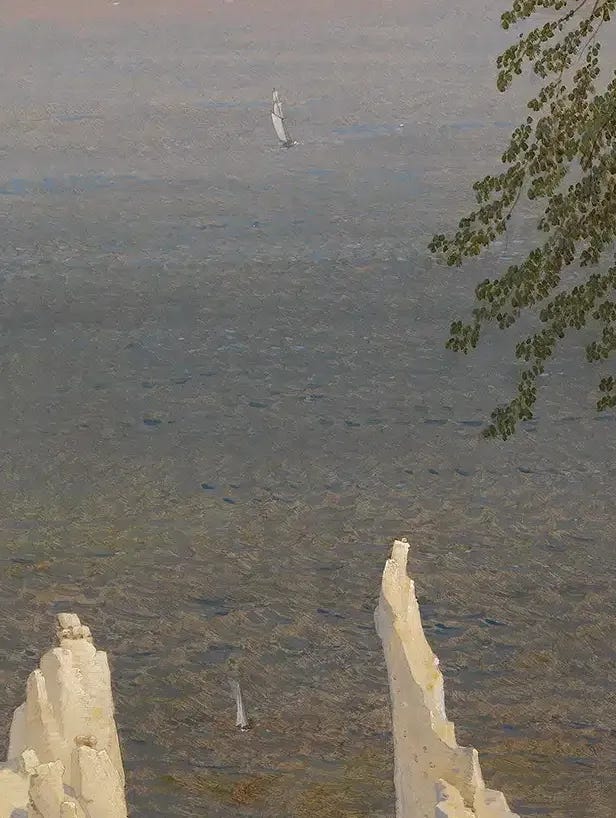
Follow Christian's gaze. He is not looking at the chasm below his feet, he is looking at the sea. Two sailboats are out there, one fairly close to shore, the other a little farther off.
These sails come back everywhere in Friedrich's work. A boat setting out to sea is, for him, the image of a life leaving for the other shore. He painted dozens of harbors at dusk and ships pulling away from land.
These two sailboats are going to matter.
The Colors

Step back for a moment. Look at nothing but the colors of the three figures.
Caroline's red. Friedrich's blue. Christian's green.
These are not random colors. Since the Christian Middle Ages, they are the colors of the three great virtues. Red for Charity, for love. Blue for Faith. Green for Hope.
Friedrich is a devout Lutheran, close to a pastor from Rügen who preached a simple idea: nature is a place of prayer, and a landscape truly looked at is worth a sermon.
So he dresses his loved ones as virtues. Love on his wife. Faith on himself. Hope on his younger brother.
The Structure
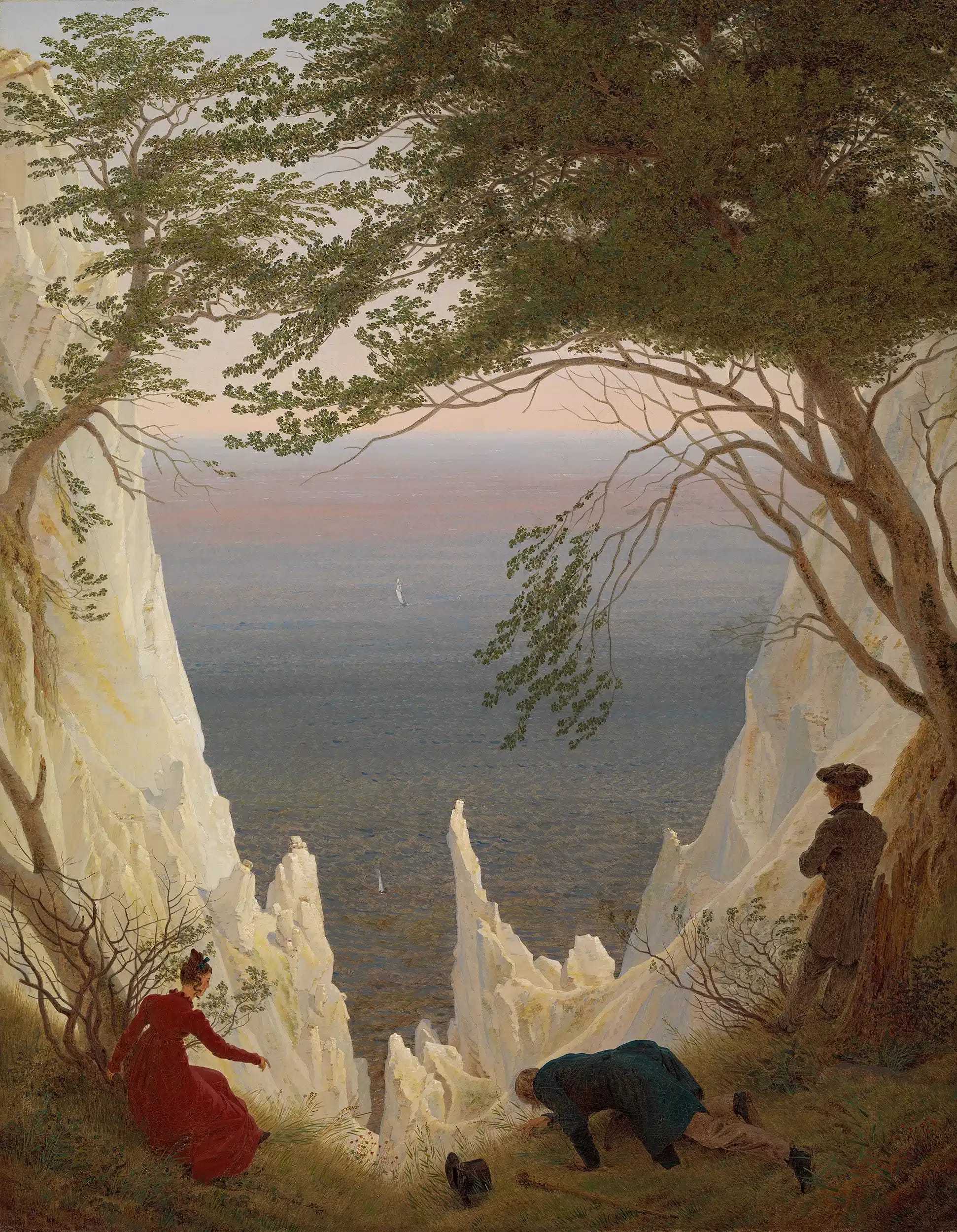
Step back again. Look at the whole canvas.
It holds together in three stacked bands.
At the bottom, green. The grass, the branches, the three walkers. This is the living.
In the middle, white. The chalk dropping straight down, dead rock, fossil, a wall of bone. This is death.
In the distance, blue. Sea and sky blend with no dividing line. This is the infinite.
And the three figures stand exactly on the seam, where the green ends and the white begins. Where the living tips over into death.
It is Friedrich who placed them there, all three, at the exact edge where the living stops.
The Gesture
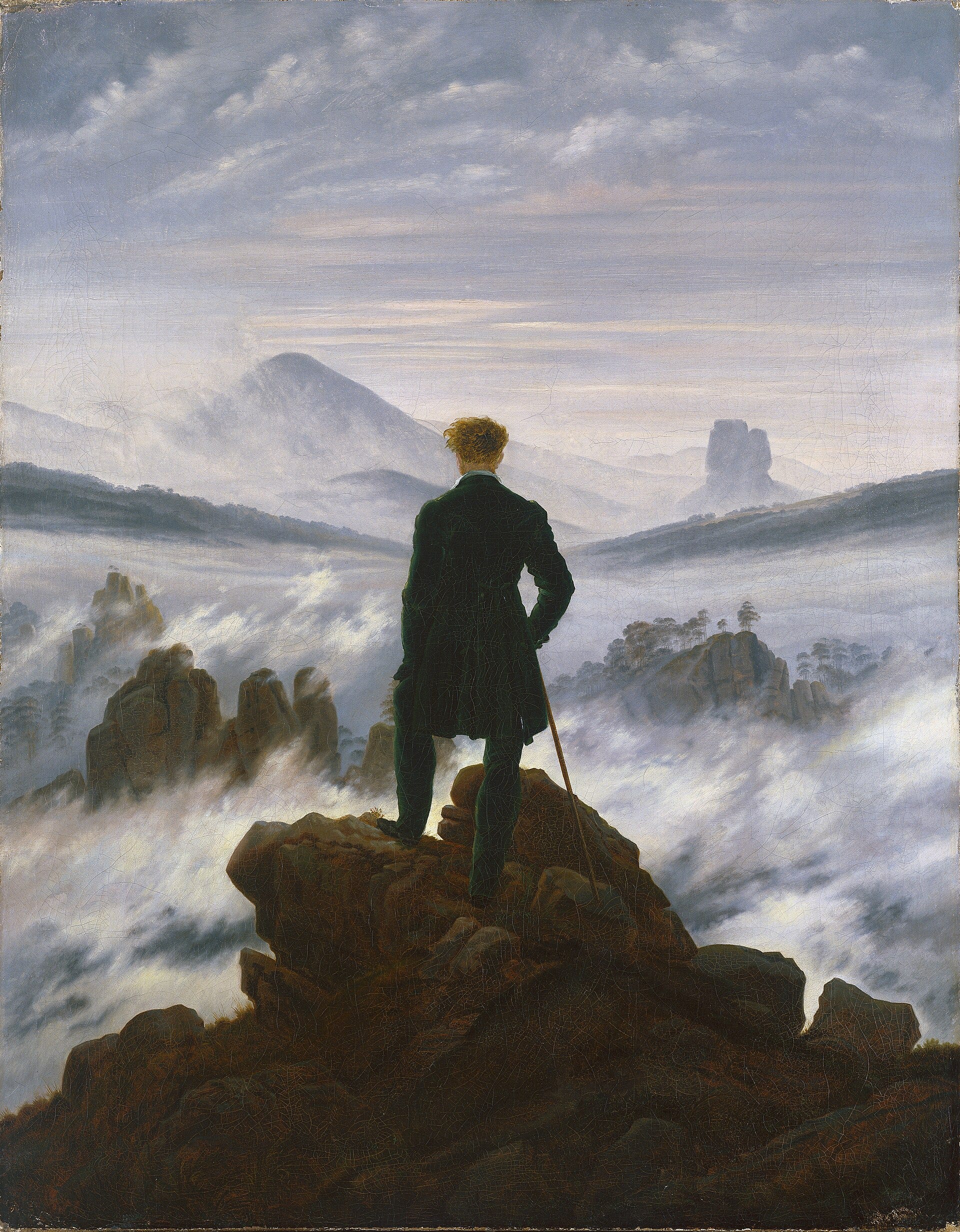
One detail in this painting is off.
Friedrich spent his life defending one rule: in a landscape, the person matters less than what the person is looking at. That is why his figures face away, anonymous, turned toward the horizon. He wrote it, repeated it, stood by it.
And here he does the exact opposite. He puts himself in the middle, alone, bent to the ground, one hand planted in the earth, the other reaching out over the chasm.
This figure is the key to the whole painting.
You will never look at these three people the same way again..