
The oldest paintings known were made on rock, in caves and under overhanging cliffs, with charcoal and colored earth. The earliest found so far are more than 50,000 years old, and people kept painting such walls into historical times, on every inhabited continent. Some now lie under the sea, others in the middle of the Sahara.
Cool Stories About Art is a newsletter to learn art the fun way.
Join 200,000+ readers and get:
10 new art stories / month
The entire archive of content (140+ articles)
Comment, ask questions, and chat with other readers
What a Cave Wall Asked of a Painter
Painting on these walls meant working with what the ground supplied. Iron oxides gave red and purple, kaolin clay gave white, and charcoal or manganese oxide gave black, each mixed with a binder. The painters laid the color on with their fingers, or blew it onto the rock.
In the deep caves, they worked far from daylight, by the light of a lamp, sometimes on scaffolding, on uneven rock full of bumps and hollows. Many of the walls they left behind are so fragile that visitors, with their warmth, their breath and their microbes, have damaged them.
The twelve were chosen because each one changed what was known about the people who painted, through its age, its subject or the way it came to light. Each is a single painted figure or surface, and in one case a small painted slab rather than a wall. Half are in Europe, the rest in Africa, Asia and South America.
Several were first seen by people who were not looking for paintings at all: a diver, a group of teenagers, a young girl.
12. The Hands of the Cosquer Cave, Marseille, France (about 27,000 years ago)
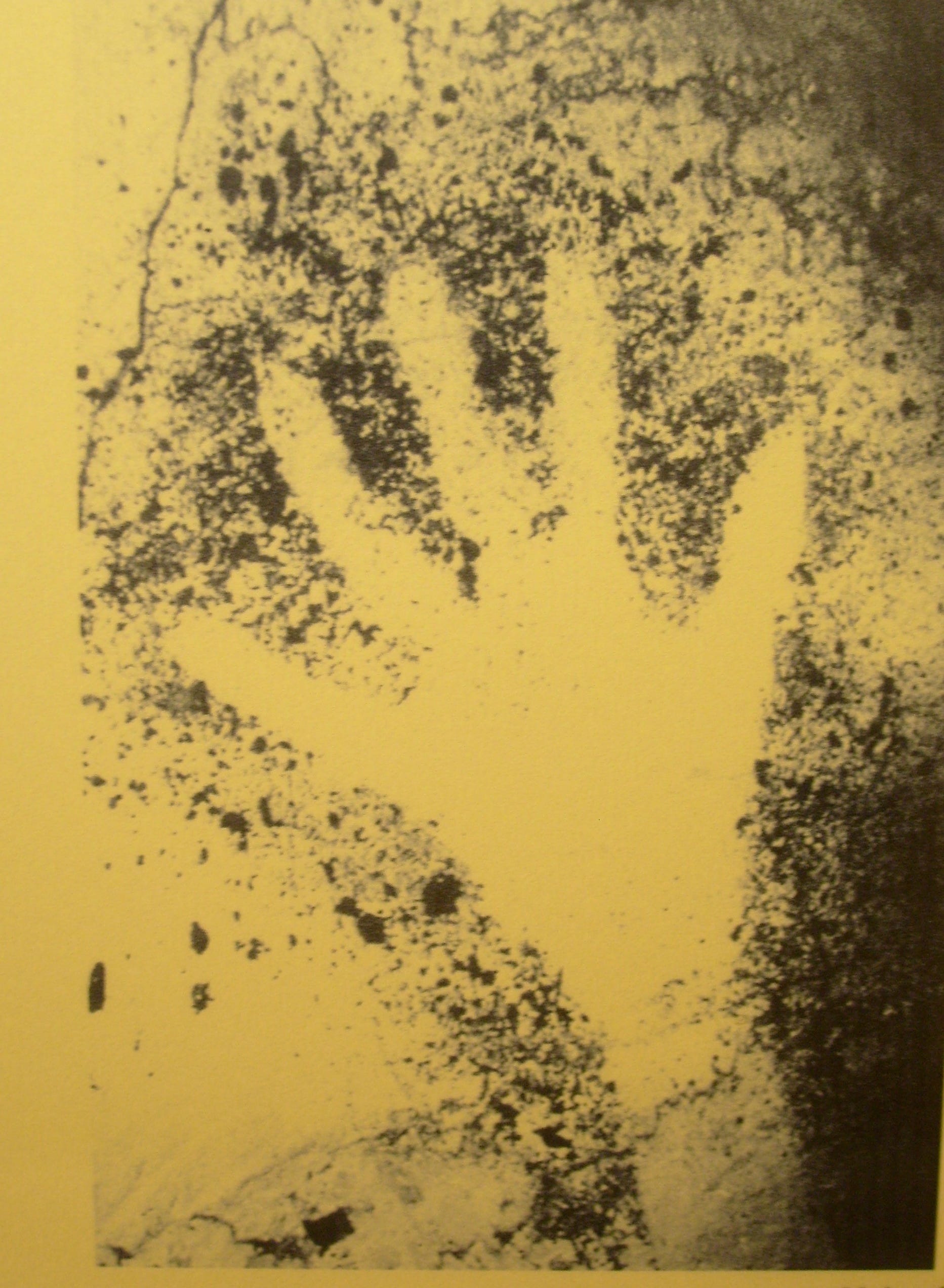
Eight left hands are lined up on a mass of stalagmites, next to a deep shaft, on a ground of powdered charcoal. Each has a complete thumb. Each has fingers that stop too short.
Nobody drew these hands. A painter pressed a hand flat against the rock and blew color all around it, so that its shape stayed bare inside a cloud of paint. The result is called a stencil.
The Cosquer Cave, in the rocky inlets near Marseille, holds more than fifty hands, some made this way, others dipped in color and pressed on the wall. Black hands from the cave have been dated to about 27,000 years ago.
The short fingers are the puzzle. All the hands are in the eastern part of the cave, along a path that leads to a shaft 24 meters deep, and the eight with short fingers are the closest to it.
Frostbite seems unlikely, since it would probably have taken the thumbs as well. One possibility is that the painters folded some fingers down on purpose, to make a sign.
Reaching the hands today takes a dive. In 1985, Henri Cosquer, a professional diver who ran a diving school, came by chance upon an opening at Cape Morgiou, 37 meters below the surface. Beyond it, a diver has to swim 175 meters through a dark tunnel before coming up into air.
For six years, Cosquer explored the cave with a few friends without noticing a single painting. The first hand was spotted on a wall in 1991. Then three divers died in the tunnel, and on September 3, 1991, he declared the cave to the authorities. It was closed at once.
When the hands were painted, none of this was under water. The sea stood more than 100 meters lower, and the shore lay several kilometers away. The water reached the entrance about 10,000 years ago, and it is still rising. Only a fifth of the walls that could hold paintings is still above it, and that part may have 150 to 200 years left.
At a Glance
Artist: Unknown Paleolithic painters
Made: About 27,000 years ago
Medium: Red and black pigment, blown around hands or printed from painted hands, on limestone
Size: Life size (more than fifty hands)
Where to see it: Closed to the public, entrance 37 m under the sea. Replica at Cosquer Méditerranée, Marseille
11. The Swimmers of Wadi Sura, Gilf Kebir, Egypt (at least 6,000 years ago)
Tiny figures float across the rock with their bodies flat and their arms and legs spread wide. They are painted in a shelter hollowed out of a cliff on the Gilf Kebir, a plateau in Egypt's Western Desert, near the border with Libya. Outside, sand and rock run to the horizon. Someone painted what look like swimmers, in the middle of the Sahara.