
The Christmas tree looks as old as Christmas itself, yet most families in Europe and America only brought one indoors during the 1800s. Pictures helped it travel almost as fast as habit did, because a printed scene could show a whole country how Christmas Eve was supposed to look. One of those scenes even gave the custom a famous origin that never happened.
Cool Stories About Art is a newsletter to learn art the fun way.
Join 200,000+ readers and get:
10 new art stories / month
The entire archive of content (140+ articles)
Comment, ask questions, and chat with other readers
How a Fir Tree Moved Indoors
A lit tree gave painters something rare, a room that makes its own light. Once the lamps are out, the candles on the branches are the only glow, and everyone gathered around them is lit from the same point.
The custom also needed explaining. Almost everywhere it arrived, it was new, and pictures showed people how it worked. That is why the best known Christmas paintings, the nativities, have no tree at all: they are centuries older than the custom.
Each work here catches the fir at one stage of its journey, from the wood where it is cut to the room where it is lit, in a new country or a new kind of household. Side by side, they follow a local custom on its way to becoming everyone's.
12. Carl August Schwerdgeburth, Luther in the Circle of His Family at Wittenberg on Christmas Eve, 1536 (1843)
A small fir covered in lit candles stands on the table before Martin Luther. The reformer holds a lute and sings with his wife and children, and the title of the engraving places the scene in Wittenberg, on Christmas Eve 1536.
Carl August Schwerdgeburth engraved it in 1843 for a publisher in Leipzig, in a series of eight scenes from Luther's life.
The scene illustrates a story told about Luther. Walking home one winter night, he saw the stars shining between the branches of a fir, and he wanted his children to see the same thing, so he fixed candles to a little tree at home. It is a legend, and historians find nothing to support it.
The real beginnings of the custom are humbler. The oldest precise account comes from Strasbourg in 1605, where an anonymous writer described firs set up in rooms and hung with paper roses, apples, wafers, gold foil and sweets. Other parts of Germany took up the habit in the 1770s, and it only became common there in the 1830s.
Schwerdgeburth's engraving therefore came out just as the tree was spreading, and it gave a new habit a respectable founder. To me, that explains why the legend held so well: a family buying its first tree could believe it was following the great reformer.
The picture then traveled with the story. A version of the scene appeared in a gift book published in Philadelphia in 1853, and German printers were still selling framed color copies in the 1910s.
For generations of Protestant families, it showed what a proper Christmas Eve looked like, though Luther's own household almost certainly celebrated in another way. Those families were copying the sixteenth century from a picture made in the nineteenth.
At a Glance
Artist: Carl August Schwerdgeburth (1785 to 1878)
Made: 1843
Medium: Engraving
Size: Not published
Where to see it: Royal Collection, London (one impression)
11. Christian Krohg, Christmas (1893)
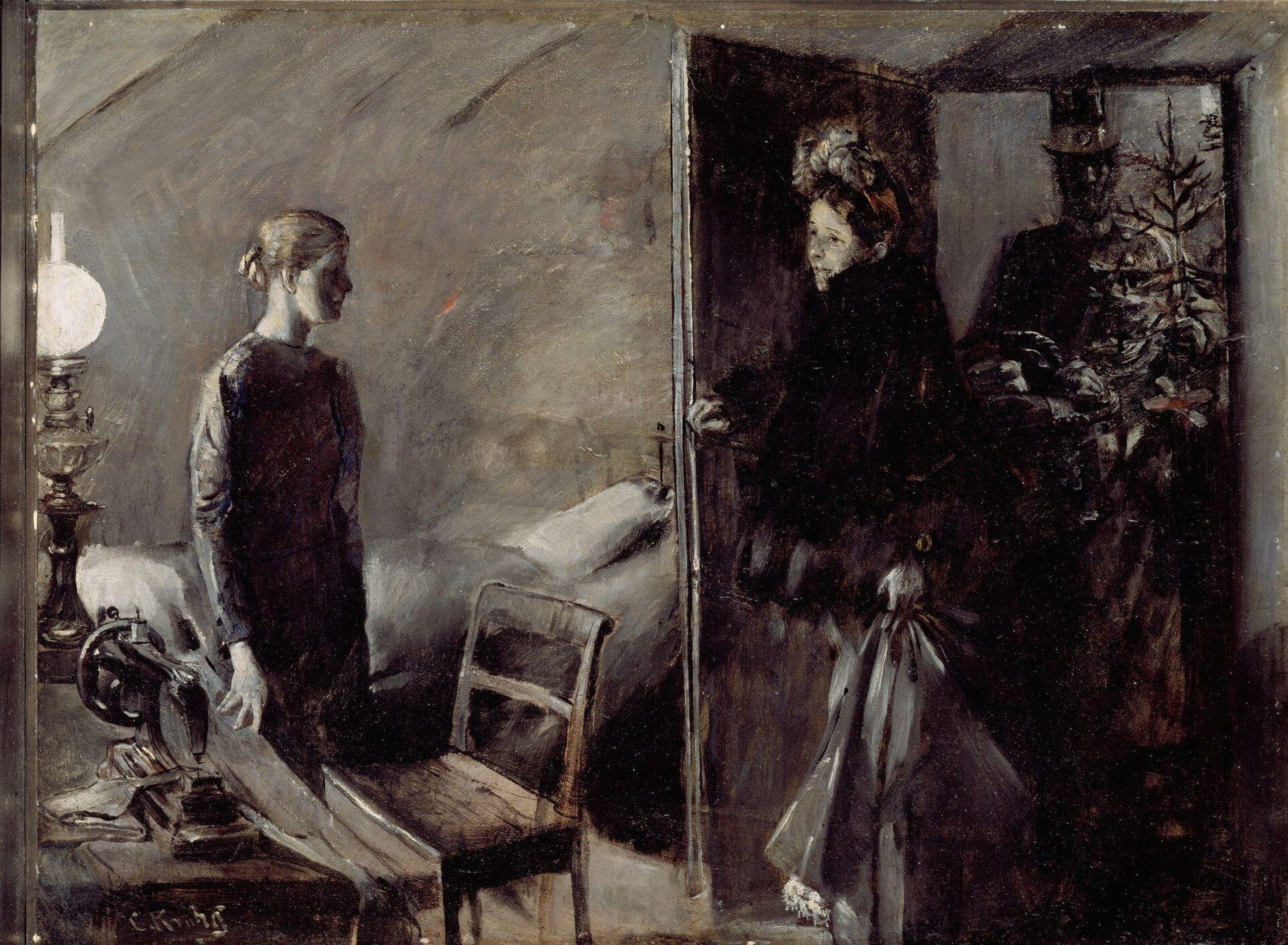
The door of an attic room has just opened. Inside, a young woman in a plain dark dress stands by a sewing machine and a narrow bed, lit by a single oil lamp. On the threshold, a lady in furs and a feathered hat looks at her, and behind the lady a gentleman in a top hat carries a small fir tree, still out in the dark hallway.