Chuck Close: The Complete Story

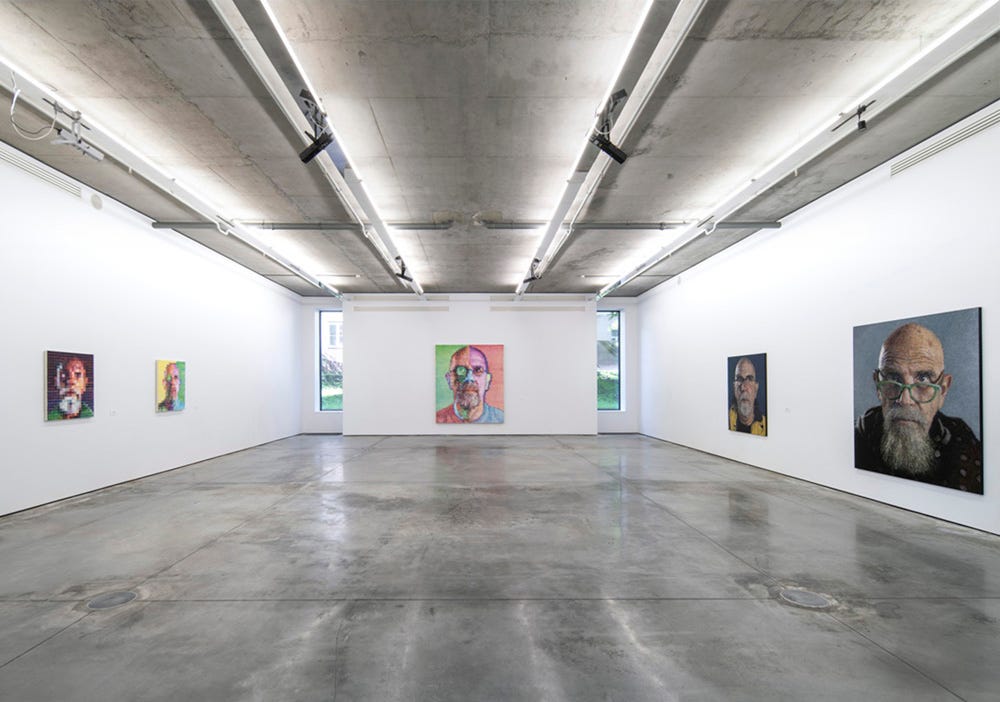
A face the size of a wall, built from thousands of tiny squares, each one a little blob of colour. Step back and the squares resolve into a person; step close and they dissolve into pure pattern.

Saardom Chuck Close
Saardom Chuck Close
Saardom Chuck Close
Saardom Chuck Close

Chuck Close spent his life on the human face, and made it new with a grid.

He was an American artist famous for enormous, highly detailed portraits built from grids, who kept working after paralysis and lived with face blindness.


Read by 110,000 people who love a good art story. Join free.


Where to go deeper

These go past the caption and into what actually happened:


The grid

Close worked from photographs, laying a grid over the image and the canvas, then filling each square one at a time until a giant face emerged.

This patient, almost mechanical method turned portrait painting into something between photography, abstraction and craft, a face made of countless small decisions.

The face blind painter

Close2 by Van Pelt
Close2 by Van Pelt
Close2 by Van Pelt
Close2 by Van Pelt

Close had prosopagnosia, or face blindness, meaning he could not easily recognise faces, even of people he knew well.

He once said that painting faces flat, and studying them square by square, was his way of fixing them in memory, so his whole art grew out of a condition most people never notice.

The Event

In 1988 a collapsed blood vessel left Close largely paralysed, an episode he called the Event.

He learned to paint again with a brush strapped to his wrist, and his later grid portraits, built from loose, coloured lozenges, are among his most loved, proof of a refusal to stop.

Self portraits and friends

Danoff.Close.Farnsworth.Pitt 723292

Close painted himself again and again, a running record across decades, as well as fellow artists and composers he admired.

His giant self portraits track a whole life and the changes in his own method, from photographic precision to dancing colour.

Common questions about Chuck Close

What is he known for?

Huge grid based portraits and self portraits.

What is face blindness?

A condition, prosopagnosia, that makes recognising faces hard.

What was the Event?

A 1988 spinal collapse that left him largely paralysed.

When did he die?

In 2021.

Why his giant faces hold us

Close made the most familiar thing in the world, a human face, strange and monumental, and showed how a picture is built one small piece at a time.

That he kept painting after paralysis, reinventing his own method, makes the work a study in persistence as much as in faces.


Read by 110,000 people who love a good art story. Join free.


In his later years Close faced serious public allegations of misconduct from several women, which complicated his reputation and remain part of any honest account of him.

His art and that controversy are now discussed together, an uncomfortable pairing that museums and writers have had to weigh rather than ignore.

His grids influenced a generation of painters and even early ideas about digital images, since building a picture from small uniform units anticipated how screens render a face from pixels.

Despite the controversy that shadowed his final years, the work itself, those vast and patient faces, remains in the great museums of the world, studied for both its method and its strange humanity.

He kept making art until the end of his life, adapting his tools again and again to his changing body, so his late grids of dancing colour are records of both a face and a will to keep working.

His giant self portraits, spread across decades, now read as a single long record of one man face and one man method changing together over a lifetime.

His work hangs in major museums across the United States, and his patient grid method is still taught as a lesson in how attention itself can become a style.


The story behind the masterpiece, in your inbox. Free.