
The most interesting painted church interiors are Protestant ones, painted after the images were removed. A Dutch painter would spend months rendering a whitewashed wall where an altarpiece used to be, and sell the picture to the same congregation that took it down.
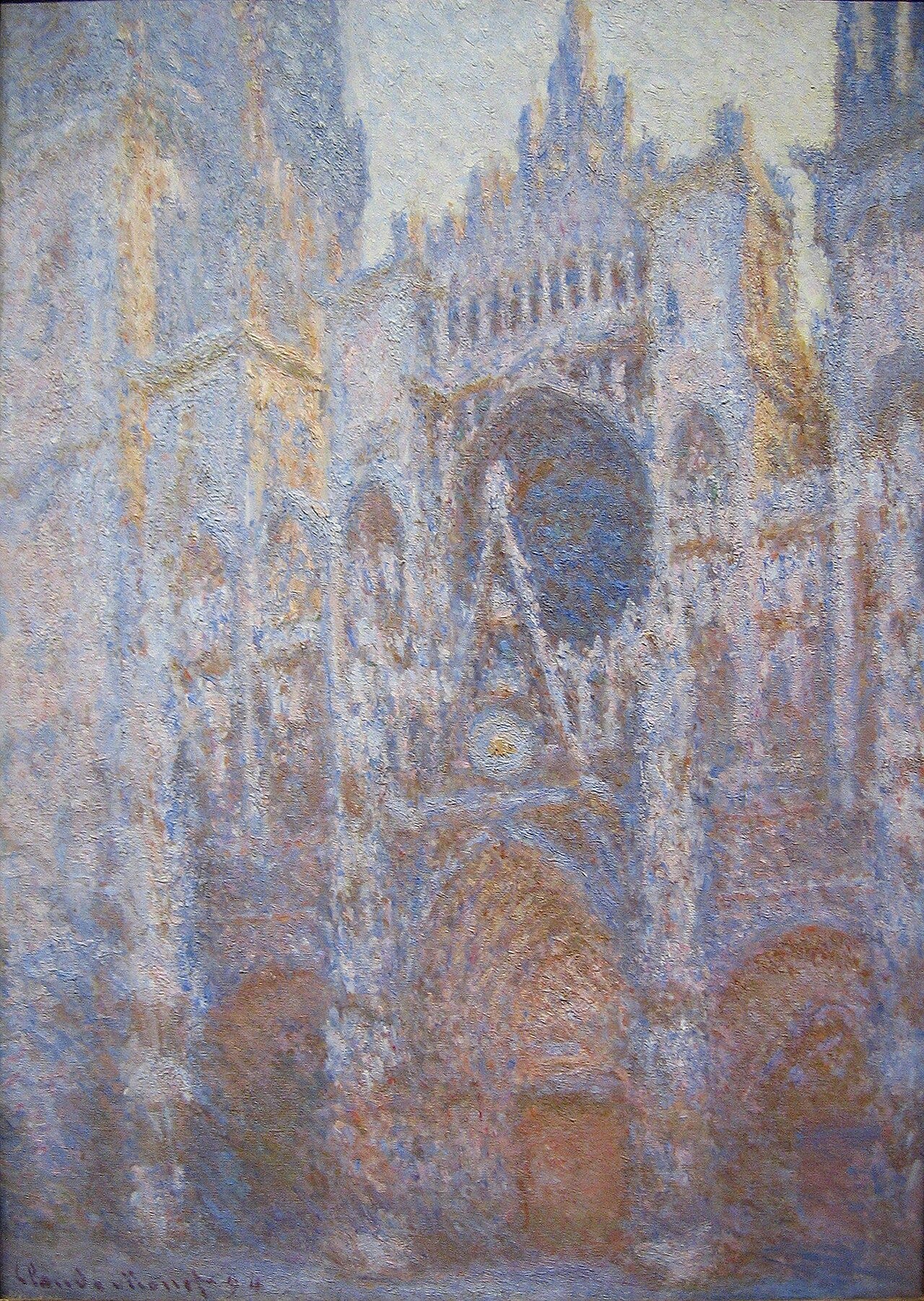
Learn art the fun way
1 | Rouen Cathedral, Claude Monet (1892 to 1894)
He rented rooms opposite the west front and painted it more than thirty times, at different hours, tracking the stone changing colour. The building is the same in all of them.
More on him in Claude Monet.
He worked from three rented rooms opposite the west front in 1892 and 1893, running several canvases at once and swapping them as the light moved. Twenty of the series were shown at Durand Ruel in May 1895 and most sold at once.
2 | The whitewashed Dutch interior
Pieter Saenredam went to the buildings first. He measured them, made drawings on the spot with the date written on the sheet, and only worked the painting up in the studio years later. The Interior of the Church of Saint Bavo in Haarlem, dated 1648, is built on drawings he made in 1635.
And the white is never white. Look closely and the walls are grey, pink, ochre and green, because a flat white wall in paint reads as a hole. Saenredam mixes everything except white into it.
More on the underlying skill in what is perspective in art.
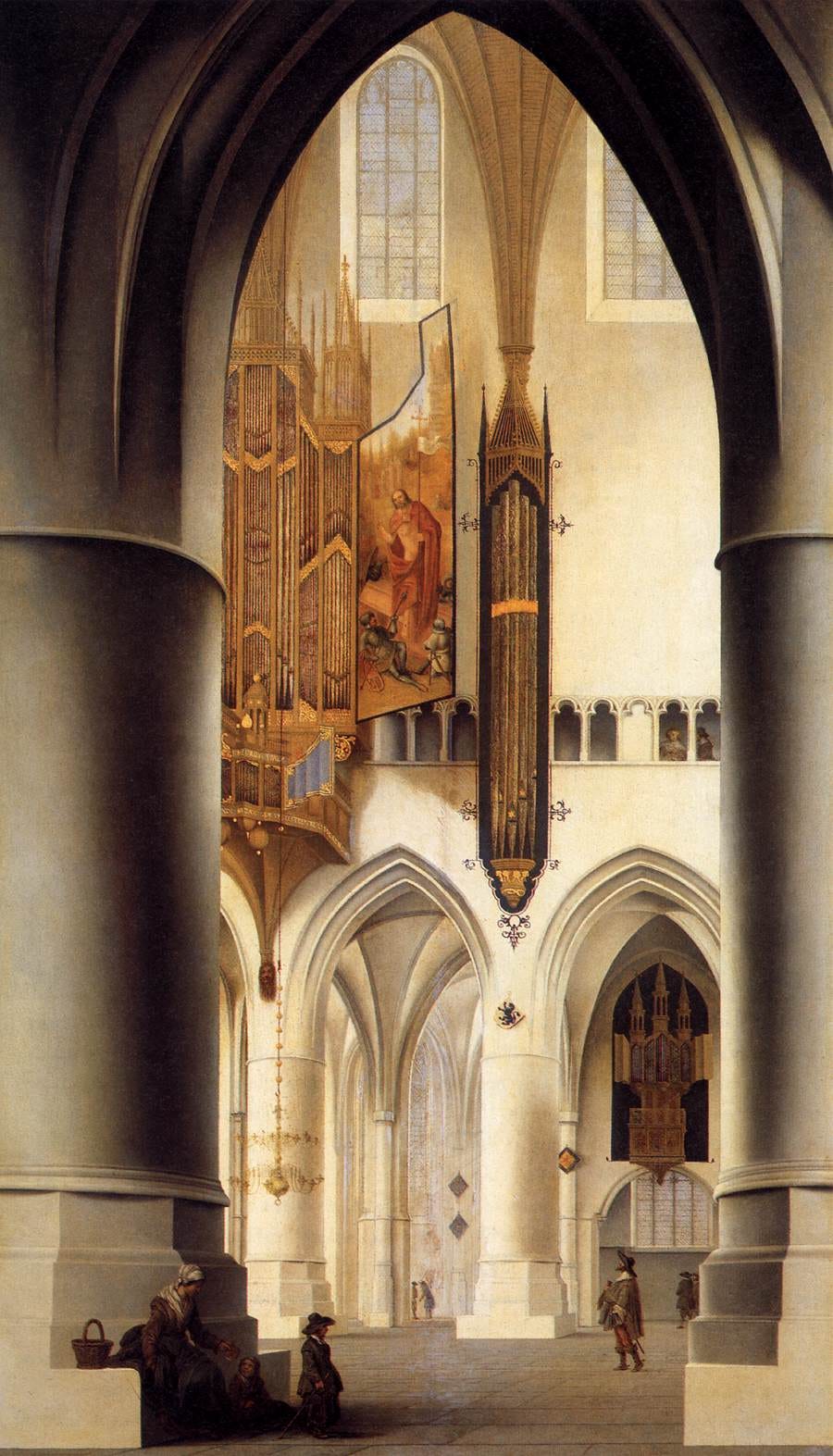
Pieter Saenredam measured real churches, then painted them stripped bare, with pale light and small figures. The subject is the absence of decoration.
More on the underlying skill in what is perspective in art.
3 | Emanuel de Witte and the church as public building
De Witte painted the Oude Kerk and the Nieuwe Kerk in Amsterdam and Delft over and over from the 1650s, and filled them with things a verger would have chased out: dogs, a man leaning on an open grave, children playing, a woman nursing a baby.
He was not recording one building. He recombined columns from several churches into one interior, which is why his views rarely match any real floor plan.
More on the genre in what is genre painting.
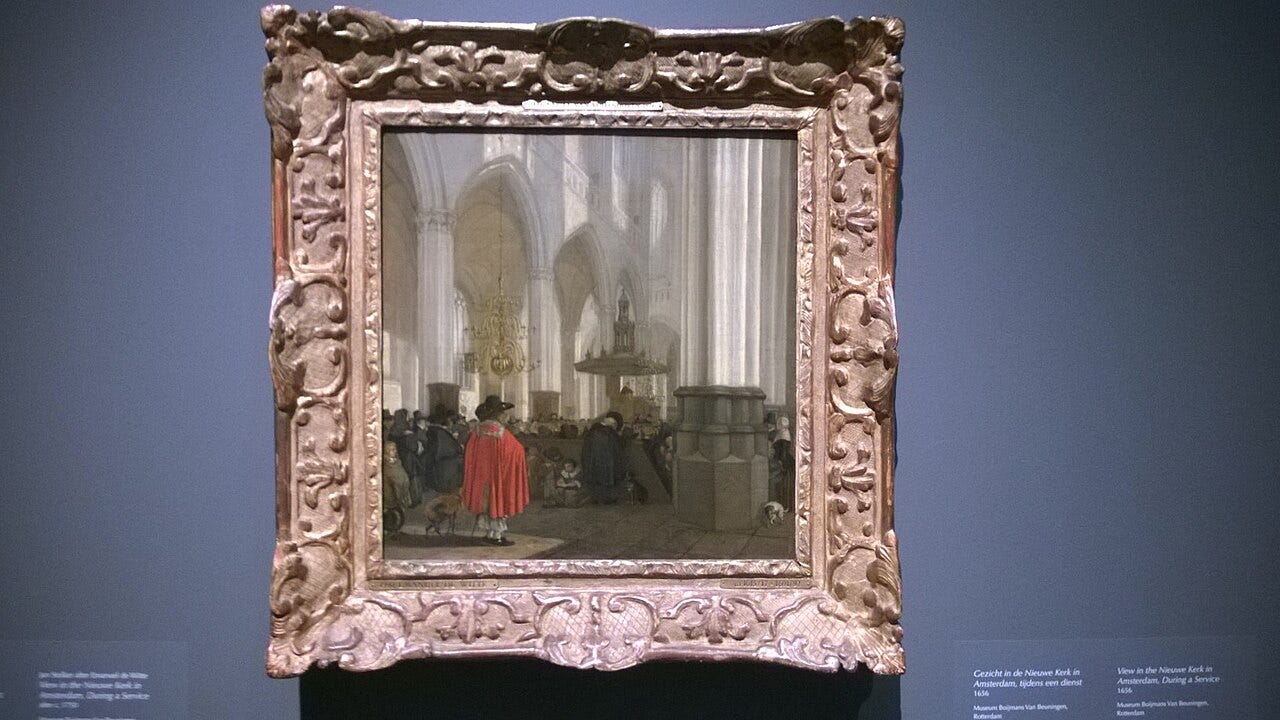
De Witte kept the architecture but added dogs, gravediggers, gossiping women and shafts of sun. His churches are places people pass through.
More on the genre in what is genre painting.
4 | The Ghent Altarpiece and the chapel it was built for
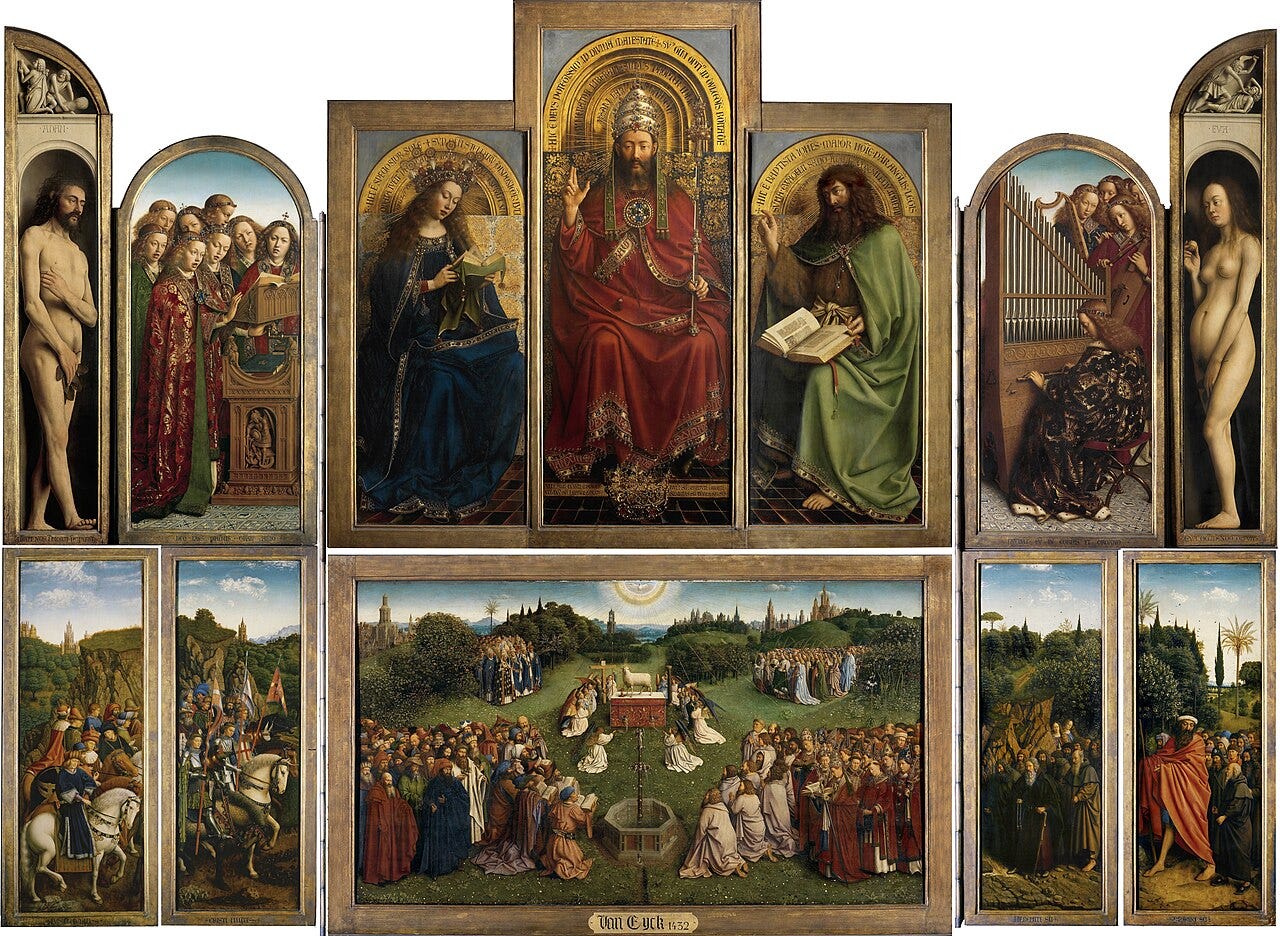
Van Eyck’s polyptych was made for one chapel in Saint Bavo, and it has been stolen, hidden, split and reassembled more than almost any other work.
More on him in Jan van Eyck, and on the format in what is a polyptych.
5 | The Scrovegni Chapel, Giotto (around 1305)
A small brick box built by a banker’s son, covered inside with thirty eight scenes and a blue vault. It was built partly to make up for the family’s money lending.
More on him in Giotto, and on the technique in what is fresco painting.
6 | The Sistine Chapel
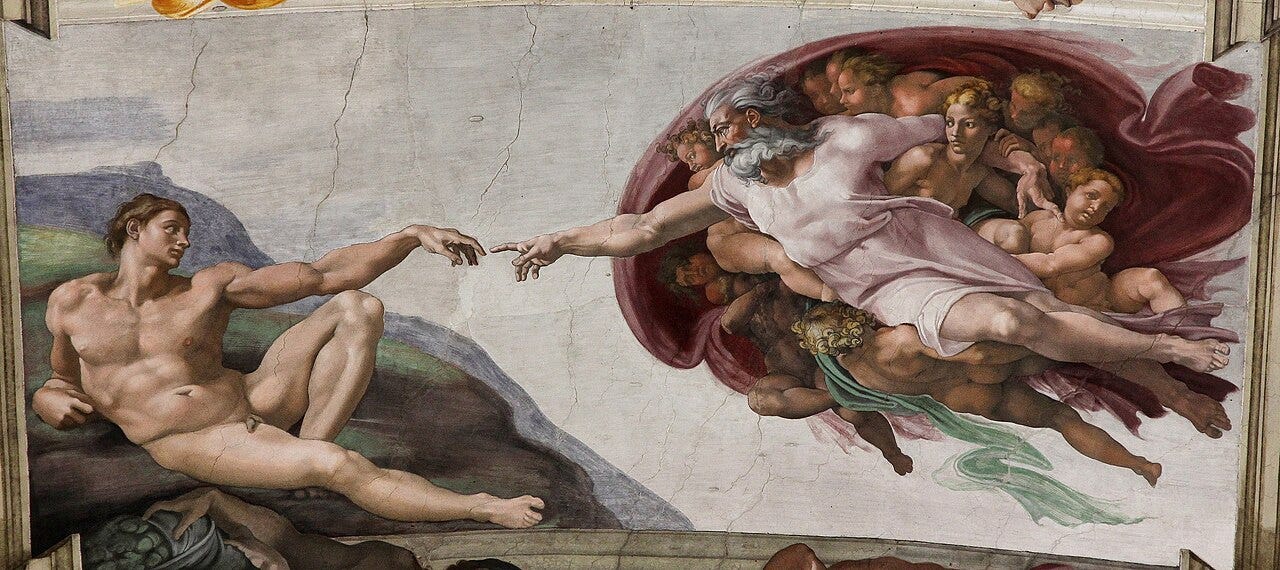
The ceiling gets the attention, but the walls were painted first, in 1481 and 1482, by Botticelli, Perugino, Ghirlandaio and Rosselli, before Michelangelo arrived.
More in who painted the Sistine Chapel.
The ceiling hides more than most visitors are told. I go through the ones people miss in 7 secrets hidden in famous paintings.
The wall cycle was commissioned by Sixtus IV and painted between 1481 and 1482 by a team brought from Florence and Umbria. Michelangelo started the ceiling in 1508, a full twenty six years later, and the Last Judgement only in 1536.
7 | Turner and the cathedral as light
Turner drew Salisbury and other English cathedrals in watercolour early in his career, using the vaults to study how light falls in a tall dark space.
More on him in JMW Turner.
He produced a large set of watercolours of Salisbury for Sir Richard Colt Hoare between about 1795 and 1805, including interiors looking down the nave. They were made to be engraved, which is why the perspective is so exact.
8 | Friedrich and the ruined abbey
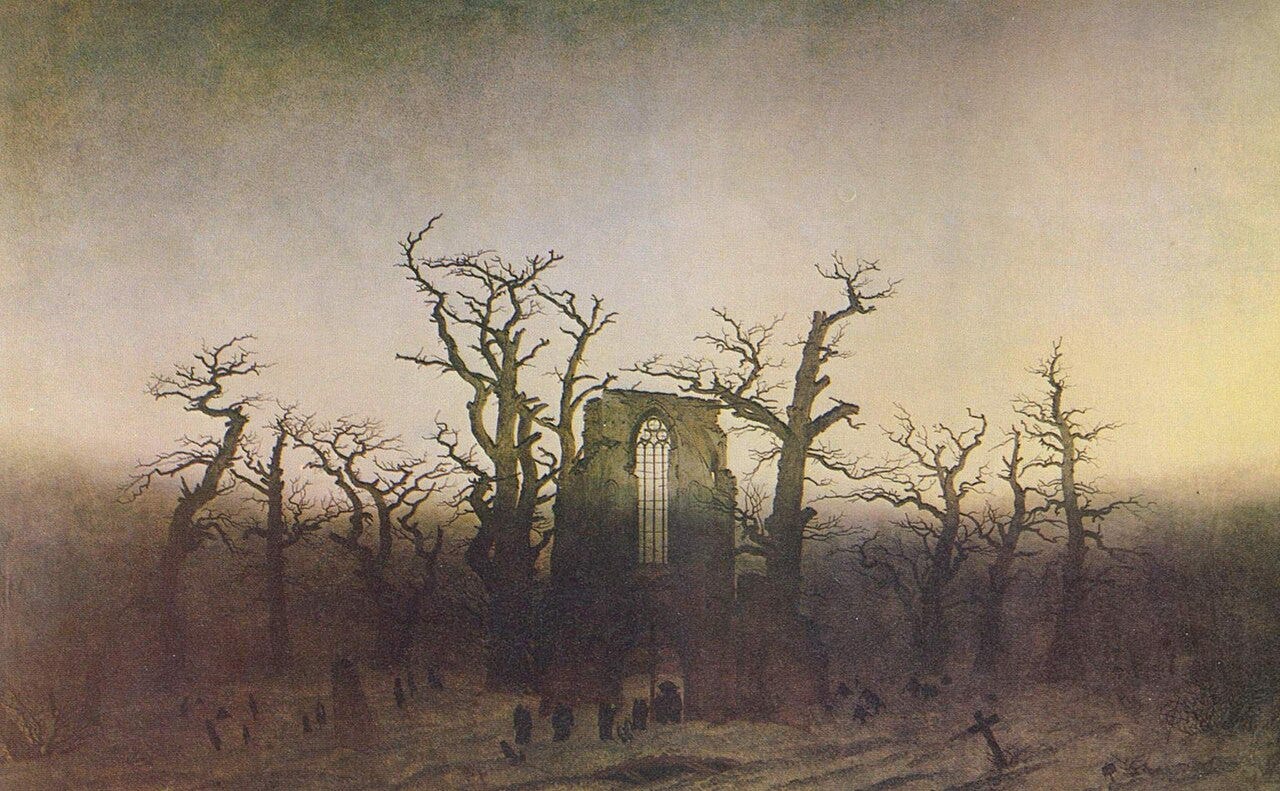
For the German Romantics the church works best broken. A roofless Gothic shell in fog carries the idea of faith better than a functioning building.
More on him in Caspar David Friedrich.
The Abbey in the Oakwood was shown at the Berlin Academy in 1810 alongside Monk by the Sea, and the King of Prussia bought both. The ruin is based on the abbey at Eldena, near Greifswald, which Friedrich drew many times.
9 | The church that was never built
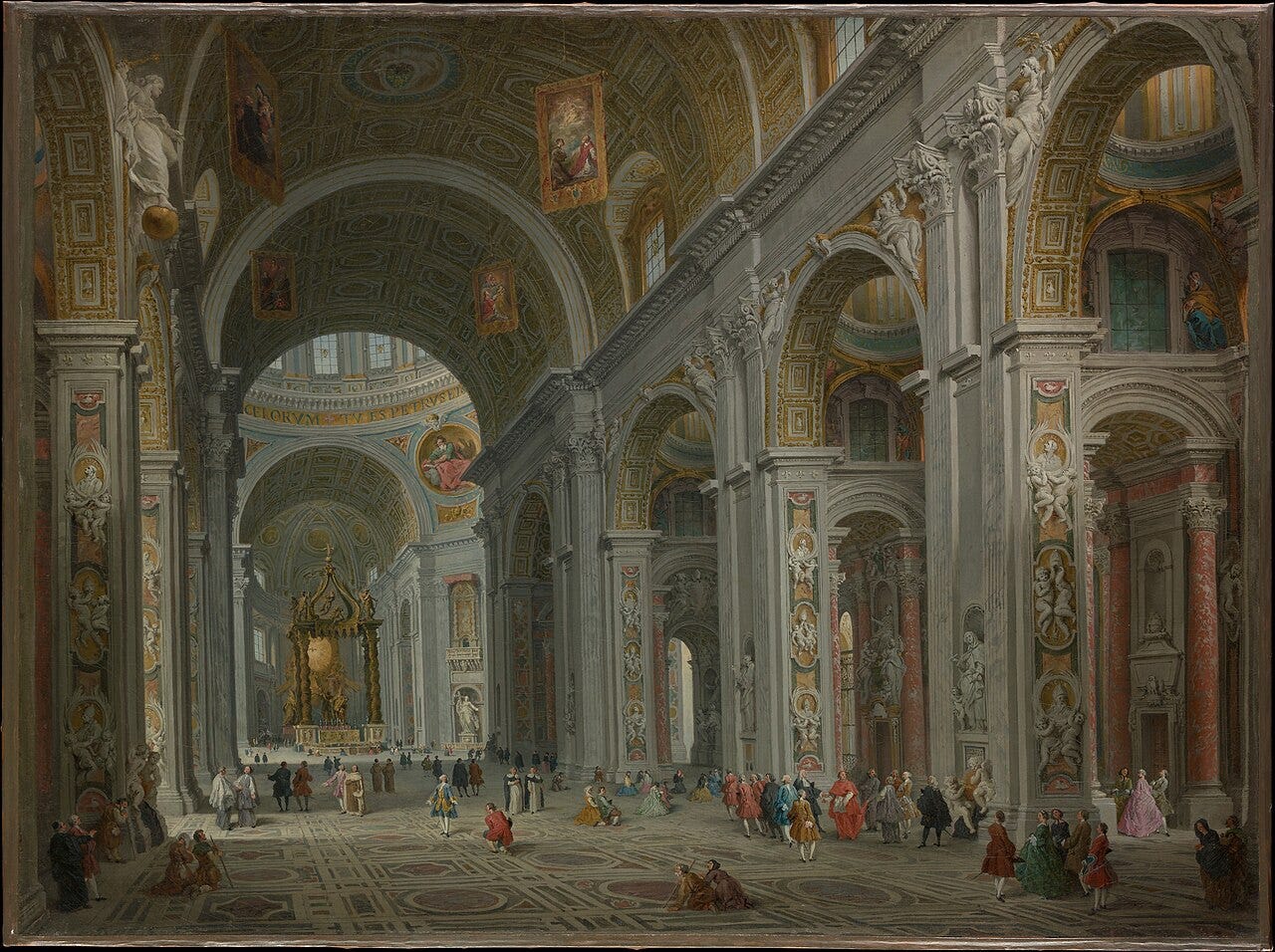
Painters of architectural fantasies combined a real dome with an invented nave and sold the result as a view. Several much loved church pictures show no building that ever existed.
More on the type in what is a capriccio.
The Venetian painters called this kind of picture a capriccio. Canaletto and Guardi both produced them, and buyers knew perfectly well that the building was invented.
10 | The village parish
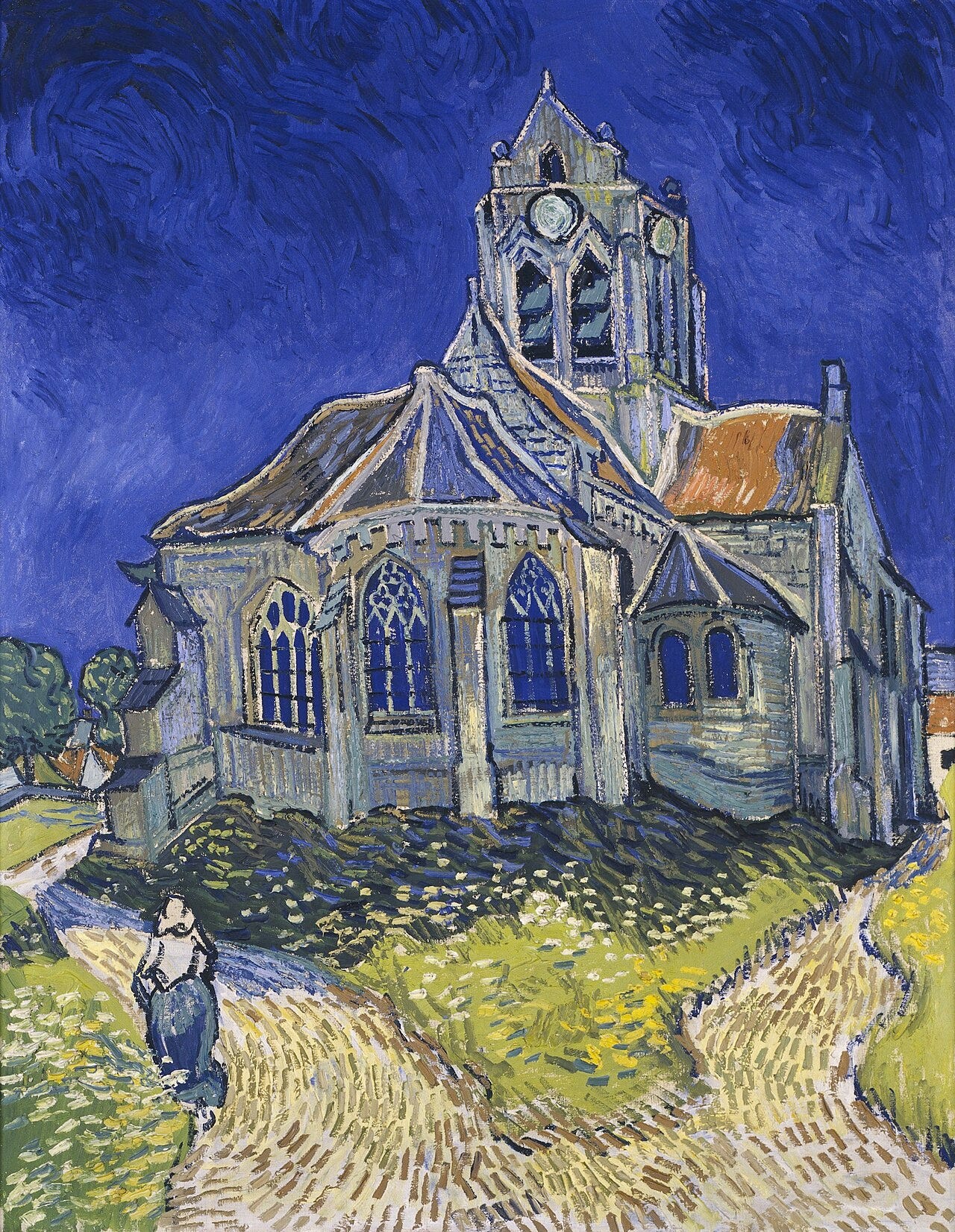
Van Gogh painted the church at Auvers in 1890 with the walls leaning and no visible door on the side we can see. It is a portrait of a building he could not enter.
More on him in Vincent van Gogh.
11 | What the light is doing
In a Catholic interior the light usually falls onto an altar. In a Dutch Protestant interior it comes in sideways through clear glass, because the coloured windows were gone.
You can often tell the denomination from the shadows.
12 | Why churches suit painting so well
A church gives a painter a long space with parallel lines, a controlled light source and a reason for people to be quiet and still. It is a perspective exercise you are allowed to sell.
Count the vanishing points and you find the painter’s real subject.
The perspective in Saenredam’s panels is accurate enough that architectural historians use them to reconstruct interiors destroyed since. That is a rare thing to be able to say about a painting.
Churches on canvas, questions readers ask
How many times did Monet paint Rouen Cathedral? More than thirty canvases, made between 1892 and 1894 from rented rooms opposite the west front.
Why are Dutch church interiors empty? After the Reformation the images were removed and the walls whitewashed. Painters made a genre out of the bare interior.
Who painted the Sistine Chapel walls? Botticelli, Perugino, Ghirlandaio and Rosselli, in 1481 and 1482, well before Michelangelo painted the ceiling.
What is the Scrovegni Chapel? A small chapel in Padua frescoed by Giotto around 1305, with thirty eight scenes and a blue star vault.
Where are Monet’s Rouen Cathedral paintings? Rouen and the Orsay for Monet, the Rijksmuseum for Saenredam and de Witte, Saint Bavo in Ghent, the Scrovegni Chapel in Padua.
Those bare Dutch walls are not neutral. Somebody removed what used to be there, within living memory of the painter, and the picture is quietly about the removal.
Search either of these and you will turn up dozens more: the Met and the Rijksmuseum.
This subject is one thread in a wider theme. See how it fits into Religion and the Sacred in Painting.
Many of the buildings caught inside these paintings are Gothic construction themselves; the pointed arches and gold ground panels behind the style get their own explainer in What Is Gothic Art?