Painters keep returning to the same places because each one sets a specific problem. Venice puts light on water, London wraps buildings in fog, Rome supplies ruins. Monet painted Rouen Cathedral's facade more than 30 times between 1892 and 1894 just to track its changing light.
In 1895, Monet hung 20 paintings of the same church wall in a Paris gallery.
Same stone, same angle, different hours of the day. He had made more than 30 of them, and he reworked many in his studio before letting anyone see them.
That exhibition explains something about how painters treat places. A city or a landscape stops being scenery and becomes a subject you can fail at.
The fog over London, the reflections in a Venetian canal, the glare of a desert at noon, each one has defeated painters and made the reputations of others.
This page maps the places painters return to most. Eight of them, each with its own full page of works, stories, and arguments. Here is the short version of each, and why it earned its own chapter.
Rome, the city painters inherit
Every painter who arrived in Rome walked into a city already painted a thousand times.
The response of Giovanni Paolo Panini in 1757 was to paint the problem itself. His two pendant canvases, Ancient Rome and Modern Rome, show galleries hung floor to ceiling with painted views of the Pantheon, the Colosseum, and Trajan's Column. Paintings of paintings of the city.
One pair now hangs at the Museum of Fine Arts in Boston, the other at the Metropolitan Museum of Art in New York. Even the copies of Rome ended up scattered like relics.
Many of Rome's most painted interiors are its churches, covered separately on the churches and cathedrals page.
Paris, painted from street level
Gustave Caillebotte put an umbrella in the middle of his masterpiece.
Paris Street; Rainy Day, painted in 1877, is over two meters tall and nearly three wide, and its subject is people crossing a wet intersection. Nothing heroic happens. That was the point.
The canvas has hung at the Art Institute of Chicago since 1964, which means one of the most famous images of Paris lives in the American Midwest.
Paris and London get compared often, two rival capitals painted in opposite weather, and the London page tells the wetter half of that story.
Caillebotte is one of 12 views of the city collected on the Paris page, along with the painters who preferred its rooftops, its bridges, and its bad weather.
London, or how to paint fog
Between 1900 and 1904, Monet rented rooms across the Thames and painted the Houses of Parliament through the fog.
He worked on multiple canvases at once, switching from one to another as the light shifted, because no single session could hold the motif still. By 1904 he had completed 37 canvases of it for exhibition.
That number tells you what London gave painters. The fog was the subject. The buildings were just what it landed on.
The London page follows 12 views of that fog and the painters who chased it.
Venice, the city that sells itself
Canaletto had a client problem most painters would envy.
Joseph Smith, the British consul in Venice from 1744 to 1760, commissioned a series of 20 view paintings of the city from him. British visitors wanted to bring Venice home, and Canaletto supplied it, canal by canal. Part of that series is now at the Metropolitan Museum of Art.
Venice may be the only city where the view paintings became an export industry. The demand shaped the art.
Venice's own waterfront traffic overlaps with the harbours and ports page, where the Grand Canal turns up again next to working ports and open sea.
The Venice page collects the famous paintings of the city and sorts out which views made it an industry.
Harbours and ports, where painting meets money
A harbour is a landscape with an economy in it. Ships, cargo, departures.
Claude Lorrain understood this in 1648 when he signed and dated Seaport with the Embarkation of the Queen of Sheba, a biblical scene staged as a sunlit port.
That painting has a second life in institutional history. It was among the first works acquired by the National Gallery in London, bought in 1824 from the collection of John Julius Angerstein. A harbour scene helped found a national museum.
The harbours and ports page walks through 12 works where painters put the sea, the ships, and the light in the same frame.
Deserts, the place painters had to travel for
David Roberts, a Scottish painter, went where almost no European artist had worked.
He traveled through Egypt and Nubia in 1838 and 1839, and on November 8, 1838, he sat in front of Abu Simbel and sketched it on site.
The lithographs made from those sketches, produced with Louis Haghe, were published between 1842 and 1849 in The Holy Land, Syria, Idumea, Arabia, Egypt, and Nubia. There were 247 hand colored lithographs in total. For many Europeans, that was their first accurate look at the desert monuments.
The deserts page covers 12 famous works, from Roberts onward, and what painters found when they got there.
Churches and cathedrals, the building as a sitter
Monet's Rouen campaign is the extreme case.
More than 30 canvases of one west facade between 1892 and 1894, many finished later in the studio, 20 of them chosen for the 1895 exhibition. He treated a cathedral the way other painters treat a face they cannot stop drawing.
Churches gave painters something rare, a building designed to handle light dramatically. Painters have been repaying that favor for centuries, inside and out.
The churches and cathedrals page looks at how painters handled these buildings, from full facades to a single shaft of light in a nave.
Cityscapes, the genre behind all of this
Strip away the specific city and a genre remains, the cityscape.
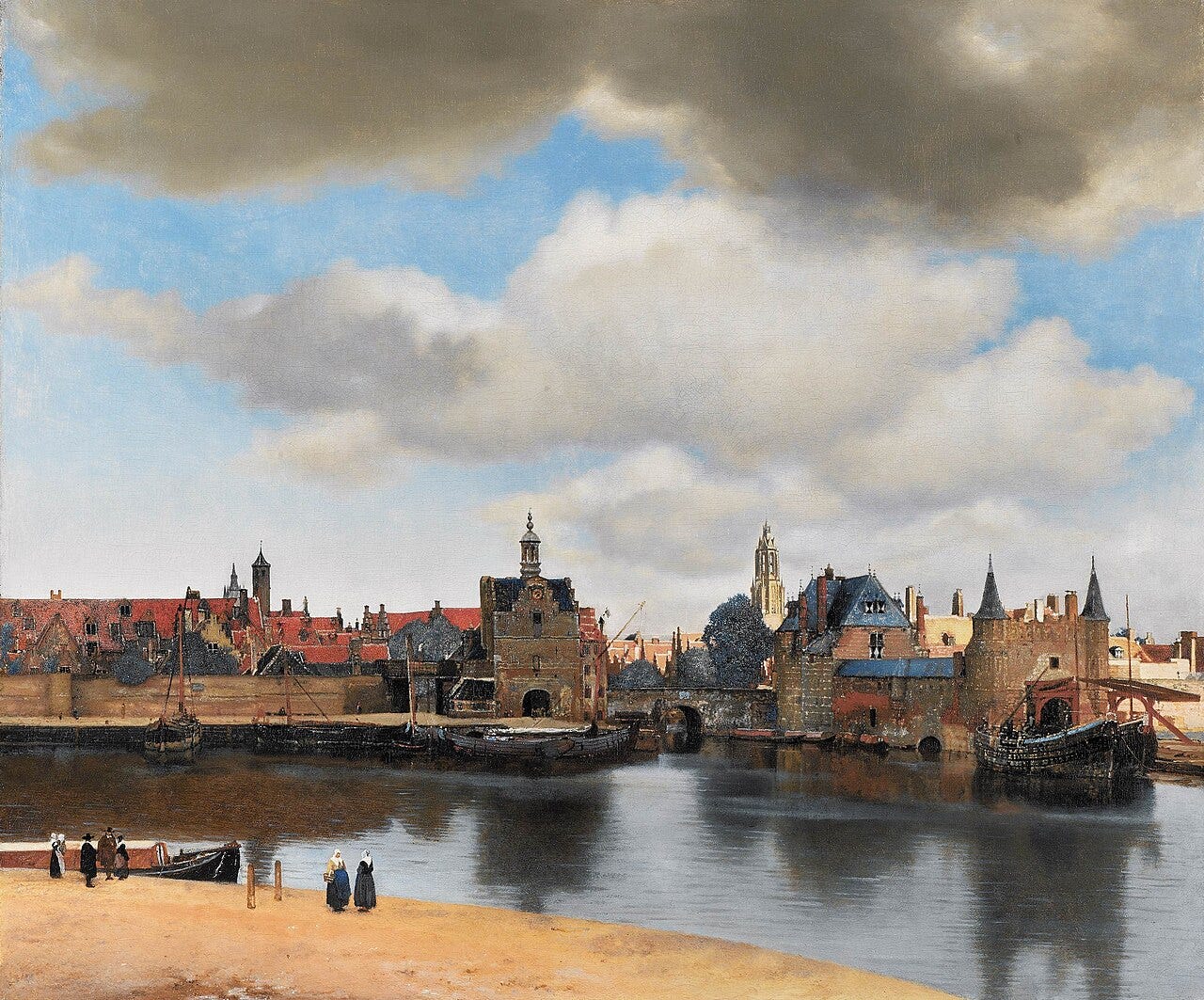
Vermeer painted exactly one. View of Delft, made around 1660 to 1661, is his only cityscape, one of just three known views of his hometown he ever painted. It now hangs at the Mauritshuis in The Hague.
One canvas was enough. It stands with works by artists who painted cities their whole careers.
The famous cityscapes page brings together 12 views that define the genre, Delft included.
Frequently asked questions
Why did Monet paint the same building over and over?
Because his subject was the light, and light changes by the hour. At Rouen he made more than 30 canvases of one facade between 1892 and 1894. In London he worked on multiple canvases of the Houses of Parliament at once, switching as the conditions shifted, and finished 37 of them by 1904. One canvas per building could never hold all of that.
Why do so many old master paintings show harbours?
Harbours combined everything a painter could want in one scene: architecture, ships, water, and dramatic light at the horizon. They also carried meaning, since ports stood for trade, power, and departure. Claude Lorrain built a career on them, and his 1648 Seaport with the Embarkation of the Queen of Sheba was among the first paintings the National Gallery in London ever acquired.
What counts as a cityscape?
A cityscape is a painting whose main subject is the city itself, its buildings, streets, or skyline, rather than the people in it. Figures can appear, as they do in Caillebotte's Paris Street; Rainy Day, but the urban view carries the picture. Vermeer's View of Delft, a profile of the town seen across the water, is the classic example.
Is Venice painted more than any other city?
It is certainly among the most painted, and demand explains why. In the 18th century, visitors wanted views of Venice to take home, and painters like Canaletto supplied them at scale. His series of 20 views for Joseph Smith, British consul in Venice from 1744 to 1760, shows how organized that market became.
Did painters really work in the desert on site?
Some did. David Roberts sketched Abu Simbel in person on November 8, 1838, during his travels through Egypt and Nubia. The finished lithographs, made afterward with Louis Haghe, filled a publication of 247 hand colored plates issued between 1842 and 1849.
Closing
If you want a measure of what a painted place can mean to someone, take View of Delft.
Vermeer painted it around 1660 to 1661, his only cityscape, and after seeing it in 1902 the novelist Marcel Proust called it the most beautiful painting in the world.