
Claude Lorrain (around 1600 to 1682) was a painter from Lorraine, then an independent duchy and today a region of eastern France. He spent almost his whole life in Rome, painting harbors and countryside lit by the low sun of early morning or late evening.
Claude, as he is often called, came to Rome as a kitchen servant and painted people so clumsily that he joked about it. Yet more than a century after Claude died, J. M. W. Turner, the great English painter of skies and seas, burst into tears in front of one of Claude's harbors.
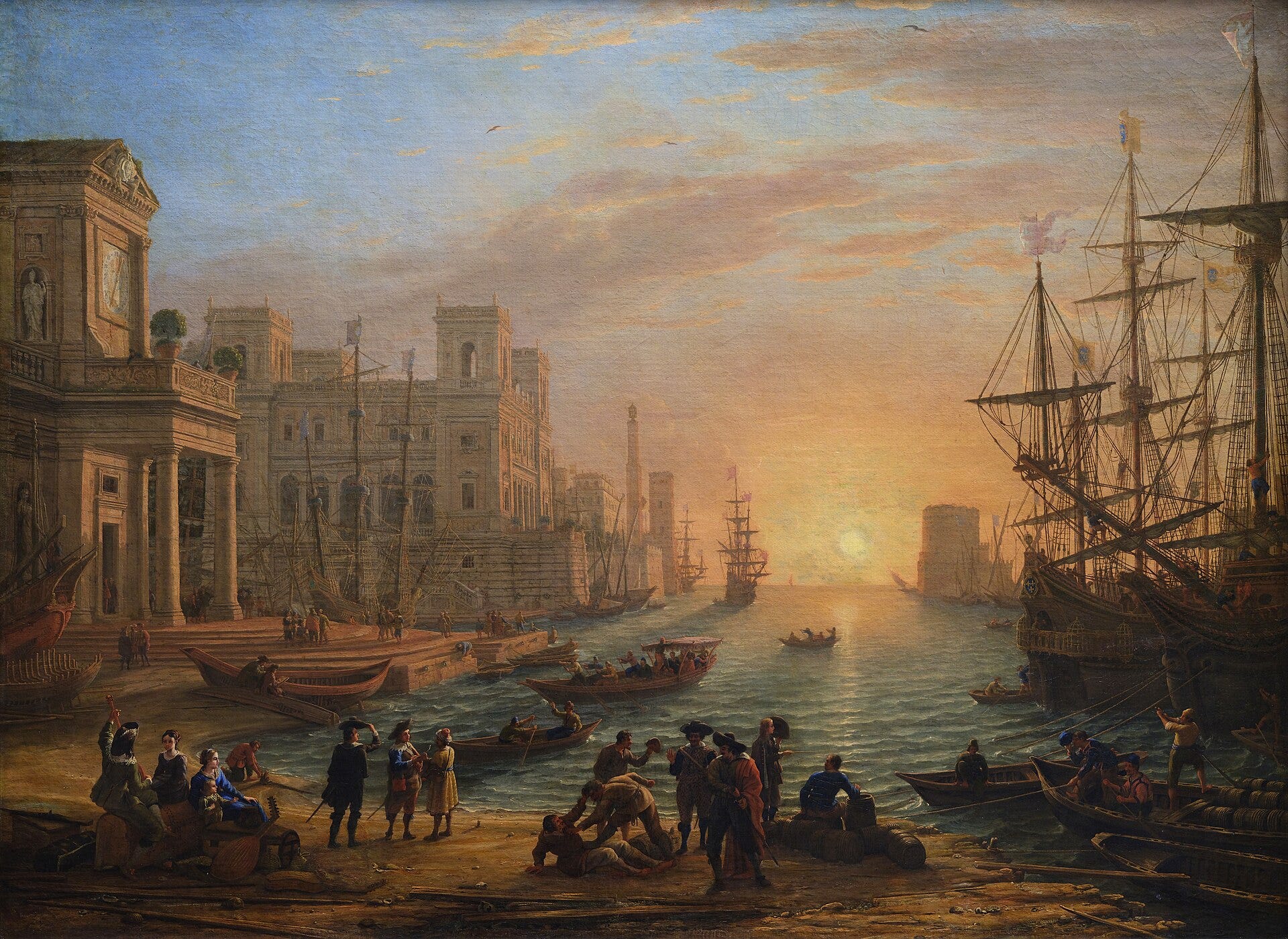
Claude Lorrain was born Claude Gellée, in a village of the Duchy of Lorraine. The name Lorrain simply means "from Lorraine."
Claude was twelve when both his parents died. The orphan went to live with an older brother, Jean, in Freiburg, a town in southwestern Germany. Jean was a woodcarver, and he taught the boy to draw.
Rome was then the capital of European art. Young painters came from all over Europe to study its ancient ruins and the works of Raphael and Michelangelo.
Still a teenager, Claude went to Rome too, but as a pastry cook. Agostino Tassi, a painter who covered palace walls and ceilings with landscapes, took Claude into his house to cook and serve.
Later, Tassi made the young servant his apprentice and taught him to paint landscapes.
Landscapes like Tassi's were treated as decoration. The famous painters of Rome painted saints, heroes and gods, with trees and sky as mere background. Claude chose the opposite and went out into the countryside to study trees, light and sky.
A young German painter, Joachim von Sandrart, went drawing outdoors with Claude. Sandrart wrote that Claude lay in the fields "before the break of day and until night," to learn to paint "the red morning sky, sunrise and sunset and the evening hours."
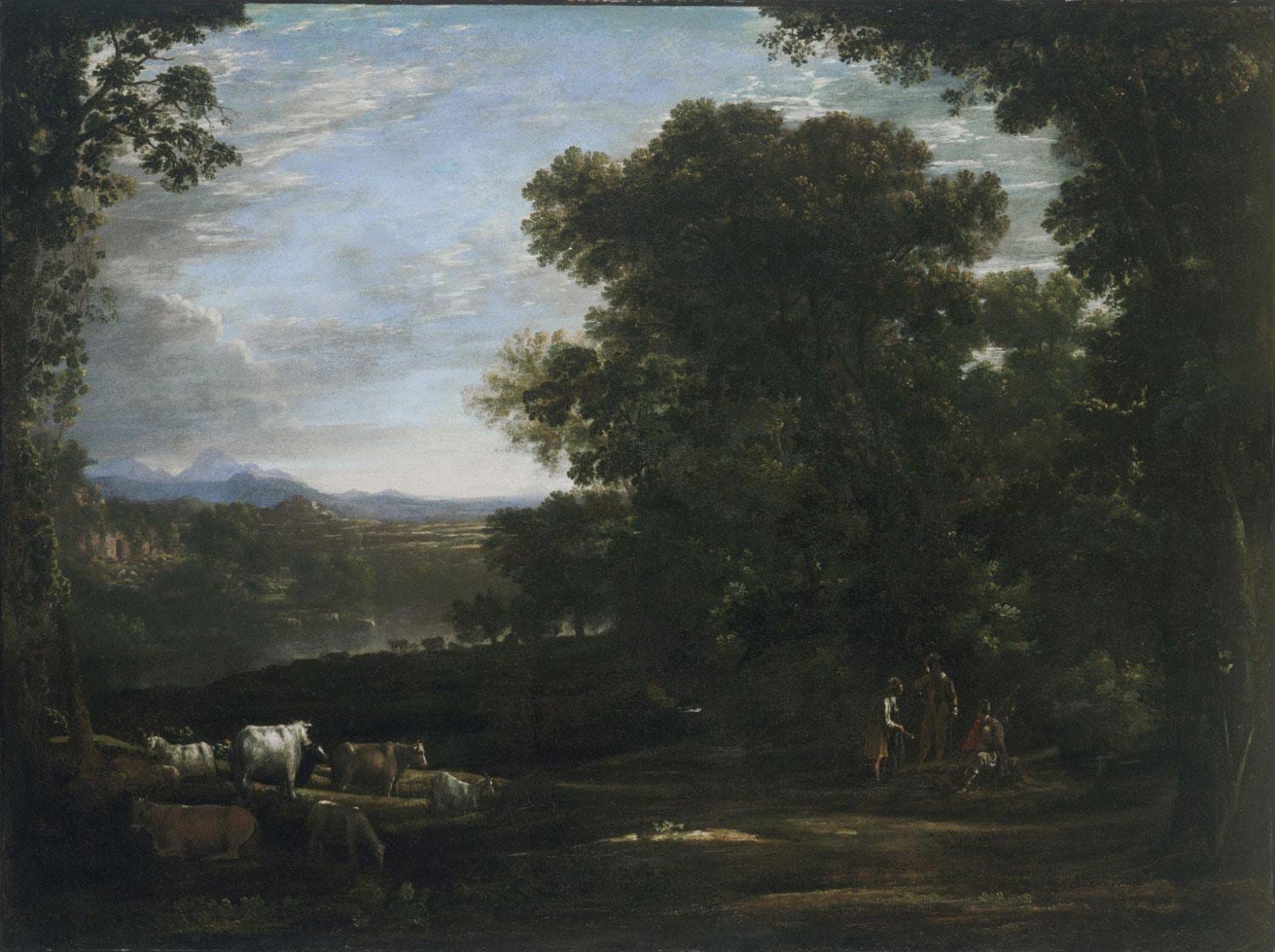
Claude's days in the fields paid off. In the early 1630s, a cardinal, one of the highest officials of the Catholic Church, bought two of his landscapes and recommended Claude to the most powerful man in Rome.
That man was Pope Urban VIII, head of the Catholic Church, who also ruled Rome and central Italy like a king. Soon the pope ordered paintings from Claude too.
Fame brought copycats, painters who sold their own landscapes under Claude's name. How could Claude prove which pictures were really his?
In the rest of the story
How Claude fought back against the painters who used his name.
Claude's joke about his own clumsy figures.
The same tower painted in two pictures for one duke.
The one condition Turner wrote in his will.