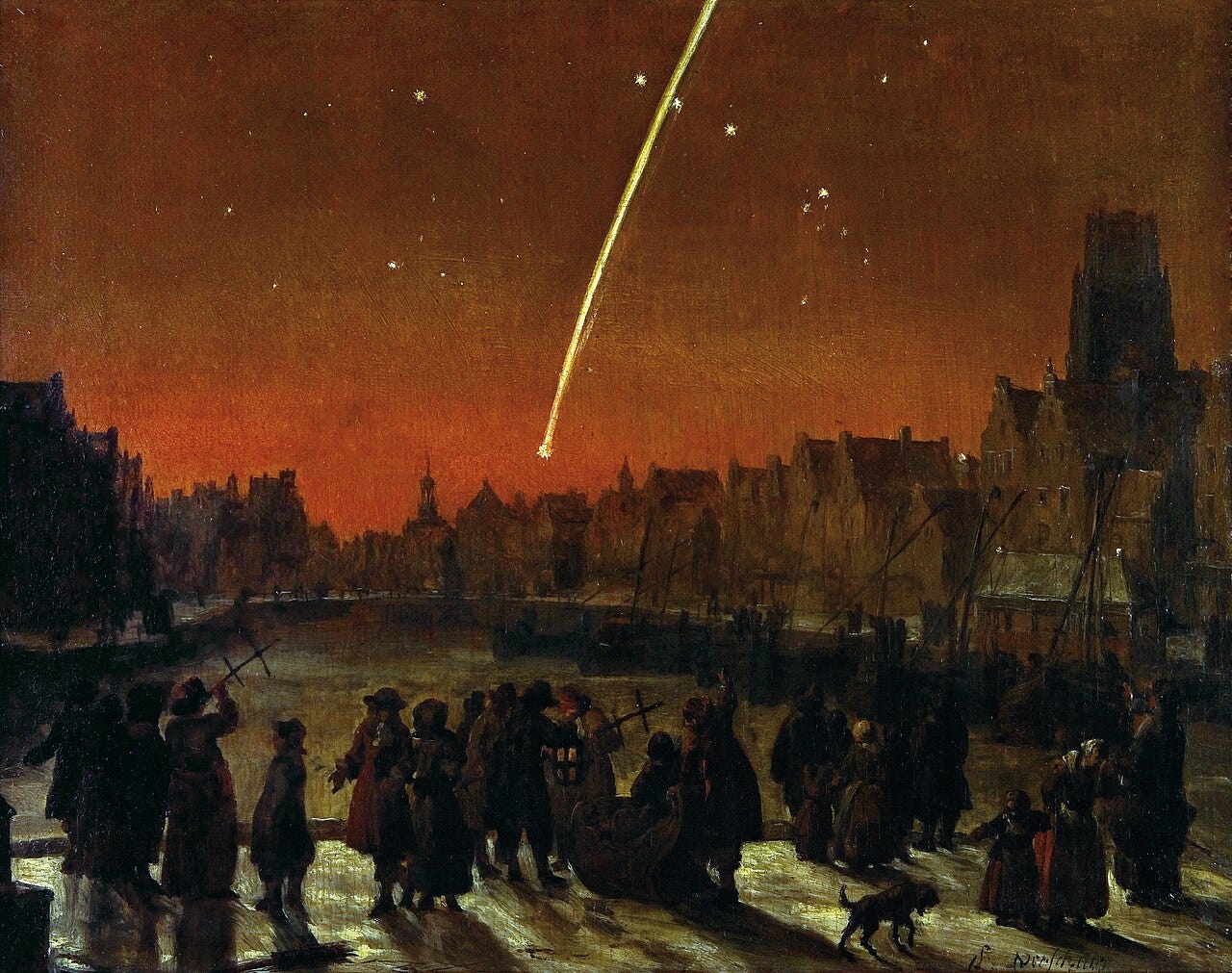
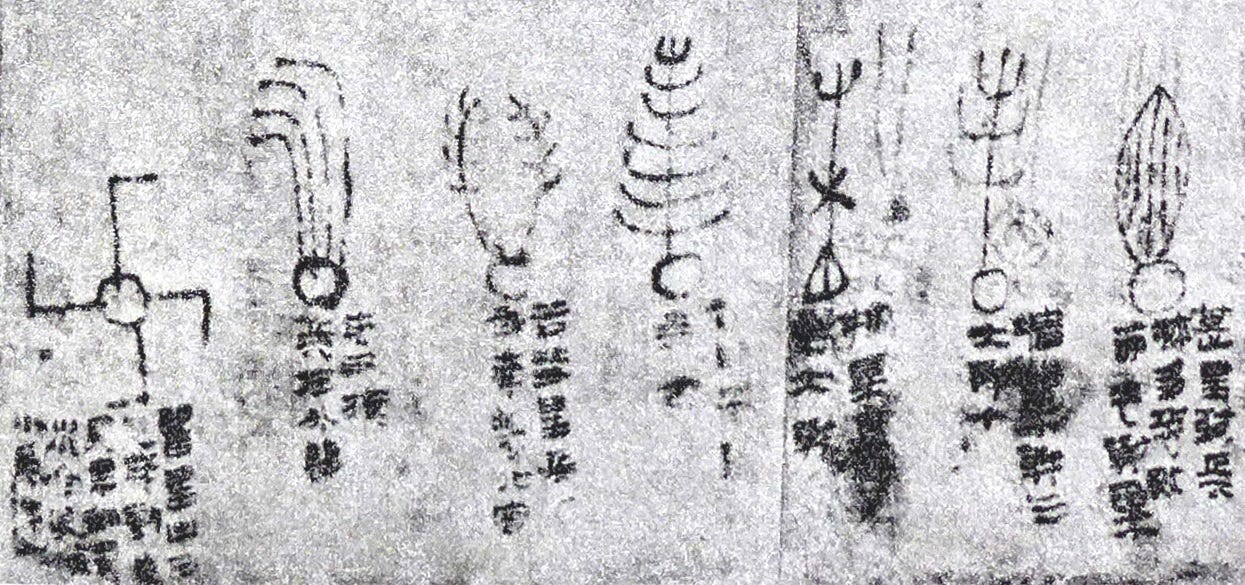
A comet gives you weeks. A total eclipse gives you minutes, sometimes seconds. For most of history, neither could be predicted by the people watching, which is why both were read as messages before they were studied as objects.

That double life runs through art. The same event could be embroidered as a curse on a king, carved as the grief of the cosmos, or painted with a stopwatch running. This page follows that shift, from omen to observation.
Quick answer: Artists depicted comets and eclipses first as divine signs, in works like the Bayeux Tapestry and medieval crucifixion scenes, then as observed phenomena, from a red lunar eclipse frescoed in Padua in the 1370s to Howard Russell Butler painting totality from 112 seconds of notes in 1918.
Before the paintings, there were the explanations. Norse mythology imagined two wolves, Skoll and Hati, chasing the sun and the moon across the sky, with an eclipse marking the moment one of them nearly caught its prey. In China, the traditional account held that a dragon was devouring the sun, and communities responded with noise, banging drums to drive the beast away. Artists inherited these stories long before they inherited telescopes.
1. The Bayeux Tapestry (about 1070s)
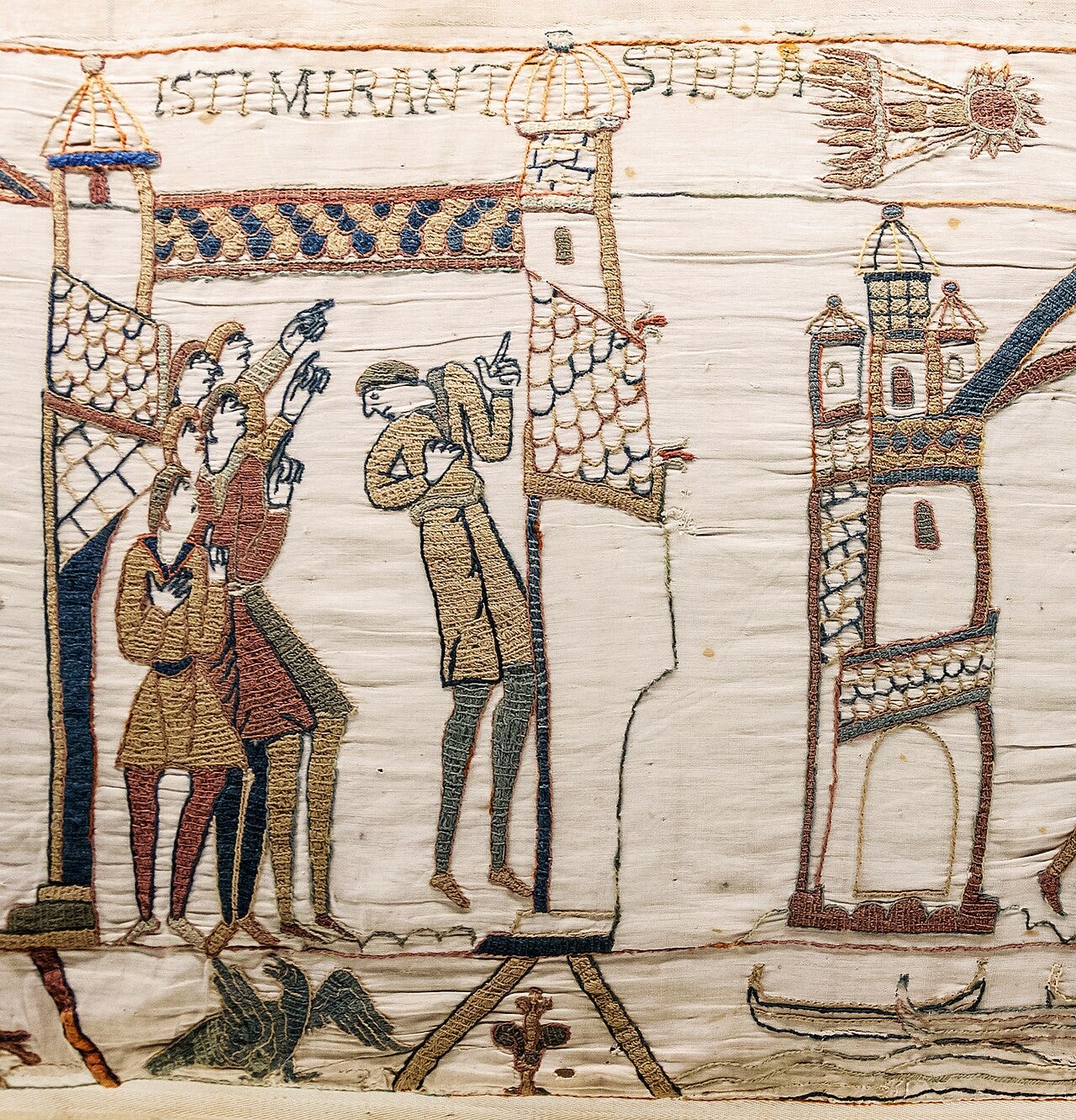
The most famous comet in Western art is stitched, and it is aimed at a king. In the Bayeux Tapestry, made in the decade or so after the Norman Conquest, a crowd of Englishmen points at a fiery star with a streaming tail while the Latin caption reads ISTI MIRANT STELLA, these men marvel at the star.
The object is Halley's Comet, which appeared in April 1066, months after Harold Godwinson took the English throne. In the next scene Harold receives the news on his throne, and in the border below, a ghost fleet of ships already waits.
The embroiderers were working after the Battle of Hastings, so they knew how the story ended. The comet functions as an accusation: heaven itself had flagged Harold's reign as illegitimate from the start.
2. The Salerno Ivories (eleventh to twelfth century)
Before painters tackled eclipses, carvers handled them through personification. Among the more than sixty ivory panels from the treasury of Salerno Cathedral in southern Italy, the crucifixion scene includes small figures of the sun and the moon above the cross.
They stand for the darkness the Gospels describe at the moment of Christ's death. In medieval crucifixion imagery this pairing became standard, the two lights of the sky present as mourners, the cosmos itself registering the event. An eclipse here is theology, with no interest yet in what the sky actually looked like.
3. Giusto de' Menabuoi, frescoes of the Padua Baptistery (1376 to 1378)
The shift toward observation starts, quietly, on a ceiling in Padua. Giusto de' Menabuoi frescoed the city's Baptistery for Fina Buzzaccarini, wife of the ruler of Padua, who intended the building as a family mausoleum.
Within the cycle, the moon appears with a reddish glow, the color a lunar eclipse actually produces when sunlight bends through Earth's atmosphere, while the sun is rendered cool and pale. It is one of the earliest known attempts by a European artist to paint what an eclipse looks like rather than what it means.
Padua was the right city for it. Its university was already a center of astronomy, and its fourteenth century fresco cycles are now collectively listed as a UNESCO World Heritage site.
4. Jan van Eyck, The Crucifixion and The Last Judgment (about 1440 to 1441)
In the Crucifixion panel of this pair at the Metropolitan Museum of Art in New York, van Eyck placed a waning moon low in the daytime sky above the crowded scene of Golgotha.
Astronomers who have studied the panel note that the phase makes sense. The Gospels place the Crucifixion just after the full moon of Passover, so a moon beginning to wane is chronologically correct.
Researchers have credited van Eyck with the first depictions of the moon in Western painting as an astronomical body, with visible surface markings, rather than a symbol. Where the Salerno carvers gave the moon a face, van Eyck gave it geography.
5. Albrecht Durer, Melencolia I (1514)
Durer's most analyzed engraving shows a winged figure slumped among instruments of measurement, and in the sky behind her, a glowing object with rays, arched by a rainbow. Many art historians identify the object as a comet.
One reading ties it to the comet Durer and his contemporaries observed in late 1513, widely taken as a sign of coming catastrophe. Others connect it to the astrology of Saturn, the planet of melancholy, or to prophecies of a great flood then circulating in Germany.
Whatever Durer intended, the comet fits the print's mood of brilliant intelligence stalled. Impressions of Melencolia I are held by major print rooms worldwide, including the Metropolitan Museum of Art.
6. Raphael and workshop, Isaac and Rebecca Spied Upon by Abimelech (about 1518 to 1519)
In the Loggia of the Vatican Palace, one small fresco hides a piece of astronomy. The scene shows King Abimelech at a window, catching Isaac and Rebecca in an intimate moment. Above them, the sun is partly covered, its edge breaking into fiery streamers.
Genesis mentions no eclipse. But an eclipse crossed Italy on June 8, 1518, shortly before the Loggia was decorated, and Raphael's workshop appears to have remembered it, rendering the corona with unusual accuracy for the period.
Some art historians read the detail as a visual pun. The king spies on a half hidden couple while the sun itself is half hidden, secrecy written into the sky.
7. Antoine Caron, Dionysius the Areopagite Converting the Pagan Philosophers (about 1570)
At the court of Catherine de Medici, a queen famously preoccupied with omens and astrology, Antoine Caron painted a city square full of astronomers under a darkened sun. The painting is now at the J. Paul Getty Museum in Los Angeles.
The subject is the legend of Dionysius the Areopagite, said to have witnessed from Athens the darkness at the Crucifixion and to have concluded that either the god of nature was suffering or the world was ending.
Caron may also have been responding to an eclipse visible in France around 1571, though that link is a scholarly suggestion rather than a documented fact. Either way, the picture captures a court where the line between astronomy and divination barely existed.
8. William Dyce, Pegwell Bay, Kent, a Recollection of October 5th 1858 (1858 to 1860)

On a beach in Kent, a family gathers shells and fossils below chalk cliffs. Almost nobody in the painting looks up. Faint in the sky above them hangs Donati's Comet, which reached its greatest brilliance on October 5, 1858, the exact date in the title.
Dyce, a Scottish painter seriously interested in science, built the picture around two kinds of deep time. The cliffs speak of geology, the comet of astronomy, and the human figures occupy a sliver of time between them.
Critics have long read the painting, now at Tate Britain in London, as a portrait of the Victorian moment when science was quietly rescaling humanity's place in the universe. The comet is no longer an omen. It is a fact most people are too busy to notice.
9. Howard Russell Butler, Solar Eclipse (1918)
Butler trained in physics at Princeton and practiced law before turning to painting, where he made his living on society portraits, including Andrew Carnegie. In 1918 he was invited to join the United States Naval Observatory expedition to Oregon for the total solar eclipse of June 8.
By his own account he was allowed 112 1/10 seconds of totality. He worked through a shorthand system of rapid notes on color, light, and tone, then completed the oil painting afterward from those notes and memory.
Astronomers on the expedition judged the result accurate in both form and color, a useful record in an era when photography still struggled to capture the corona's subtleties. Butler repeated the exercise for the eclipses of 1923 and 1925, and his 1918 Solar Eclipse now belongs to Princeton University, a gift of H. Russell Butler Jr.
For the most famous comet in painting, Giotto's Halley inspired Star of Bethlehem in the Scrovegni Chapel, see The Night Sky and Stars in Art, where that story is told in full.
Where to see them
London: Pegwell Bay by William Dyce, Tate Britain.
New York: Van Eyck's Crucifixion and Last Judgment panels, and impressions of Durer's Melencolia I, both at the Metropolitan Museum of Art.
Princeton: Howard Russell Butler's eclipse paintings, Princeton University.
Los Angeles: Antoine Caron's eclipse scene, J. Paul Getty Museum.
Padua: Giusto de' Menabuoi's frescoes, Baptistery of the Cathedral.
Rome: Raphael's Loggia in the Vatican Palace, though access to the Loggia itself is restricted and it is best known through prints and reproductions.
Bayeux: The Bayeux Tapestry, on permanent display in its dedicated museum in Normandy.
Salerno: The ivories, in the Diocesan Museum near the cathedral.
For the wider story of how painters handled everything overhead, from clouds to constellations, start with The Sky in Art.
FAQ: comets and eclipses in art
Why were comets considered bad omens? They broke the rules. Stars and planets moved on predictable paths, while a comet appeared without warning, changed nightly, and vanished. Across Europe and Asia that irregularity was read as a message, usually about the death of rulers or coming disaster.
What is the earliest realistic eclipse in European art? One of the strongest early candidates is Giusto de' Menabuoi's fresco in the Padua Baptistery, painted between 1376 and 1378, which shows the moon with the reddish tint of an actual lunar eclipse.
Did any artist paint a solar eclipse from direct observation? Howard Russell Butler did, in 1918, working from 112 seconds of totality in Oregon with a system of rapid color notes. Raphael's workshop also seems to have drawn on the eclipse of June 1518 for a Vatican fresco.
Is the comet in the Bayeux Tapestry really Halley's Comet? Yes. The appearance of April 1066 matches Halley's known orbit, and the tapestry shows it with a clear tail while the caption calls it a star.
Why do crucifixion scenes include the sun and the moon? The Gospels describe darkness falling at the moment of Christ's death. Medieval artists translated that into paired figures of the sun and moon, often mourning, as on the Salerno Ivories.
Is there a comet in Durer's Melencolia I? Most scholars identify the glowing object in the sky as one, possibly recalling the comet of late 1513, though its exact meaning within the engraving is still debated.
One last date. In September 1858, the English photographer William Usherwood pointed his camera at Donati's Comet and produced what is generally considered the first photograph of a comet, weeks before Dyce began painting that same comet over Pegwell Bay.