
Constructivism was the movement in which artists in Russia, from about 1915, turned away from the painted picture and set out to build things for a new society, with real wood, metal and wire. Its story runs through a flying machine assembled in a convent and a structure of three rods that stands up although the rods never touch.
Cool Stories About Art is a newsletter to learn art the fun way.
Join 200,000+ readers and get:
10 new art stories / month
The entire archive of content (140+ articles)
Comment, ask questions, and chat with other readers
What the Constructivists Wanted Art to Do
What set constructivism apart from an abstract painting was the material and the purpose. In March 1921, in Moscow, a group of artists named itself the Working Group of Constructivists, and its members preferred to speak of spatial constructions rather than sculpture. A spatial construction took the space around it as one of its materials, along with the wood, the metal and the wire.
Two years later, the magazine Lef, in which the constructivists published, summed up the idea in a single sentence: "Constructivism is a purely technical mastery and organisation of materials." What they made was meant to be useful, in the street, on the stage or in print. Before the end of the 1920s, the movement had been stifled in Russia.
The eleven works that follow date from 1914 to 1932. Each of them built something, or tried to, outside the framed painting. Many such works were taken apart, lost or destroyed within a few years, and several survive only in photographs and in reconstructions made decades later. The only canvases among the eleven are three that their painter later presented as the end of painting.
11. Vladimir Tatlin, Letatlin (1929 to 1932)
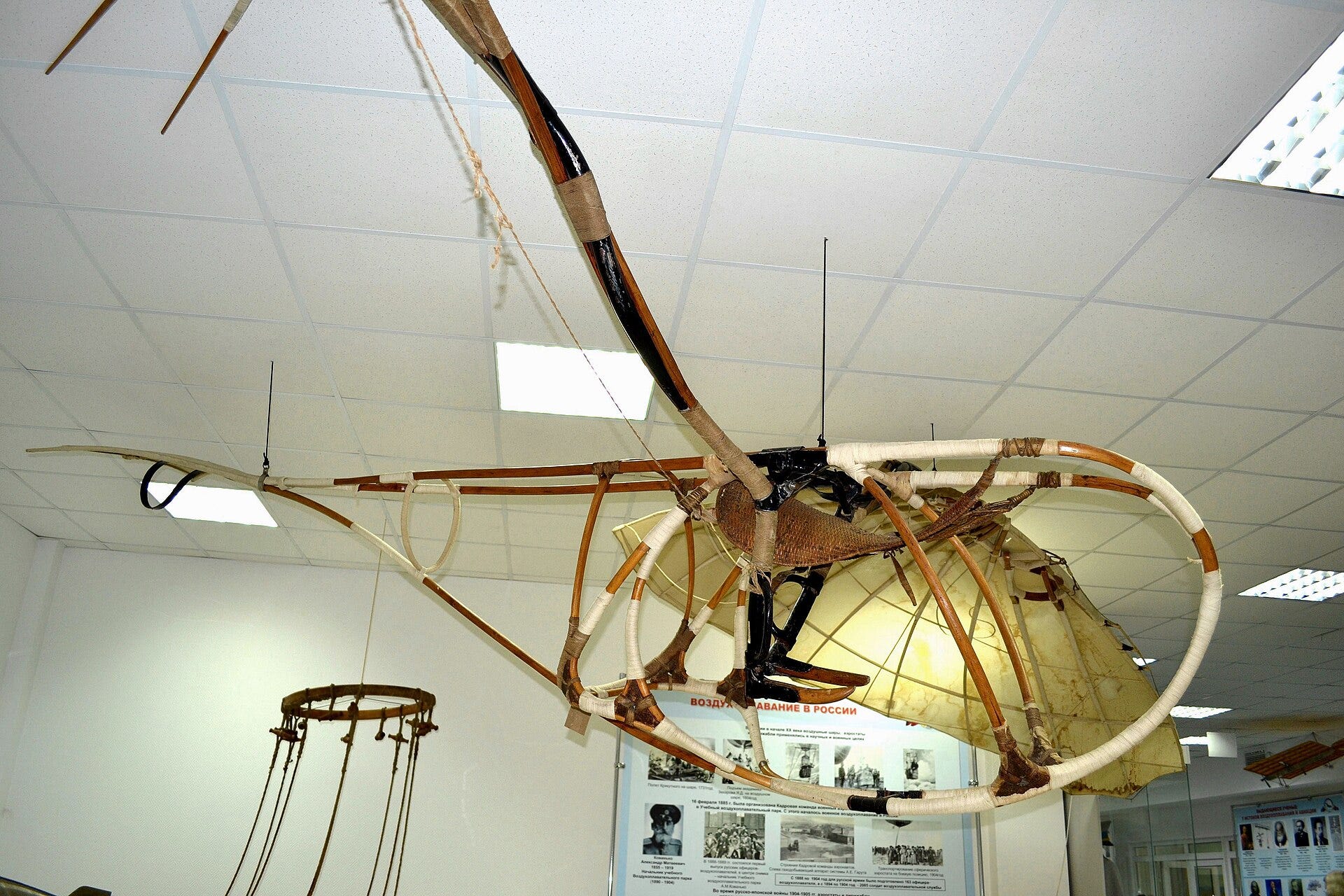
Like the bones of a bird, the ribs of these wings are strips of wood bent into curves, and between them sits a small open body made for one man. Vladimir Tatlin built three of these flying machines, and this is the one that remains, a bare frame with no covering.
All three had wings almost ten meters across. On the other two, the wings were covered with parachute silk and held taut by steel cables, leather and whalebone. Both of those machines are lost.
Tatlin worked on them from 1929 to 1932, in his workshop inside the Novodevichy Convent in Moscow. He named them Letatlin, a mix of his own name and the Russian verb letat', to fly. He called the machine an "air bicycle," an everyday object that anyone might use, and he also said it should be looked at as a work of art.
In 1932 all three went on show at the Pushkin Museum in Moscow. That same year, Tatlin took one of them out of the convent to a field, to try it at last. The test was called off, because the machine had been damaged on the way there. Tatlin never managed to get Letatlin off the ground.
At a Glance
Artist: Vladimir Tatlin (1885 to 1953)
Made: 1929 to 1932
Medium: Bent wood, left without its covering
Size: Wingspan of almost 10 m (about 33 ft)
Where to see it: Central Air Force Museum, Monino, near Moscow
10. Karl Ioganson, Spatial Constructions (1921)
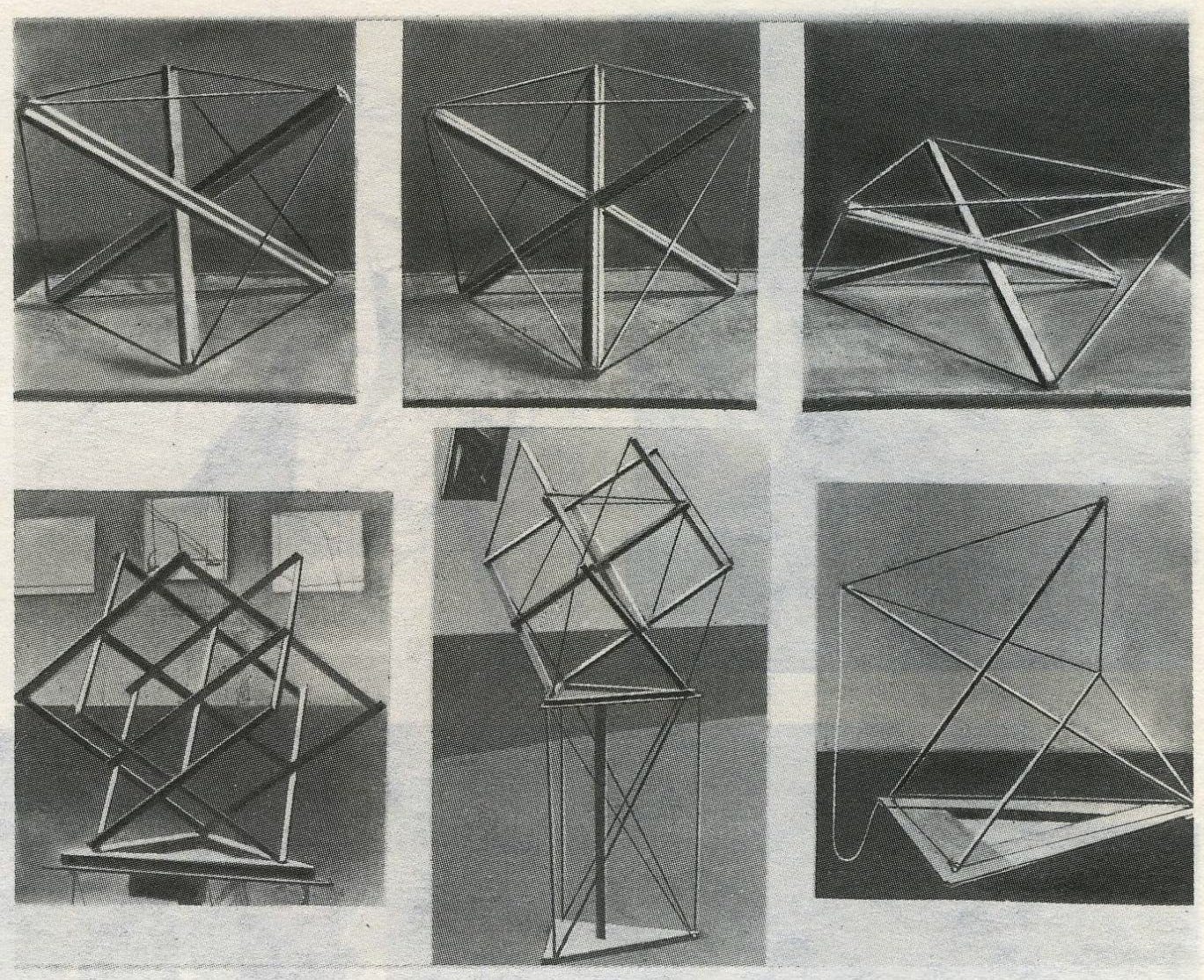
A photograph taken in Moscow in 1921 shows an exhibition room crowded with thin structures of rods and wire, set on low stands. At the far end rises one taller than the rest, made of three metal rods and a few taut cables. The three rods do not touch one another anywhere, and yet the structure stands.