Creepy Paintings: 12 of Art History's Scariest
The scariest paintings in art history include Bosch's hell, Bruegel's army of skeletons, Fuseli's Nightmare, Goya's swarming monsters and Munch's Scream.
Each one still unsettles, and the tales behind them, from morgue studies to a cursed island, are stranger than the pictures.
Fear has always been good for art. A demon, a skull or a burning city gives a painter permission to go big, and viewers have lined up to be scared since long before horror films.
Some of these were meant to warn, some to shock, and a couple came straight out of the artist's own bad dreams. I have ordered them roughly by date, so you can watch the nightmares change.
What makes a painting scary:
The wrong body. A face where it should not be, a skeleton acting alive, a beast half human.
The real behind it. Plague, madness, the morgue. The best horror borrows from life.
The dark. What the artist hides is scarier than what is lit.
The calm. A quiet, still scene can chill harder than a screaming one.
Where the real detail lives
Three that take a single painting apart, properly:
The secret behind Hopper Soir Bleu, the clown picture that went wrong
Ten women artists you need to know, the names the textbooks skipped
Was Monet really the first Impressionist, the painting that may have got there first
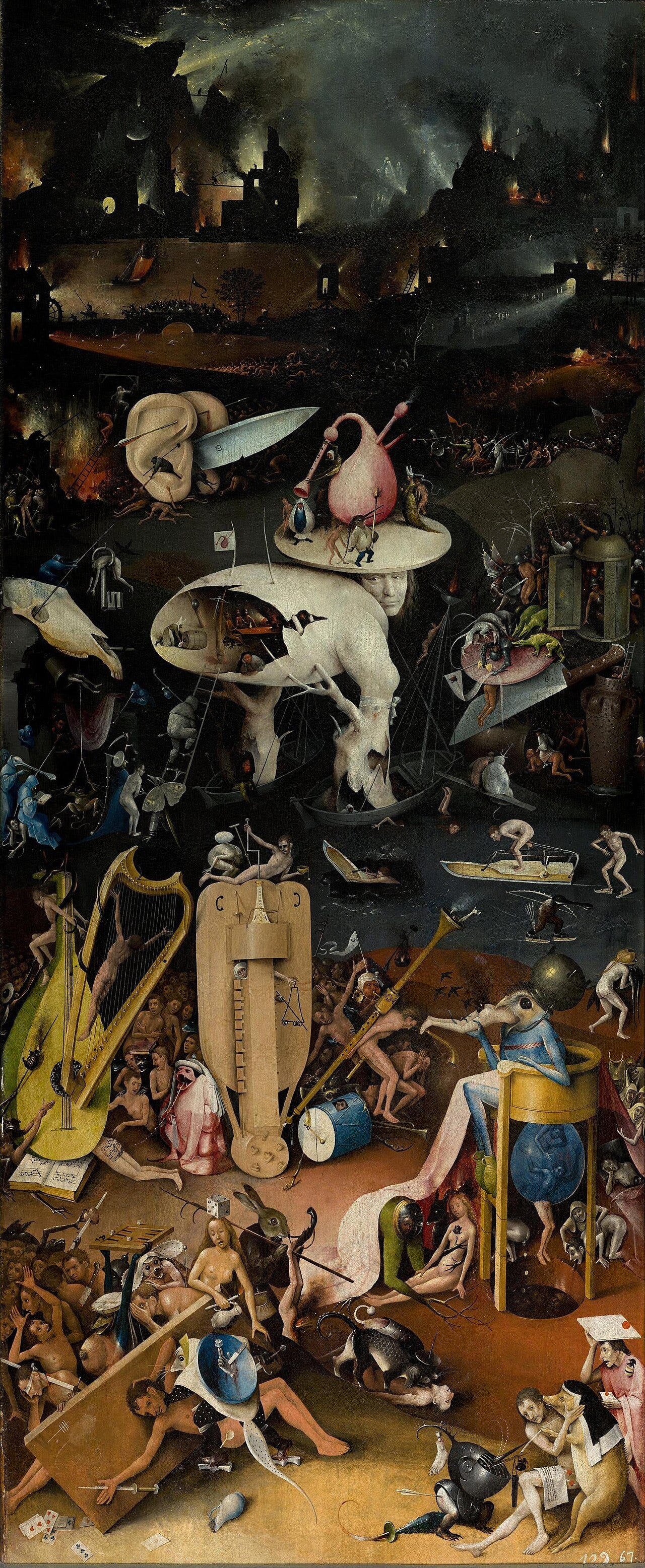
1. Hieronymus Bosch, Hell (about 1500)
Nobody has painted damnation like Bosch. The right wing of his Garden of Earthly Delights is a night world where a city burns, a giant pair of ears rolls forward on a knife, and a birdheaded demon swallows sinners whole and lets them drop through a hole below.
The details reward staring. A man is crucified on a harp, and one sinner has a full tune scrawled across his backside, which a student later transcribed and recorded as a viral tune.
Bosch loved this kind of hidden joke, and I chase more of them in the secrets hidden in famous paintings.
The great blank face at the center, staring out of a broken eggshell body, may be Bosch himself. Five hundred years on, no one has fully decoded it.
2. Pieter Bruegel the Elder, The Triumph of Death (about 1562)
An army of skeletons sweeps across a scorched land, and there is no escape. They herd the living toward a giant coffin, ring a funeral bell, drag a cart of skulls, and drown a ship in the burning harbor behind.
Bruegel painted it soon after waves of plague had gutted Europe, and every rank dies the same. A king clutches his gold as a skeleton counts it, and two lovers sing in a corner, oblivious, while death tunes a matching instrument at their backs.
It is a whole world ending at once. The Prado cleaned it in 2018 and found details no one had seen in centuries.
3. Henry Fuseli, The Nightmare (1781)
A woman sleeps flung backward, and a squat imp sits on her chest while a blind eyed horse pushes its head through the curtains. Fuseli painted a bad dream literally, the Romantic horror that made his name.
The title carries a pun. The imp is the demon that presses on a sleeper, and the horse is the night mare itself. When it hung at the Royal Academy in 1782, crowds were both repelled and unable to look away.
It became his signature. Fuseli painted several versions and it has haunted psychology and film ever since, a print of it even hung in Freud's apartment.
4. Francisco Goya, The Sleep of Reason Produces Monsters (1799)
A man slumps asleep at his desk and the darkness behind him fills with owls and bats, wings beating toward his bent head. Goya made this as plate 43 of his print series the Caprichos.
The line scratched on the desk gives the warning. When reason sleeps, monsters come out, whether they are superstition, cruelty or plain stupidity. Goya meant it as a jab at the Spain of his day.
He nearly opened the whole series with it. The self portrait under siege is Goya telling you exactly how he saw his country.
5. William Blake, The Great Red Dragon (about 1805)
Blake turns his back on us and becomes the monster. His muscled dragon rears over a tiny woman below, wings spread like a bat, straight out of the Book of Revelation.
Blake made a set of these dragon watercolors around 1805, visionary and coiled with menace. He said he simply drew what he saw in his head, and he saw a great deal.
The image found a second life in horror. The novel and film Red Dragon built a serial killer around it, a man so obsessed he eats one of Blake's originals.
6. Theodore Gericault, Severed Heads (1818)
This one is scary because it is real. Gericault painted two severed heads on a cloth, pale and slack, with the plain attention of a still life of fruit.
He was preparing his huge Raft of the Medusa, and he wanted to get death exactly right. So he borrowed real heads and limbs from a hospital and a morgue and kept them in his studio until they rotted, sketching the whole time.
Visitors could not stand the smell. The study of severed heads now in Stockholm is a young painter teaching himself exactly what a corpse looks like.
7. William Adolphe Bouguereau, Dante and Virgil in Hell (1850)
The most polished painter of the 1800s made one true nightmare. Two damned souls wrestle in the eighth circle, and one sinks his teeth into the other's throat while a bat winged demon hovers over them, grinning.
Bouguereau took the scene from Dante, the moment the forger Gianni Schicchi bites the alchemist Capocchio. Dante and Virgil watch from the shadows, and so do the dead.
Critics did not know what to do with it. The man who built a career on smooth goddesses had painted raw animal violence, and then rarely went near horror again.
8. John Martin, The Great Day of His Wrath (1851 to 1853)
Martin painted the end of the world at full volume. Whole cliffs tear loose and topple onto a crowd as a red sky splits open, one of three vast canvases on the Last Judgment.
He came from a strange and unlucky family. One brother tried to burn down York Minster, and Martin himself was obsessed with catastrophe on a giant scale, mountains folding, cities swallowed.
Audiences paid to see it tour like a show. It is disaster as spectacle, terror you buy a ticket for.
9. Arnold Bocklin, Isle of the Dead (1880)
Here the horror goes quiet. A small boat carries a white shrouded figure and a coffin toward a rocky island of black cypress trees, and nothing moves.
Bocklin called it a picture to dream over and refused to explain it. He painted five versions, and the still, sealed island reads as death itself, patient and waiting.
It cast a long spell. Hitler owned a version outright, reproductions hung in the studies of Freud and Lenin, and Rachmaninoff turned it into a piece of music that sways like the oars.
10. Odilon Redon, The Smiling Spider (1881)
A spider with a human face and a wide, crooked grin crawls out of the dark on ten hairy legs. Redon drew it in charcoal, part of the shadowy world of dream creatures he called his blacks, close to the Symbolist edge of nightmare.
There is a weeping version too, and it is hard to say which is worse. Redon gives them just enough humanity to make your skin crawl.
He worked in charcoal and black lithography for years before he let color in. The blacks are where his strangest fears live.
11. James Ensor, Skeletons Fighting over a Hanged Man (1891)
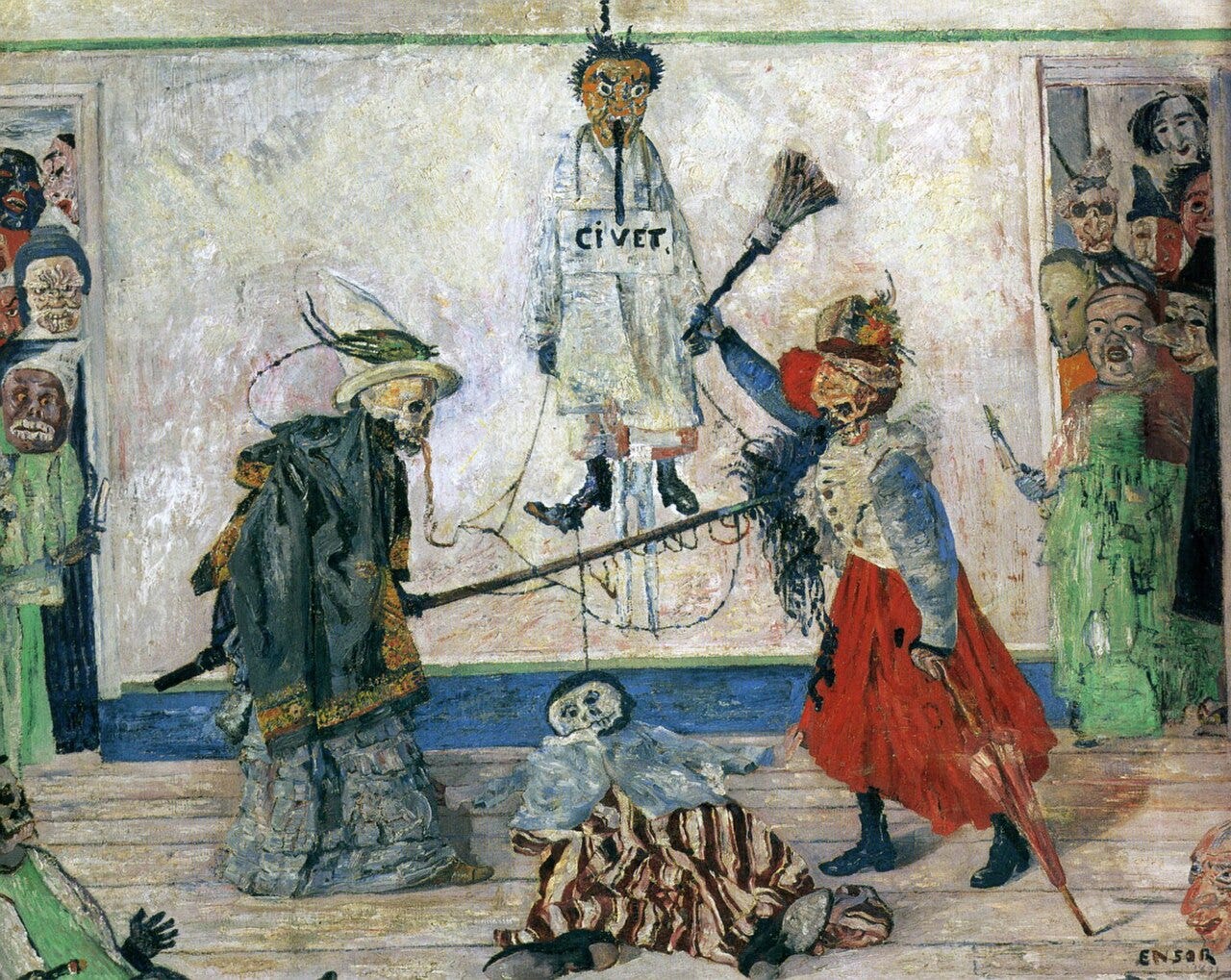
Two skeletons in wigs and gowns hack at each other with a broom and an umbrella, while a hanged body dangles above them with the word civet, a stew, pinned to its chest. A crowd of carnival masks watches from the doors.
Ensor grew up over his family's shop in Ostend, which sold carnival masks and curiosities, and those grinning faces crawled into everything he painted. He turned the whole human comedy into a masked farce.
It is funny until it is not. The joke is that we are all squabbling skeletons under the costume.
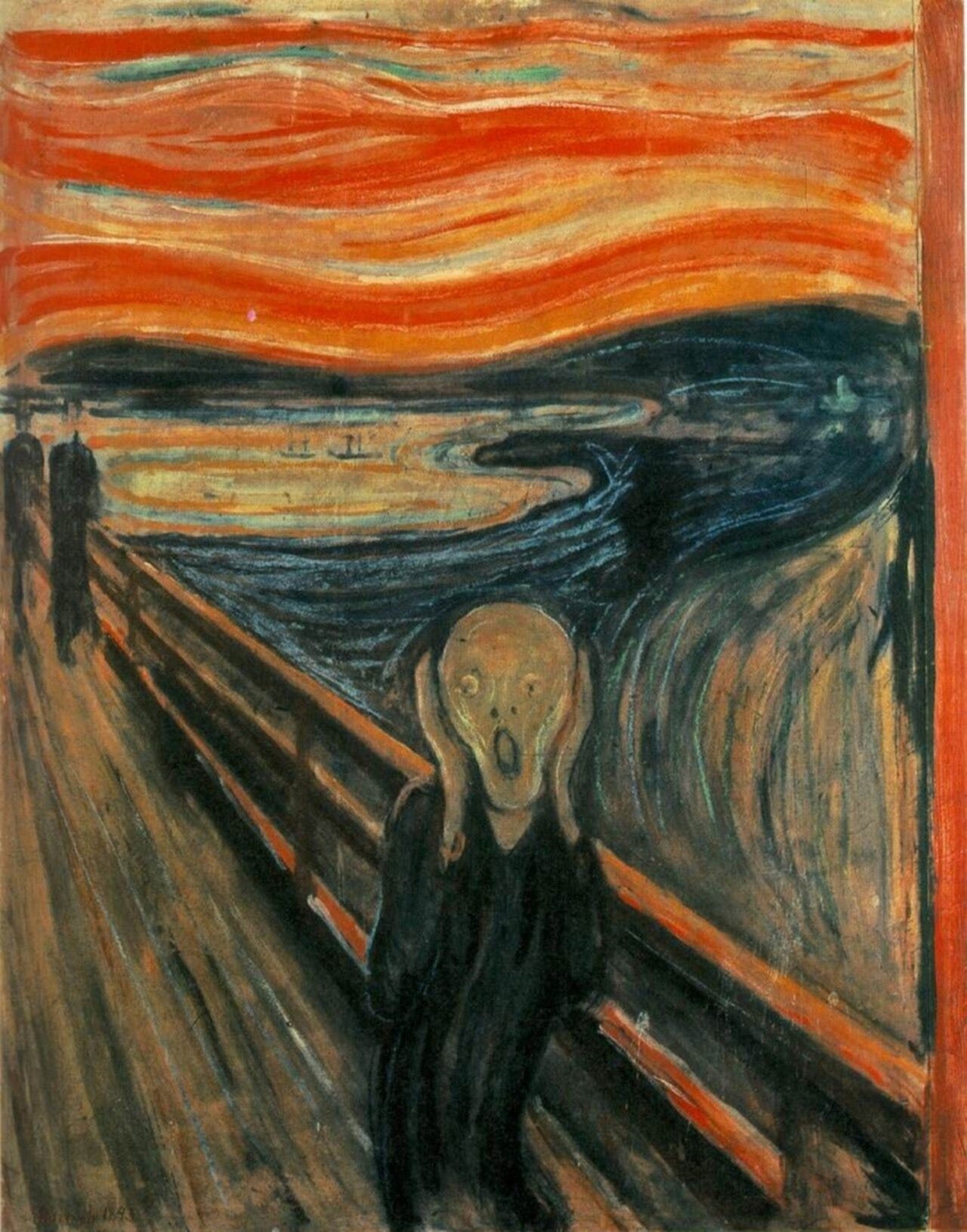
12. Edvard Munch, The Scream (1893)
The most famous fear in art is not screaming. The figure on the bridge has its hands to its ears, mouth open, because it hears a scream, one Munch said he felt tear through all of nature as the sky turned blood red.
That sky may be real. Some scientists tie its violent orange to the ash of the Krakatoa eruption, which lit skies across Europe for months in the 1880s. Munch made several versions in paint, pastel and print.
It has been a target ever since. Two of the versions were stolen in brazen thefts, in 1994 and 2004, and both were recovered, a saga I get into in the missing Caravaggio and the art mafia.
Where to go and be unsettled
Bosch, The Garden of Earthly Delights: the Prado, Madrid.
Bruegel, The Triumph of Death: the Prado, Madrid.
Fuseli, The Nightmare: the Detroit Institute of Arts.
Bocklin, Isle of the Dead: versions in Basel, Berlin, New York and Leipzig.
Munch, The Scream: the National Museum and the Munch Museum, Oslo.
More dark corners to wander into
If these gave you a good chill, keep going with these:
The secret behind Monet Magpie, one bird in the snow, and why it matters
Lady with an Ermine, detail by detail, why she is holding that animal
Titian, Sacred and Profane Love, which of the two women is which
Questions people ask about scary paintings
What is the scariest painting in art history? There is no single winner, but Bosch's Hell, Bruegel's Triumph of Death and Fuseli's The Nightmare top most lists for pure dread.
Why did old painters make such disturbing art? Often to warn. Hell scenes and skeleton armies were moral lessons about sin, plague and death aimed at a wide audience.
Is The Scream about horror? Not a murder or a ghost. Munch described a sudden wave of dread while walking at sunset, a panic attack more than a monster.
Which scary painting is based on a real corpse? Gericault's severed heads and limbs, painted from real body parts he kept in his studio while preparing The Raft of the Medusa.
Where can I see Bosch's hell? In The Garden of Earthly Delights at the Prado in Madrid, on the right wing of the triptych.
The fear that never dates
These paintings still work, which is the eerie part. Bruegel painted the plague and Gericault painted the morgue, yet a skeleton army and two pale heads on a cloth land just as hard today.
Bosch hid a song on a sinner's skin. Munch heard a scream in the sky and painted the sound. The subjects change with each century, plague, damnation, madness, the end of the world.
Gericault kept real severed heads on a shelf until they rotted, just to get the color of death exactly right.