
Crows and ravens in art carry bad news for six centuries: they circle Van Gogh’s last wheat field, they sit on Odin’s shoulders, and they turn up in Japanese screens as pure black shapes on gold. Here is the bird century by century.
Learn art the fun way
The medieval bird: an omen with a job
Illuminated manuscripts gave the raven a specific role. It is the bird Noah sends out first, and it does not come back, unlike the dove.
That single Bible detail made the raven a symbol of failure and delay for a thousand years of European art. The books themselves are a world: what is an illuminated manuscript.
Noah sends out a raven first and it never returns, which medieval commentators read as faithlessness. The dove that follows gets the olive branch and the good press, and the raven keeps the bad reputation for a thousand years.
Ravens also feed Elijah in the Book of Kings, so the same bird is both traitor and provider depending on the page. Illuminators kept the two meanings in separate manuscripts and never reconciled them.
The Northern Renaissance: crows over the gallows
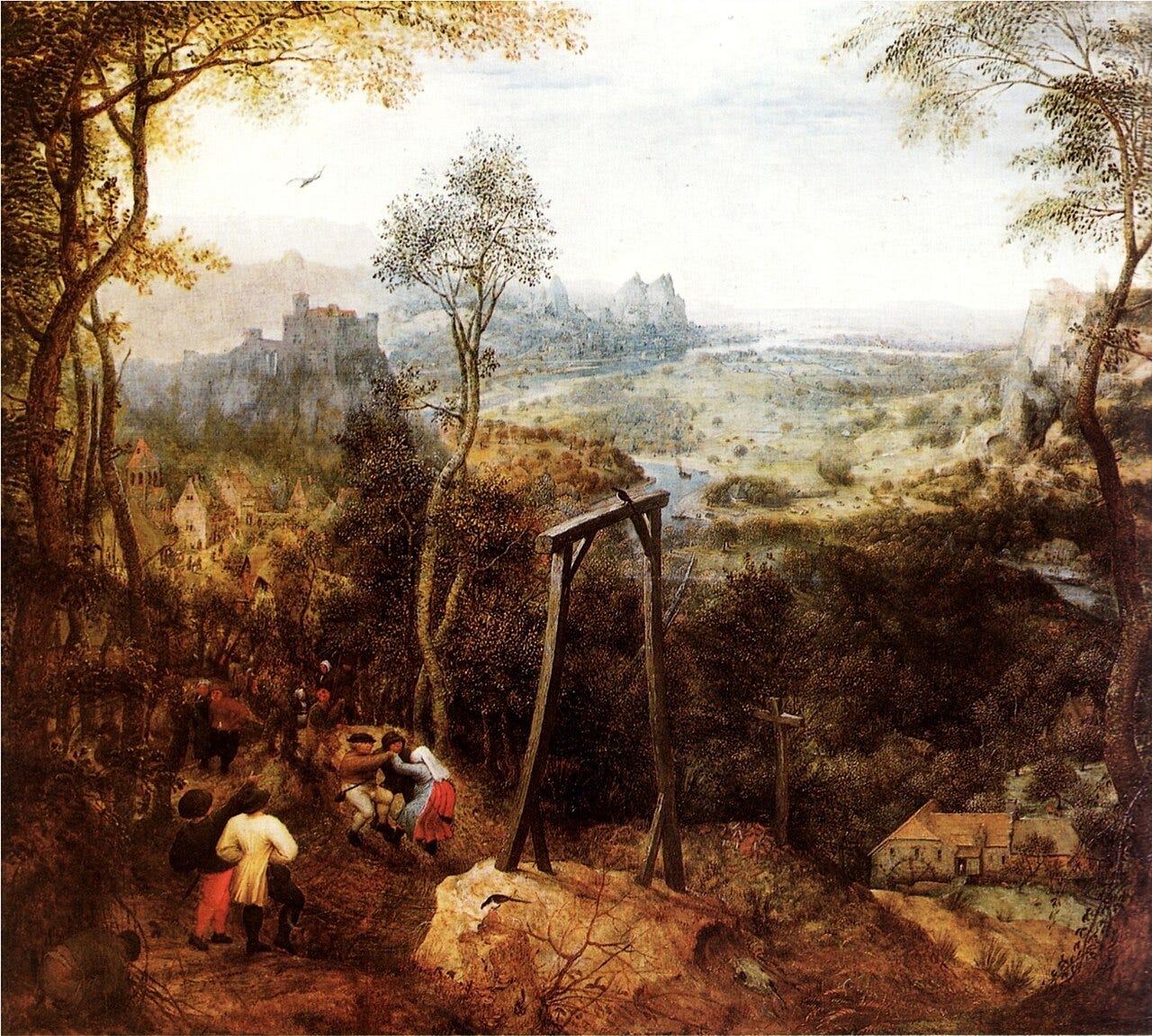
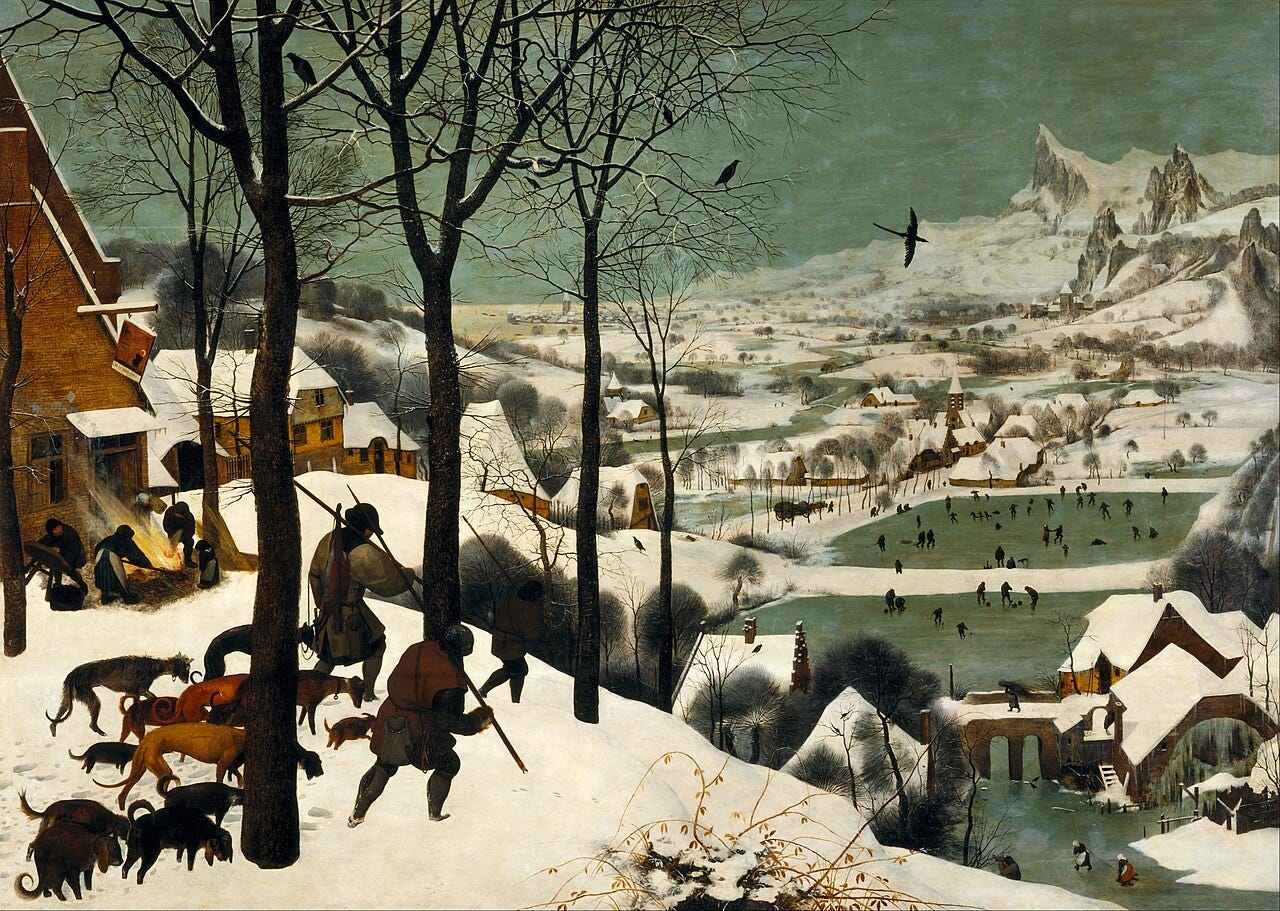
Bruegel put a magpie on a gallows in 1568 and crows in the fields of his winter scenes, small black marks that give the eye somewhere to land.
His birds are never decorative. They mark where the danger is. I go into his whole story in Pieter Bruegel the Elder.
Bruegel painted The Magpie on the Gallows in 1568 and left it to his wife. Birds on a gibbet were a common sight rather than a symbol: bodies were left hanging as a public warning, and the scavengers came.
Edo Japan: black on gold
Japanese screen painters treated crows as pure design: dozens of birds in flat black ink across a gold ground, wings overlapping into pattern.
The most famous pair of crow screens is anonymous and dates from the 17th century. Similar works sit in the Met’s Japanese collection.
Crows appear on gold ground screens in the Momoyama and early Edo periods, painted flat and black against leaf. Kawanabe Kyosai made the single crow on a bare branch into a set piece, and sold them for high prices in the 1880s.
Kyosai was arrested in 1870 for a caricature drawn at a party and beaten in custody. He kept working, and the crow pictures come from the decade after that, sold to foreign collectors in Yokohama.
The 19th century: Poe, Manet and a French print run
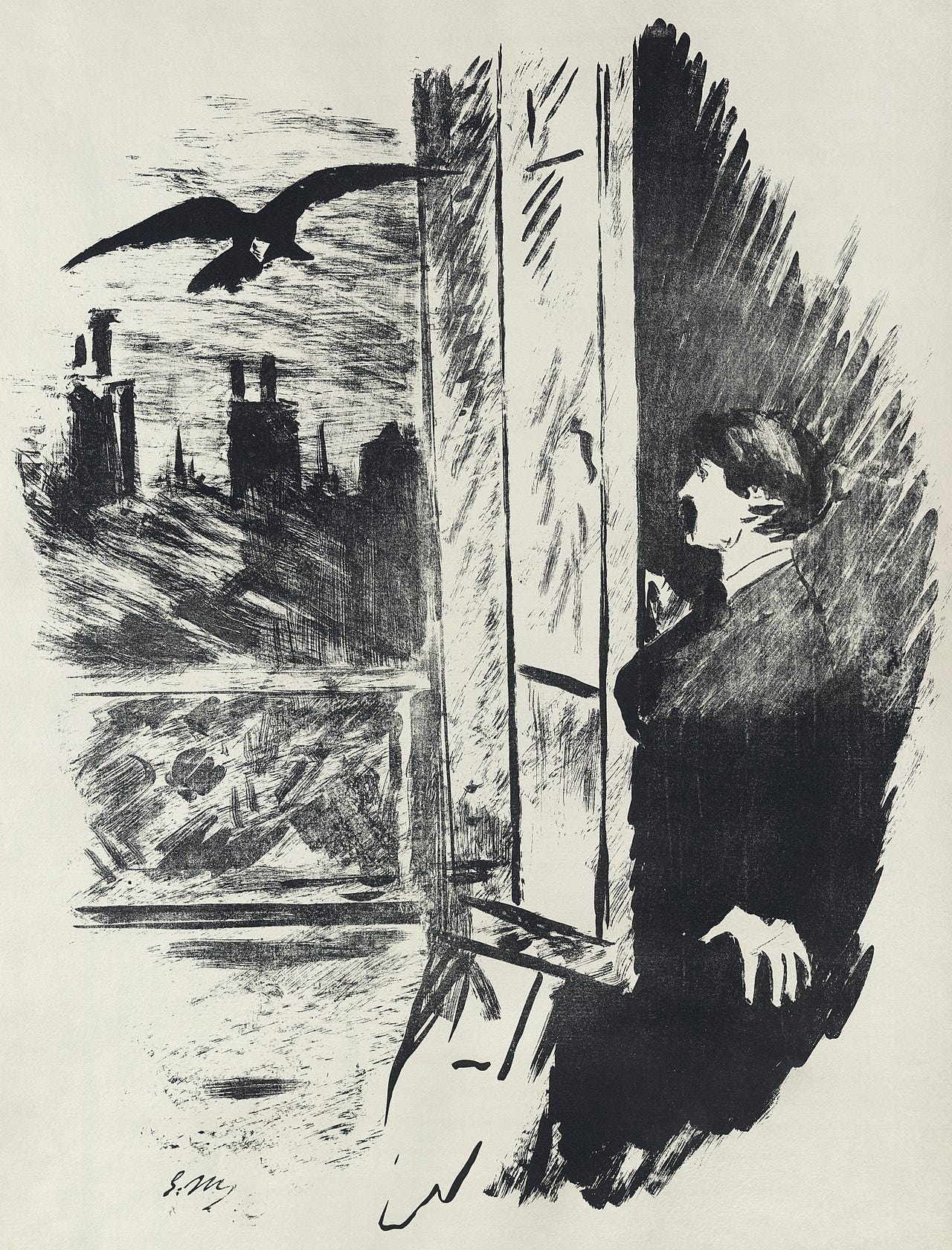
When Mallarme translated The Raven in 1875, Manet made the lithographs: a bird reduced to a silhouette, an open window, a shadow on the floor.
The edition barely sold. Today those prints are among the most requested items in print rooms. More on him in Edouard Manet.
Manet made lithographs for Mallarme’s French translation of The Raven in 1875. The edition sold badly and most copies were pulped, which is why surviving sets are rare and expensive.
July 1890: the most argued about crows in art
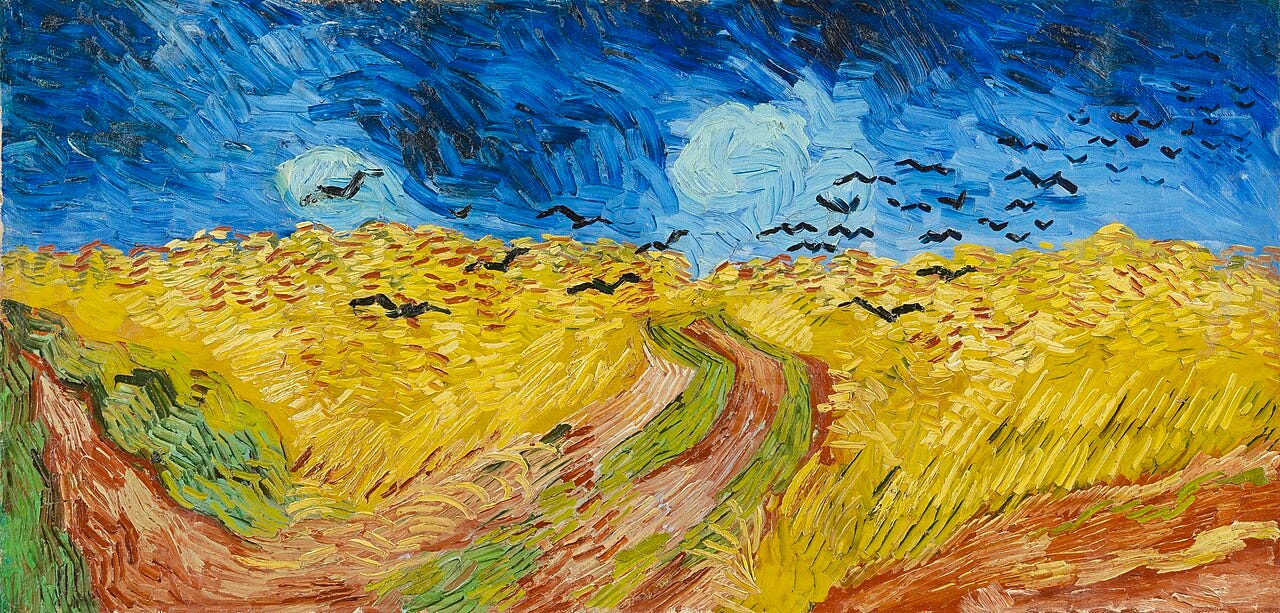
Van Gogh painted Wheatfield with Crows in the last weeks of his life, a double square canvas with a path that leads nowhere and a black flock rising.
It is often called his last painting. It was not: he painted at least a few canvases after it, and the myth persists because the picture looks like an ending. I retrace those weeks in The Last Day of Vincent van Gogh.
Wheatfield with Crows was painted in the last weeks of Van Gogh’s life at Auvers, and it is not his final canvas, whatever the films say. He wrote to Theo that he had tried to express sadness and extreme loneliness in it.
The Symbolists: the bird as a mood
Around 1900 the crow stopped being an omen and became an atmosphere. Redon drew ravens in charcoal darkness, and northern painters filled winter skies with them.
Odilon Redon called these works his noirs, and said they served the invisible. The rest of his life is in Odilon Redon.
Symbolism wanted suggestion rather than statement, so the crow becomes a mood: a black shape at the edge of a field, a sound you cannot see. Redon and Khnopff both use it that way.
The 20th century: Munch, Beksinski and the black shape
Munch used birds as punctuation in his anxiety landscapes, and later Polish painters like Beksinski turned them into anatomical shapes without names.
The crow survived the move to abstraction better than almost any other animal, because it was already a silhouette. Munch I go into it in Edvard Munch.
Munch put a black bird into several late landscapes, and Beksinski filled skies with shapes that read as birds without ever being drawn as one. The crow works because it needs almost no detail to be recognised.
What people ask about crows in painting
Was Wheatfield with Crows Van Gogh’s last painting? No. It is the most cited candidate, but he painted others after it. The legend survives because the image feels final.
Why are crows a bad omen in Western art? Partly the Noah story, where the raven fails to return, and partly the fact that crows follow battlefields and gallows.
Are crows negative in Japanese art? Not usually. They are treated as form and season, and in Shinto the three legged crow is a divine messenger.
Who illustrated Poe’s Raven? Manet made lithographs for Mallarme’s 1875 French translation, and Gustave Dore illustrated an English edition in 1883.
Where the black birds hang
Amsterdam for the Van Gogh, the Rijksmuseum for the Bruegel generation, and the Met for the Japanese screens and the Manet prints.
A last detail I like: the wheatfield canvas is a double square, twice as wide as it is tall. Van Gogh used that format for the pictures he considered his most serious statements, which is one reason people keep reading it as a farewell.