
For most of its history, a crucifixion was not painted for a museum. It was made for one place, an altar, a convent or a hospital chapel, and for the people who prayed there.
Floods and wars later tore several of these pictures from that place, and the journeys that followed are part of their story.
Cool Stories About Art is a newsletter to learn art the fun way.
Join 200,000+ readers and get:
10 new art stories / month
The entire archive of content (140+ articles)
Comment, ask questions, and chat with other readers
What the Cross Asked of Painters
The Gospels name the women who stood near Jesus as he died and the soldiers on guard around him. About what the scene looked like, they say almost nothing.
That silence left each painter with decisions of his own. He had to settle on three nails or four, on a lone figure or a whole crowd. He also had to think about where the picture would hang.
Many crucifixions were made to be seen from far below, above an altar or on top of the screen, a high partition that divided the clergy from the congregation in large churches. From the 1280s to the 1950s, painters answered these questions in very different ways.
12. Cimabue, Crucifix of Santa Croce (before 1288)
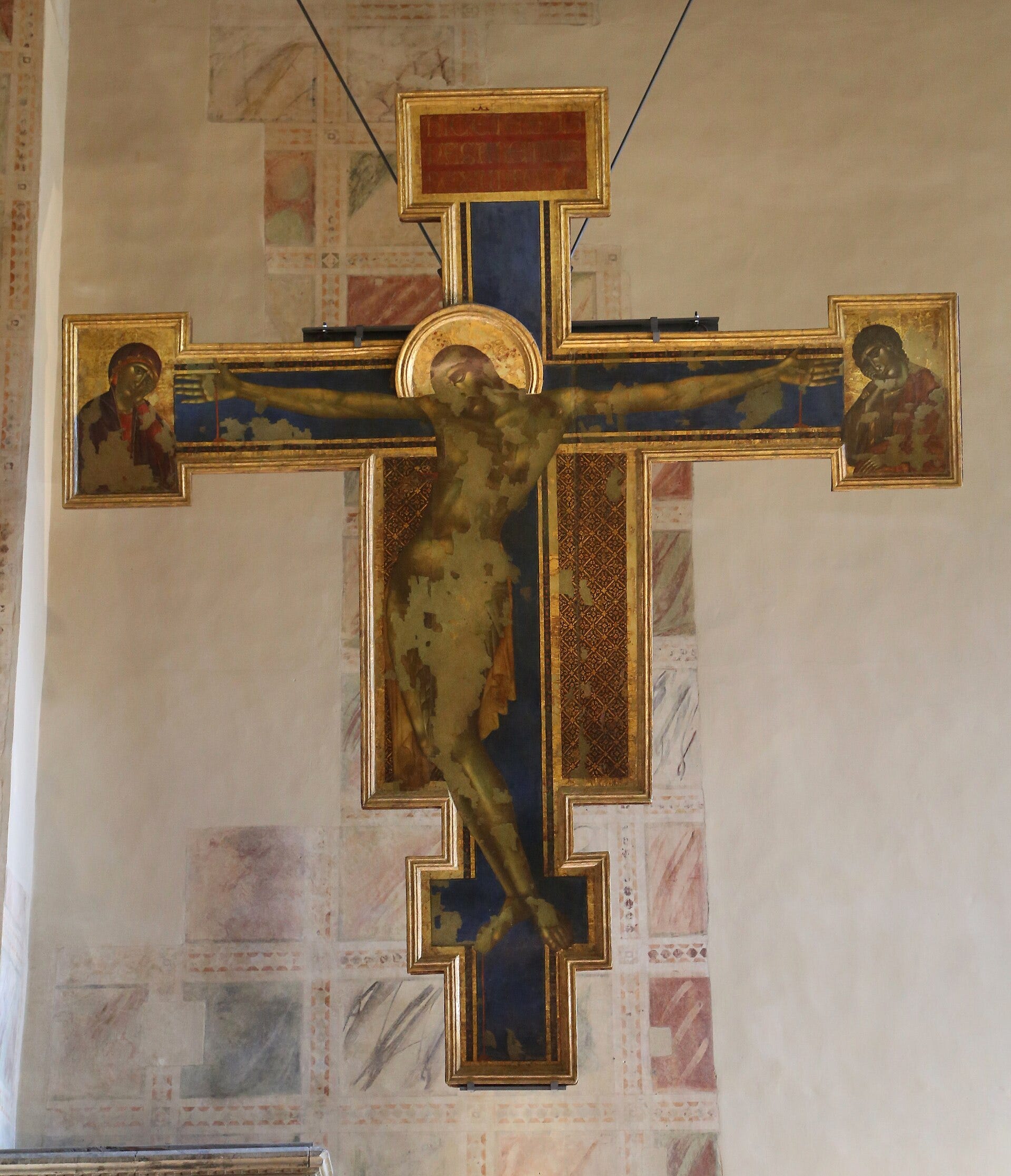
Large patches of bare wood show through Christ's body on the Crucifix of Santa Croce, in Florence. Time did not wear them away. They all date from a single day, November 4, 1966, when the Arno, the river that runs through the city, flooded Florence.
The crucifix is far older than that day. Cimabue painted it before 1288 for Santa Croce, the great Franciscan church of the city. It stands more than four meters high, and it was probably made to rise above the screen of the church, facing the congregation.
For the figure, Cimabue followed a model from Byzantine art, the Christian art of Constantinople. It was called the Christus patiens, the suffering Christ, and it showed the body bent to one side and the head bowed.
What Cimabue added was weight. He modeled the chest and belly with light and shade, so that the body seems to sag from the arms like a real body. The Byzantine images he started from were flatter.
By 1900 the crucifix no longer stood in the church. It had been moved into the museum set up in the old refectory of the convent, the hall where the friars once took their meals, and it was still hanging there when the river rose in 1966.
When volunteers reached the hall two days later, the water inside had risen to about 3.4 meters, or 11 feet. The crucifix came out coated in mud, and more than half of its painted surface was gone.
It was wheeled on a makeshift cart to the Limonaia, a lemon house in the Boboli Gardens turned into a first-aid room for paintings on wood. From there it went to the state conservation workshop of Florence, the Opificio delle Pietre Dure.
Stripped of half its paint, it soon became the symbol of the flood all over the world. It came back to Santa Croce in 1976, after exhibitions in Europe and America, with its gaps left visible.
In 2013 it was hung in the sacristy, the room beside the choir where the priests prepare for Mass. It now hangs higher than before, out of reach of the river.
At a Glance
Artist: Cimabue (Cenni di Pepo, about 1240 to after 1302)
Painted: Before 1288
Medium: Tempera and gold on wood
Size: 433 × 390 cm (170 1/2 × 153 1/2 in)
Where to see it: Basilica of Santa Croce, sacristy, Florence, Italy
About This Painting
What does Santa Croce mean?
Santa Croce is Italian for "Holy Cross." The church's full name is the Basilica di Santa Croce, the Basilica of the Holy Cross.
What is Cimabue famous for?
Cimabue was a painter and mosaicist, and he is known as the last great Italian artist in the Byzantine style, the manner that had dominated early medieval painting in Italy. His surviving works include New Testament frescoes in the upper basilica of Saint Francis at Assisi.
11. Jan Styka, The Crucifixion (1896)
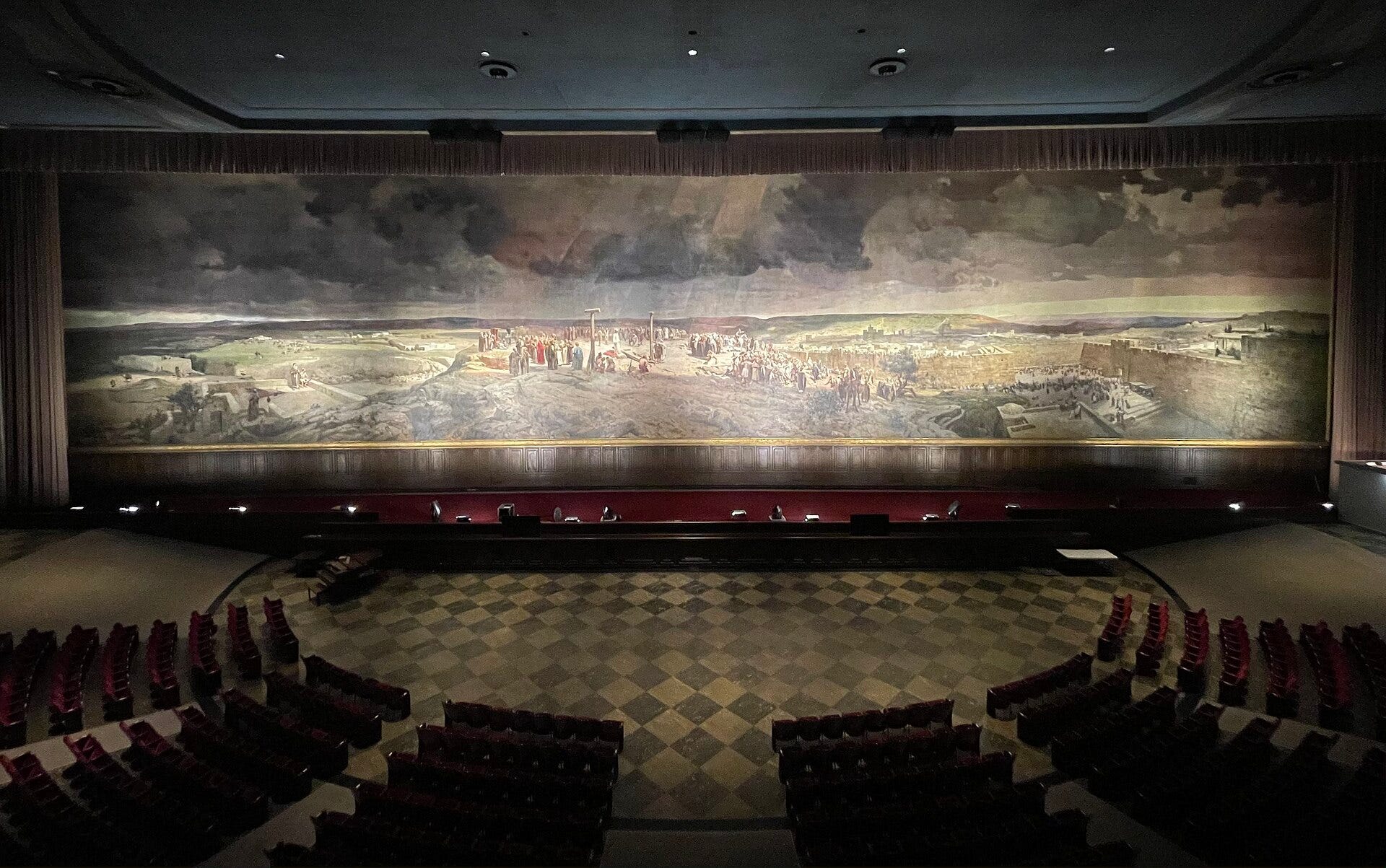
On a rocky hill outside Jerusalem, Christ stands before the cross on which he is about to die, and a crowd covers the slopes around him. Jan Styka, a Polish painter, finished this Crucifixion in 1896 as a panorama, one of the giant canvases of the time made to fill a hall of their own.
This one measures some 195 feet wide and 45 feet high, the height of a four-story building. In 1904 Styka brought it to the World's Fair in St. Louis, where it turned out to be too large to be shown. Unable to pay the customs duties to ship it home, he sailed back to Poland without it.