
For a few cents in the 1850s, an American family could buy a hand-colored picture of a sleigh on a snowy road, a farm under drifts or a crowd skating on a pond, made by a New York firm called Currier and Ives. A century later, those same winters were back on Christmas stamps, wall calendars and dinner plates, and in a line of the song "Sleigh Ride."
Cool Stories About Art is a newsletter to learn art the fun way.
Join 200,000+ readers and get:
10 new art stories / month
The entire archive of content (140+ articles)
Comment, ask questions, and chat with other readers
What a Few Cents Bought
Nathaniel Currier opened his print business in New York in 1835, and James Merritt Ives became his partner in 1857. Neither man drew. They were publishers who advertised "cheap and popular prints," paid others to make the pictures and sold them for 5 cents to 3 dollars apiece.
By the time Ives died in 1895, the firm had sold more than a million prints on thousands of subjects, from horse races to railroads. Until the 1880s, most of them came off the press in black and were colored by hand before they reached the shop.
In the firm's winter prints, the season almost never hurts. Snow tidies a farm, a frozen pond becomes a playground, and even a train stuck in a drift gets dug out. Every scene chosen keeps that gentle winter, all published by the firm between 1853 and 1871, from a country road to a city pond.
12. Otto Knirsch, The Road, Winter (1853)
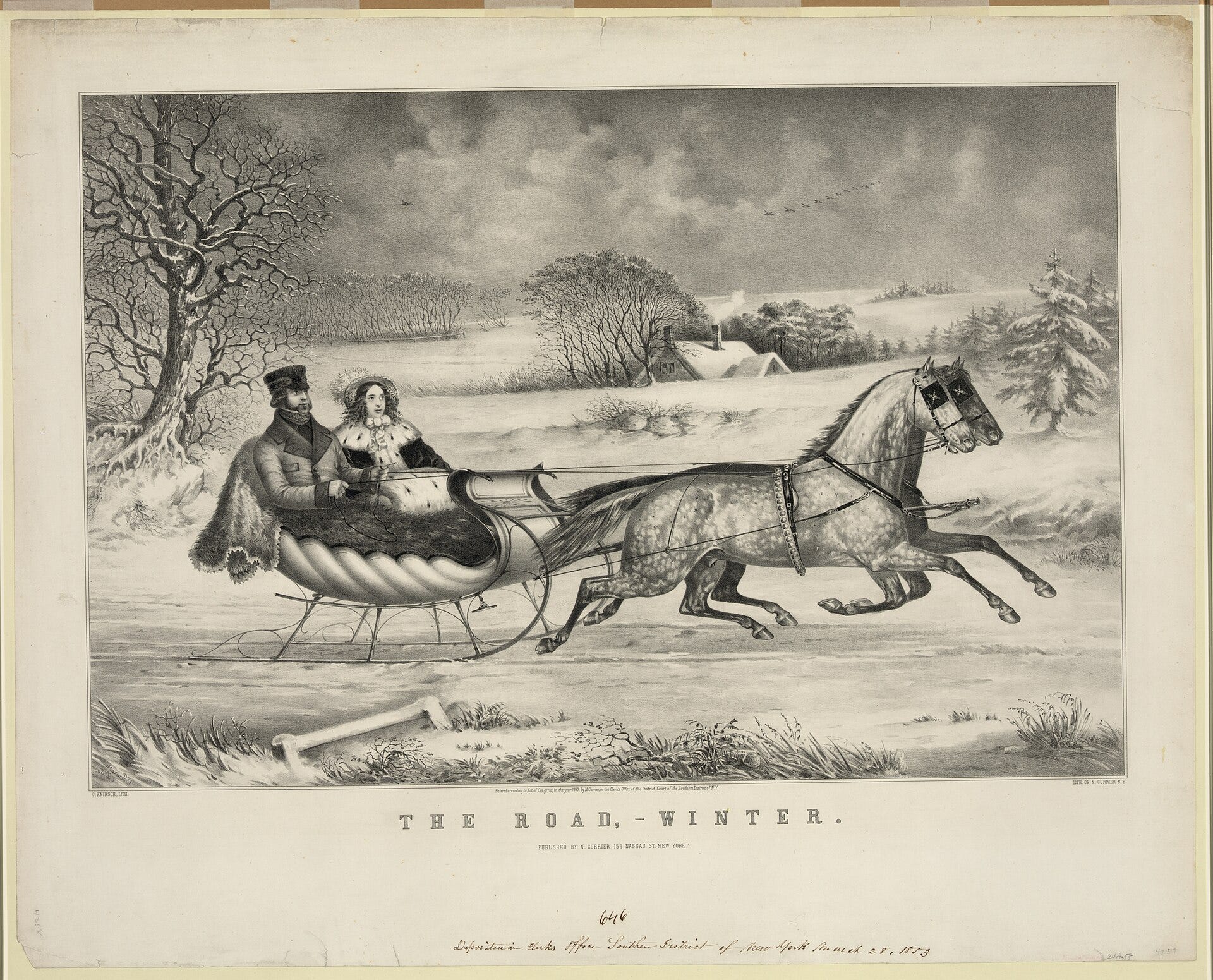
A red sleigh glides along a snowy country road behind two dark horses. The man at the reins wears a fur hat, and the woman beside him has an ermine-trimmed coat, a large muff and a plumed bonnet, with a fur rug drawn over both their knees. Behind them, smoke rises from a chimney among bare trees and pines heavy with snow.
The print is called The Road, Winter. Otto Knirsch, a lithographer born in Dresden, drew it on stone in 1853, early in his years in New York. It carries a single publisher's name, Nathaniel Currier's, because James Merritt Ives would not become his partner for another four years.
That publisher may also be the man holding the reins. According to a story told about the print, the couple is Nathaniel Currier and his second wife, Lura, and his employees gave him the picture as a Christmas present. He liked it well enough to have copies printed and put on sale.
From there the road kept finding new walls. In 1936, the Travelers insurance company of Hartford, Connecticut, printed a wall calendar of twelve Currier and Ives scenes, one for each month, and opened the year with this sleigh in January.
Its largest audience came in 1974, when the United States Postal Service chose it for the 10-cent Christmas stamp, the price of mailing a letter that year. A picture that may have begun as a gift from a publisher's staff traveled that December on Christmas cards all over the country.
At a Glance
Artist: Otto Knirsch (active 1853 to 1867), published by Nathaniel Currier
Made: 1853
Medium: Hand-colored lithograph with touches of white gouache
Size: 44.6 × 66.7 cm (17 9/16 × 26 1/4 in), image
Where to see it: Metropolitan Museum of Art, New York (not usually on view)
11. Frances Flora Bond Palmer, American Winter Scenes: Morning (1854)
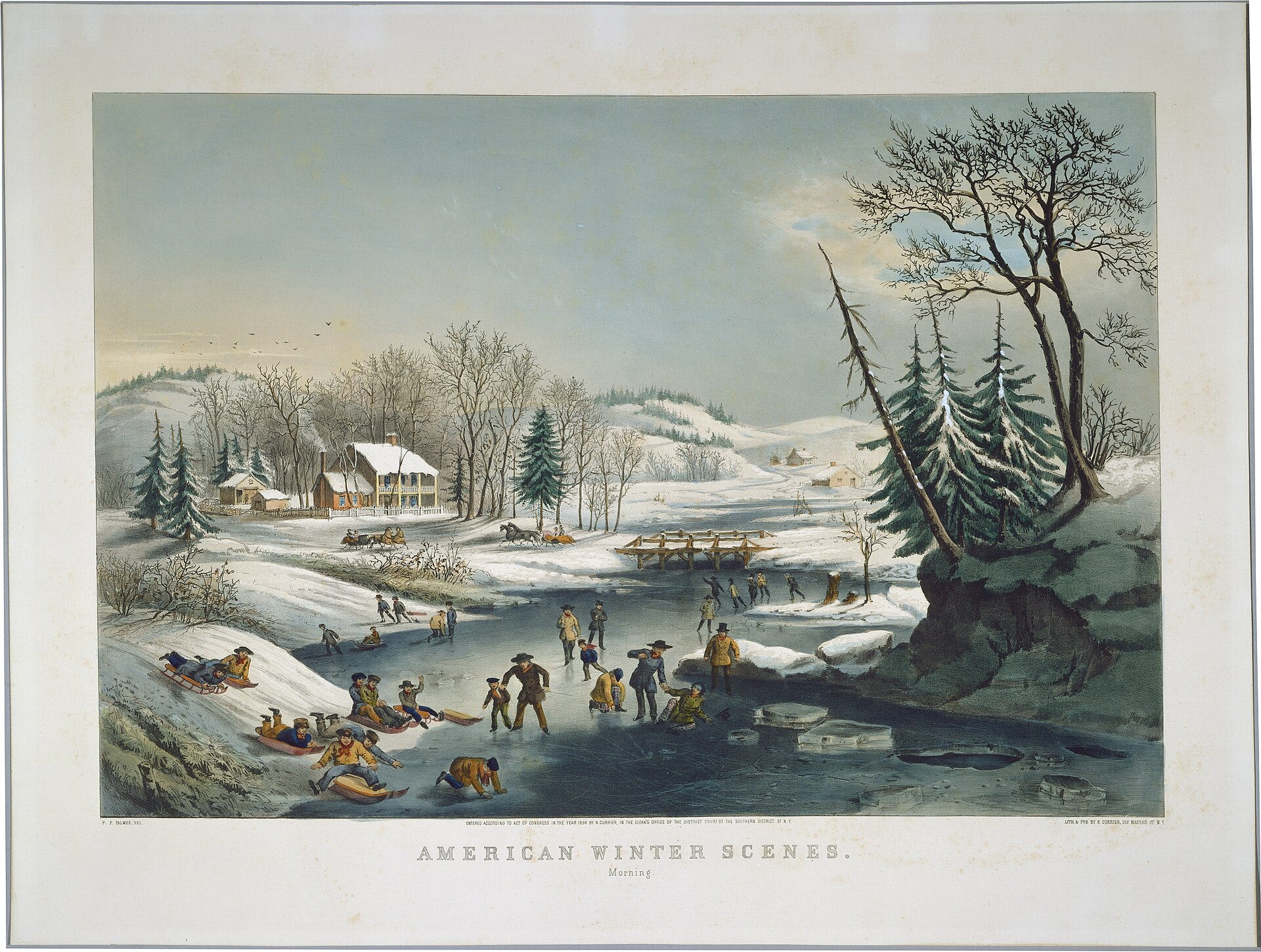
American Winter Scenes: Morning looks down, as if from a hillside, on a farm waking up in the snow. The woman who drew it had come to New York ten years earlier from Leicester, in England, with a husband, a family lithography business and lessons from one of London's leading lithographers. By the end of 1851 that business had closed, and she needed another way to live from her drawing.