
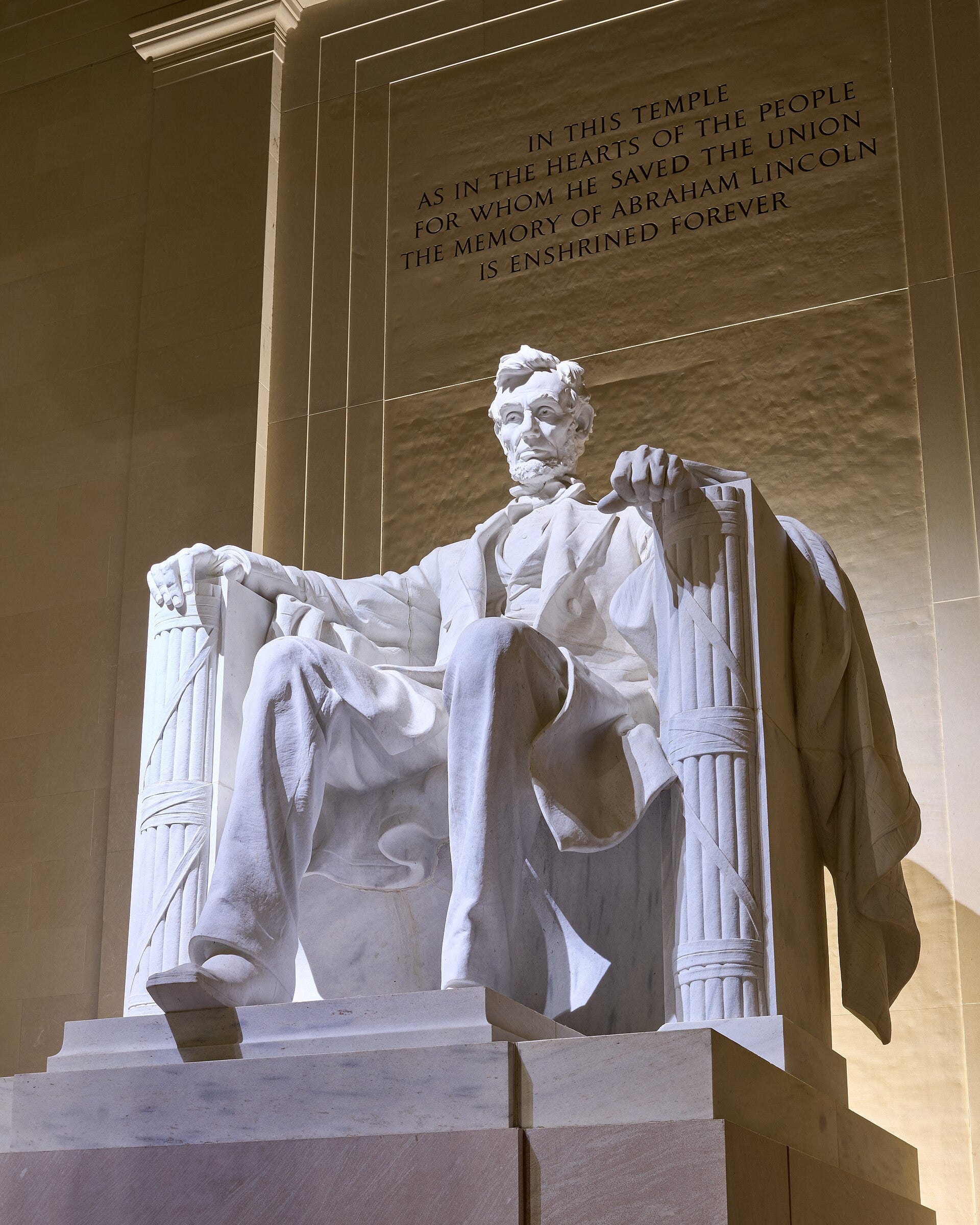
Daniel Chester French (1850 to 1931) was an American sculptor. He made the giant seated Abraham Lincoln of the Lincoln Memorial, in Washington, D.C., and The Minute Man, a bronze farmer with a musket, in Concord, Massachusetts.
Cool Stories About Art is a newsletter to learn art the fun way.
Join 200,000+ readers and get:
10 new art stories / month
The entire archive of content (140+ articles)
Comment, ask questions, and chat with other readers
At his summer studio in Massachusetts, Daniel Chester French took his statues outdoors before they were finished and judged them in daylight, the way passersby would see them. Yet his most famous statue, the seated Lincoln, was unveiled in 1922 with the light hitting Lincoln's face from below. The sculptor considered the result a disaster.
The sculptor of that Lincoln had started out half a century earlier, with a statue of a farmer. Daniel Chester French was born on April 20, 1850, in Exeter, a small town in New Hampshire.
In 1867, when Daniel was seventeen, his family moved to Concord, Massachusetts. The American Revolution, the war that won the thirteen colonies their independence from Britain, had begun there and in the neighboring town of Lexington.
On April 19, 1775, at the North Bridge over the Concord River, British soldiers met the local militia. The militiamen were ordinary men trained to fight when called, and most of them were farmers.
In Concord, Daniel's family lived near Ralph Waldo Emerson, a poet famous across the country, and near the Alcott family.
One of the Alcott daughters, Louisa May Alcott, would write Little Women, the novel of four sisters growing up in New England, the six states of the American northeast. Her younger sister, May Alcott, a painter, was the model for Amy, the youngest sister in the novel.
May Alcott taught art to the teenage Daniel and encouraged him to become a sculptor. In Boston, Daniel also studied anatomy, how muscles and bones lie under the skin, with the sculptor William Rimmer.
In November 1873, the town of Concord commissioned Daniel, then twenty-three, to make a statue honoring the fight at the North Bridge in time for its hundredth anniversary, in 1875.
The young sculptor chose a minute man, one of the Massachusetts militiamen who promised to be ready to fight at a minute's notice. He imagined a farmer who leaves his plow and steps forward with his musket.
Nearly fifty years after the farmer, the same sculptor stood inside the Lincoln Memorial, in front of his marble Lincoln of 175 tons. The light fell on the statue's shins more than on its face.
Why was the light on the Lincoln wrong, and would Daniel Chester French live to see it fixed?
In the rest of the story
What the bronze of The Minute Man was really made from.
What ran across the floor of the sculptor's studio.
How long Lincoln's face had to wait for the right light.
What the main speaker at the Lincoln Memorial's opening was asked to cut.