
Dante gave hell an address. His damned live on nine circles that drop like the floors of a building, each sin on its own level with its own punishment. No other picture of the afterlife came with such exact directions, and for six centuries artists followed them, on church walls in Florence and, by the 1950s, in pictures cut from American magazines.
Cool Stories About Art is a newsletter to learn art the fun way.
Join 200,000+ readers and get:
10 new art stories / month
The entire archive of content (140+ articles)
Comment, ask questions, and chat with other readers
What Dante's Map Asked of Artists
Bible scenes gave painters a single moment to show. Dante gave them a problem of another kind. His hell is a journey, so the poet and his guide, the Roman poet Virgil, come back in scene after scene. It is also a geography, with every sinner held at an exact depth, and a picture has to make clear where it stands.
That precision drew artists back to the poem again and again. Because the map of the poem never changed, each age could fill it with the people of its own day and still be recognized as Dante's. The damned could wear medieval robes or modern sportswear and keep their place in the circle.
Each work chosen here comes from Dante's text rather than from hell in general. An artist read the poem and drew on its places, its sinners or the poet himself. Many are not paintings, because the poem sent artists to drawing and sculpture as often as to the canvas.
12. Domenico di Michelino, Dante and the Divine Comedy (1465)
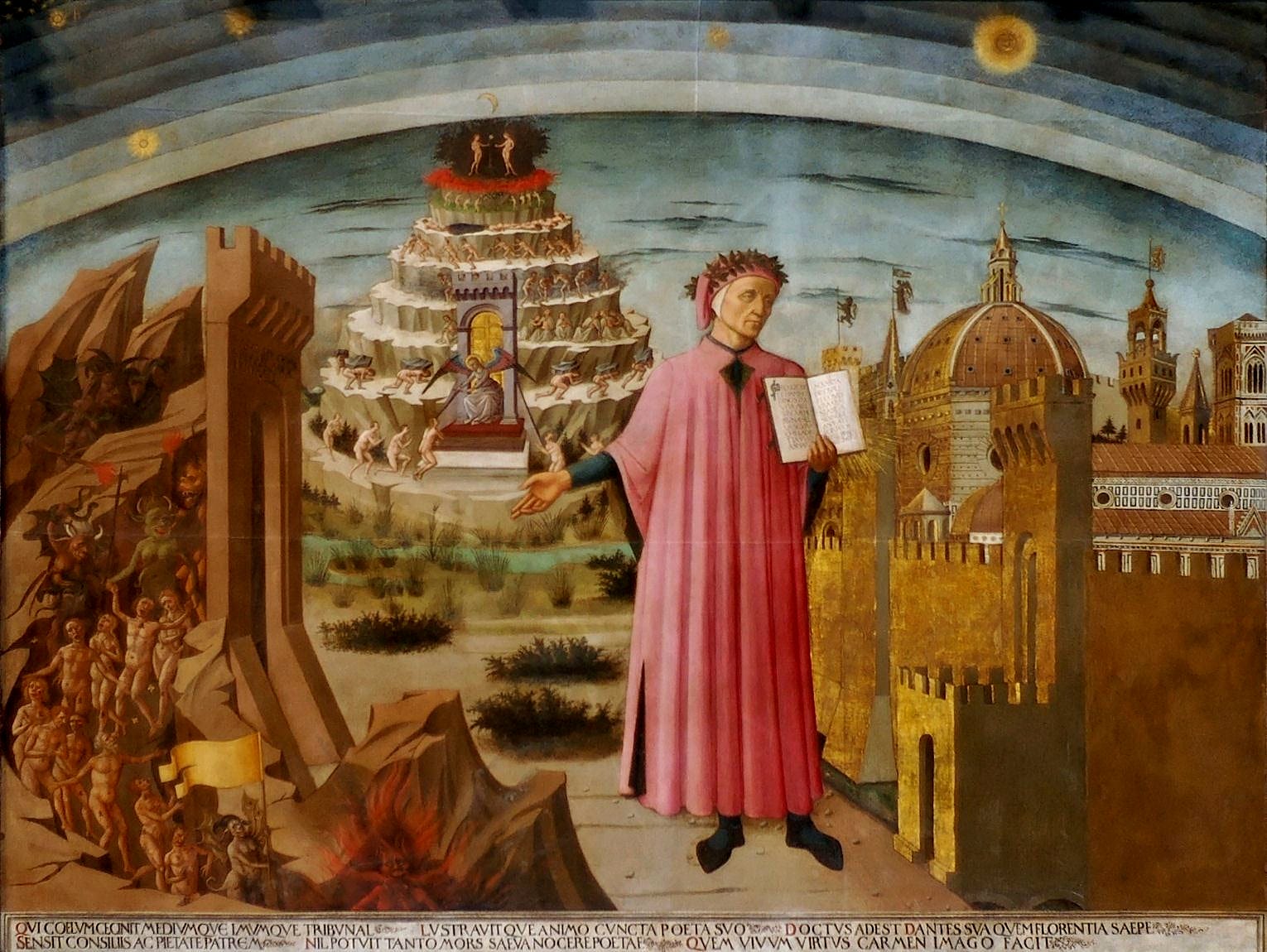
The poet in the red robe and laurel crown holds his book open in front of him. On his right stands Florence, with its cathedral dome and its bell tower. On his left, a gate opens onto hell, where the damned run behind a demon carrying a white banner. Behind him, the mountain of Purgatory climbs in terraces toward the earthly paradise at its summit.
That dome matters, because the picture still hangs inside the cathedral it shows. Dante had died in exile in Ravenna in 1321, banished by his own city. Florence then spent more than a century trying to get him back, and asked Ravenna for his remains in 1396, then again in 1429.
The body never came. So in 1465, for the two hundredth anniversary of the poet's birth, the cathedral officials ordered a portrait instead and gave the painter six months. Domenico di Michelino worked from a design attributed to Alesso Baldovinetti. The canvas went up in the north aisle, where the poem was regularly read aloud to the public.
The portrait did not end the search. In 1519, under Leo X, a pope from the Medici family of Florence, a Florentine delegation opened the tomb in Ravenna and found it empty. The Franciscan friars who looked after it had hidden the bones.
They stayed hidden until 1865, the six hundredth anniversary of Dante's birth, when two masons found a box dated 1677 inside a wall of the friars' convent. Even then, the remains stayed in Ravenna.
I find this the most honest of all the portraits of Dante: a city painting the man it could not bring home. Every year, Florence still sends the oil for the lamp that burns at his tomb.
At a Glance
Artist: Domenico di Michelino (1417 to 1491), after a design attributed to Alesso Baldovinetti
Painted: 1465
Medium: Tempera on canvas mounted on panel
Size: 232 × 290 cm (91 × 114 in)
Where to see it: Florence Cathedral (Santa Maria del Fiore), left aisle, Florence
11. Federico Zuccari, The Gate of Hell (1586 to 1588)
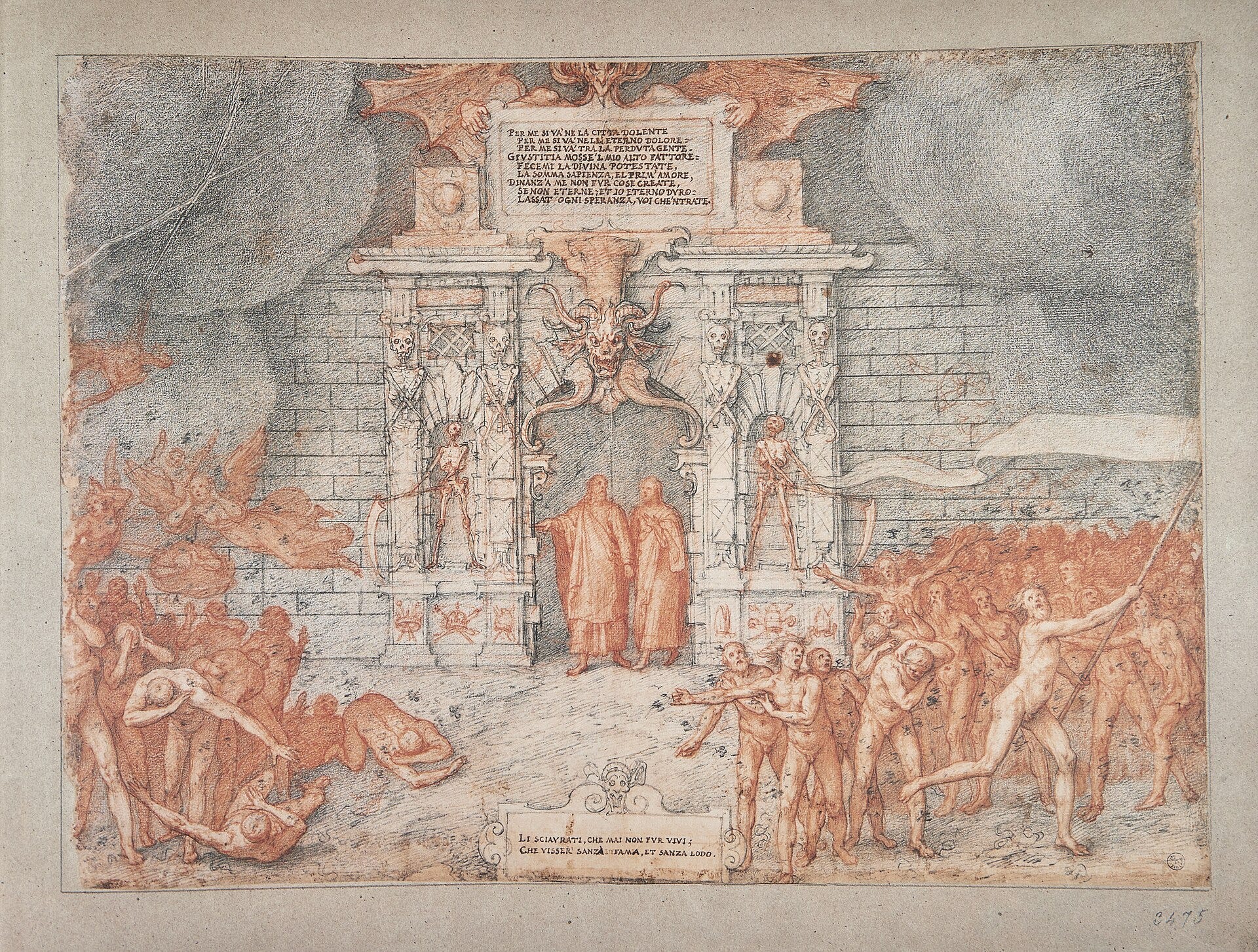
Two small figures stand before a gateway cut into the rock, with words carved above the opening and a crowd waiting beyond it. The man who drew them in red and black chalk was an Italian painter in the pay of King Philip II of Spain. He had been hired to decorate the Escorial, the king's palace and monastery outside Madrid. On the side, he was filling page after page with hell, pages almost nobody would see for nearly three centuries.