
Romanticism usually brings to mind storms, mountaintops and lone wanderers gazing at the horizon. The movement also had a night side, peopled with demons, ruins, shipwrecks and the dead.
Some painters went looking for that darkness close to home, in a studio stocked with borrowed corpses, or in front of a canvas they would never manage to finish.
Cool Stories About Art is a newsletter to learn art the fun way.
Join 200,000+ readers and get:
10 new art stories / month
The entire archive of content (140+ articles)
Comment, ask questions, and chat with other readers
A Mood Born in an Age of Revolutions
Dark Romanticism never had a manifesto or a fixed style. It was a mood more than a school, and it took hold of painters from the late 1700s, in an age of revolutions and wars.
Until then, the thinkers of the Enlightenment had trusted reason to explain and improve the world. As the guillotine and the battlefields filled up, that faith began to look fragile, and painters turned to nightmares, the macabre and the irrational.
German has a name for this current, Schwarze Romantik, black Romanticism. It was the title of a large exhibition in Frankfurt in 2012, and a year later an exhibition in Paris took its own title from a tale by the American writer Edgar Allan Poe, The Angel of the Odd.
Dark Romanticism ran from 1781 to 1857, as long as Romanticism itself, and it lived in prints, watercolors and ink drawings as much as on canvas.
The Symbolists at the end of the nineteenth century and the Surrealists in the twentieth, painters of dreams and the unconscious, revived this dark vein much later.
12. Antoine Wiertz, Two Young Girls, or The Beautiful Rosine (1847)
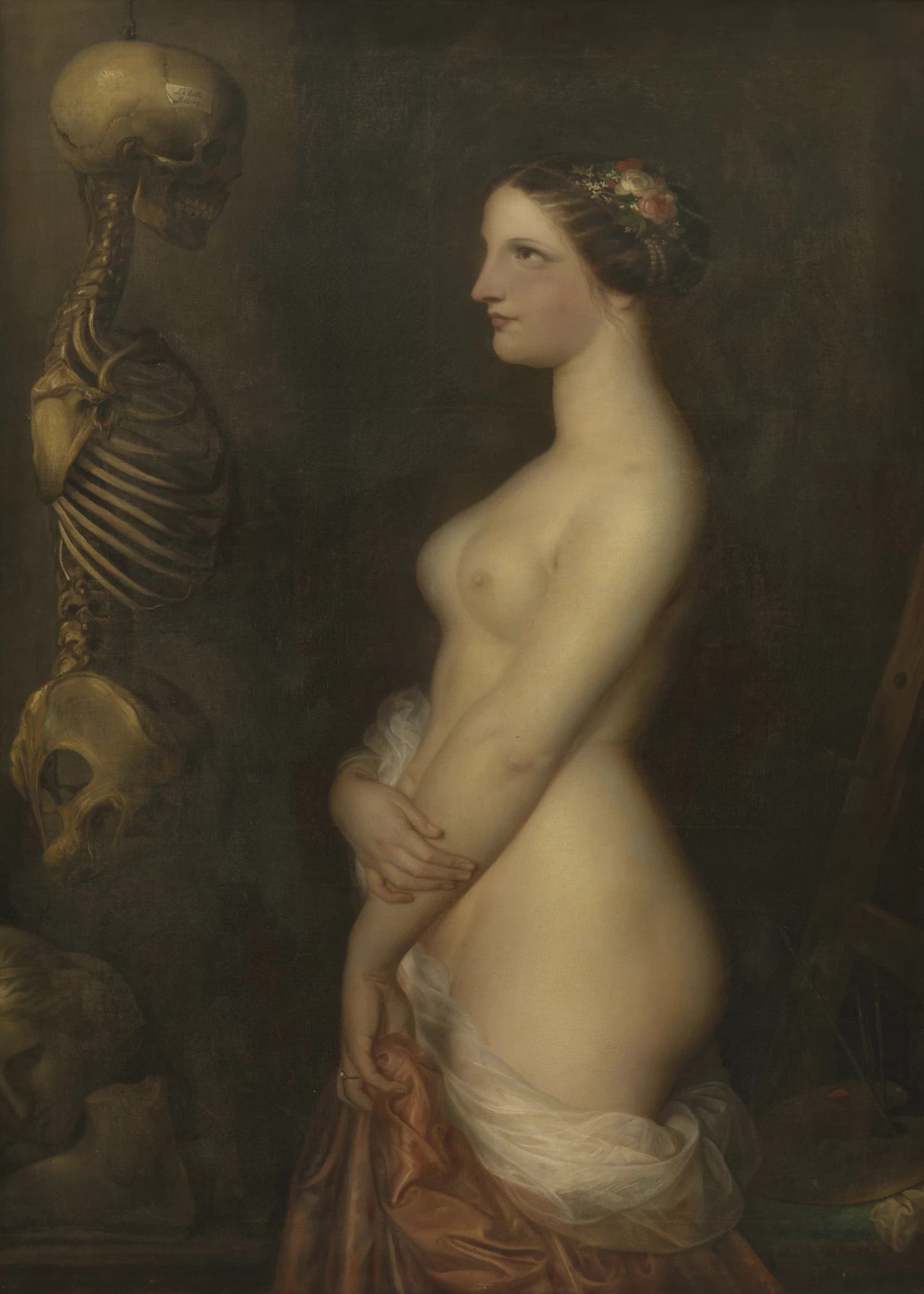
A small paper label hangs from the skull in Antoine Wiertz's Two Young Girls. It reads La Belle Rosine, the beautiful Rosine, and the name goes with the skeleton, not with the young woman with roses in her hair who stands facing it.
The Belgian painter Antoine Wiertz made the picture in Brussels in 1847. One girl is alive, the other dead long enough to lose her flesh, yet he poses them side by side like two models, with an easel and a palette waiting in the shadows.
Who Rosine was, nobody knows. But the label tells the viewer that the skeleton was once a young woman with a name, like the one facing her. That is how the title can count two young girls in the picture, and why they may be one girl, before and after.
Confrontations of this kind were Wiertz's specialty, and the Belgian state soon gave him room for them. In 1850 it agreed to build him a vast studio at public expense, on one condition: at his death, everything inside would pass to the nation.
He filled that studio with death in every form. One of the pictures still there, The Premature Burial of 1854, shows a man forcing open his own coffin, which bears the label dead of cholera.
At a Glance
Artist: Antoine Wiertz (1806 to 1865)
Painted: 1847
Medium: Oil on canvas
Size: Not published
Where to see it: Musée Wiertz, Brussels (Royal Museums of Fine Arts of Belgium)
11. John Martin, The Destruction of Pompeii and Herculaneum (1822)
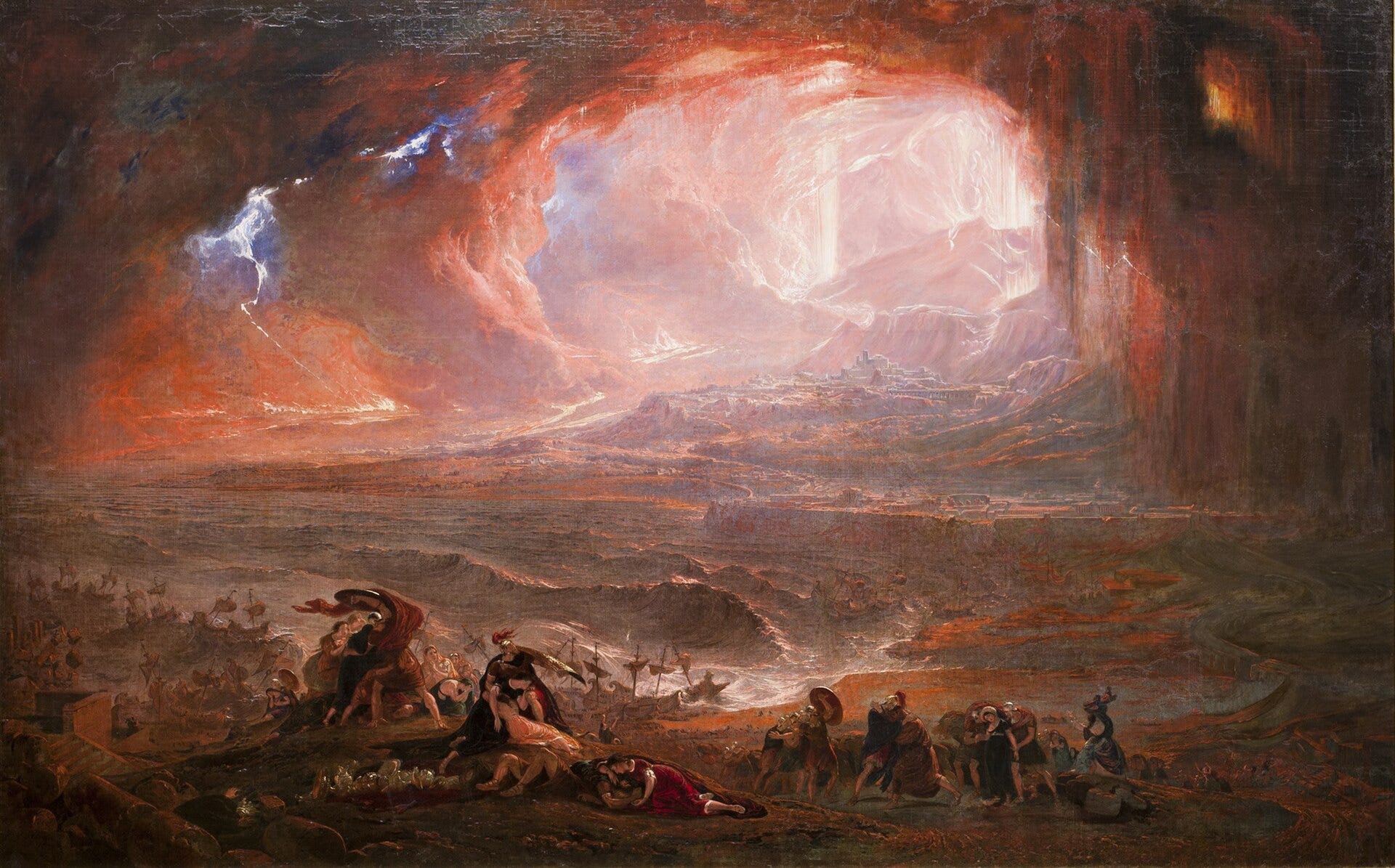
In John Martin's The Destruction of Pompeii and Herculaneum, the volcano at the center is not Martin's. Vesuvius erupting over the two Roman towns, at the heart of the canvas, was repainted long after his death.
John Martin showed the picture in London in 1822. In January 1928 the Thames burst its banks and flooded the basement of the Tate Gallery, where the canvas lay in storage, and the water tore away its center, volcano and all.
For the next eighty years, almost everyone believed the Thames had destroyed Martin's painting for good.