
Scripture tells the fight itself in a handful of lines: a shepherd boy, a sling, one stone, and a head cut off with the giant's own sword. Painters have spent six centuries on everything those lines leave out. They have argued over which instant to show, how a boy should look at what he has killed, and whose face the giant should wear.
Cool Stories About Art is a newsletter to learn art the fun way.
Join 200,000+ readers and get:
10 new art stories / month
The entire archive of content (1,000+ articles)
Comment, ask questions, and chat with other readers
One Stone, Twelve Instants
The story comes from chapter 17 of the First Book of Samuel. The Philistines send out their champion, and a young shepherd brings him down with a sling. The lesson is plain: the weak beat the strong when God stands with them.
Later readers bent that lesson to their own needs. Florence turned the boy into a civic emblem, and the Church made the fight a sign of faith defeating heresy.
For a painter, the trouble is time. The whole fight lasts one throw, so each artist has to choose a single instant and build the picture around it.
The instants on offer are many: the sling still turning, the boy kneeling on the giant, the sword at the neck, the head raised before two armies, a prayer of thanks, a long look at the head once it is over.
That choice is the rule of this page. A work earns its place by the instant it picks and by what the artist makes of it, and together the twelve cover the story from the stone to the last look.
12. Daniele da Volterra, David and Goliath (about 1555)
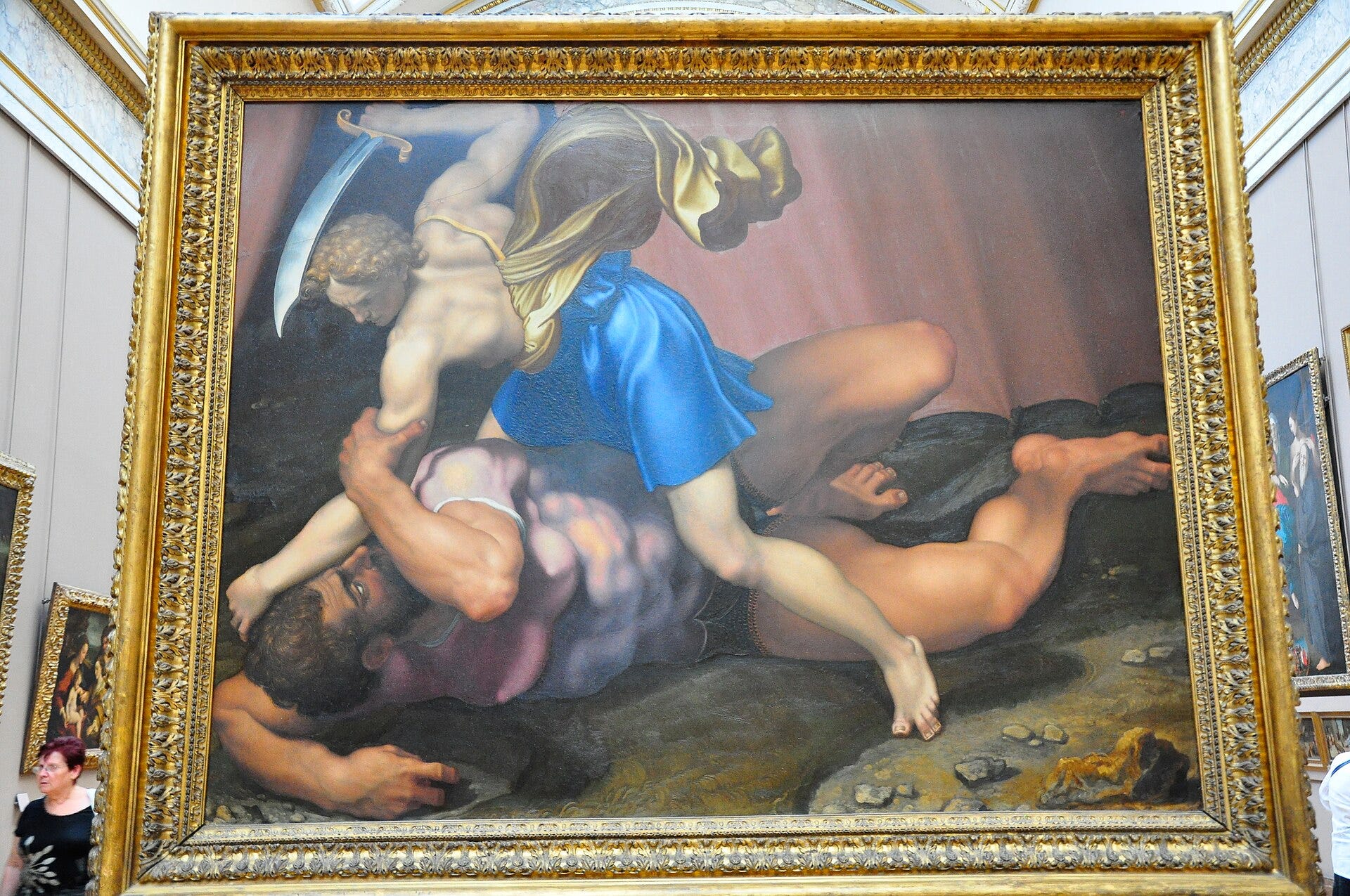
This David has two fronts and no back. Daniele da Volterra painted it on a slab of slate, a dark stone that splits into flat sheets, and he covered both faces of the slab. That is why, at the Louvre, it does not hang on a wall. It stands free in the Grande Galerie, and visitors walk around it as they would around a statue.
The idea came from the man who ordered it. Around 1555, Giovanni della Casa, an archbishop and a writer, asked Daniele for a David visible from the front and from behind. The request was a challenge thrown at painting itself, since a statue offers every side to the eye and a painting only one.
Giorgio Vasari, who knew Daniele, describes how he answered it. Daniele first modeled the group in clay. Then he painted the same fight on each face of the slate, David kneeling on the giant's back with the sword raised, Goliath pinned to the ground, seen from the front on one side and from behind on the other.
The slab later lost its author's name. In 1715 it was presented to Louis XIV as a Michelangelo. The mistake had a reason, and that reason survives on a single sheet at the Morgan Library in New York: four small sketches of the same fight, drawn in black chalk by Michelangelo and once owned by Daniele.
Daniele was Michelangelo's friend and pupil, and he built his composition from those drawings. The boy and the giant on the slate move as the master had imagined them, more than forty years after he first painted the fight on the Sistine ceiling (number 2).
At a Glance
Artist: Daniele da Volterra (about 1509 to 1566)
Painted: About 1555
Medium: Oil on slate, painted on both sides
Size: 133 × 172 cm (52 3/8 × 67 3/4 in)
Where to see it: Musée du Louvre, Paris (Grande Galerie, where it stands free so both sides can be seen)
11. Andrea del Castagno, David with the Head of Goliath (about 1450 to 1455)
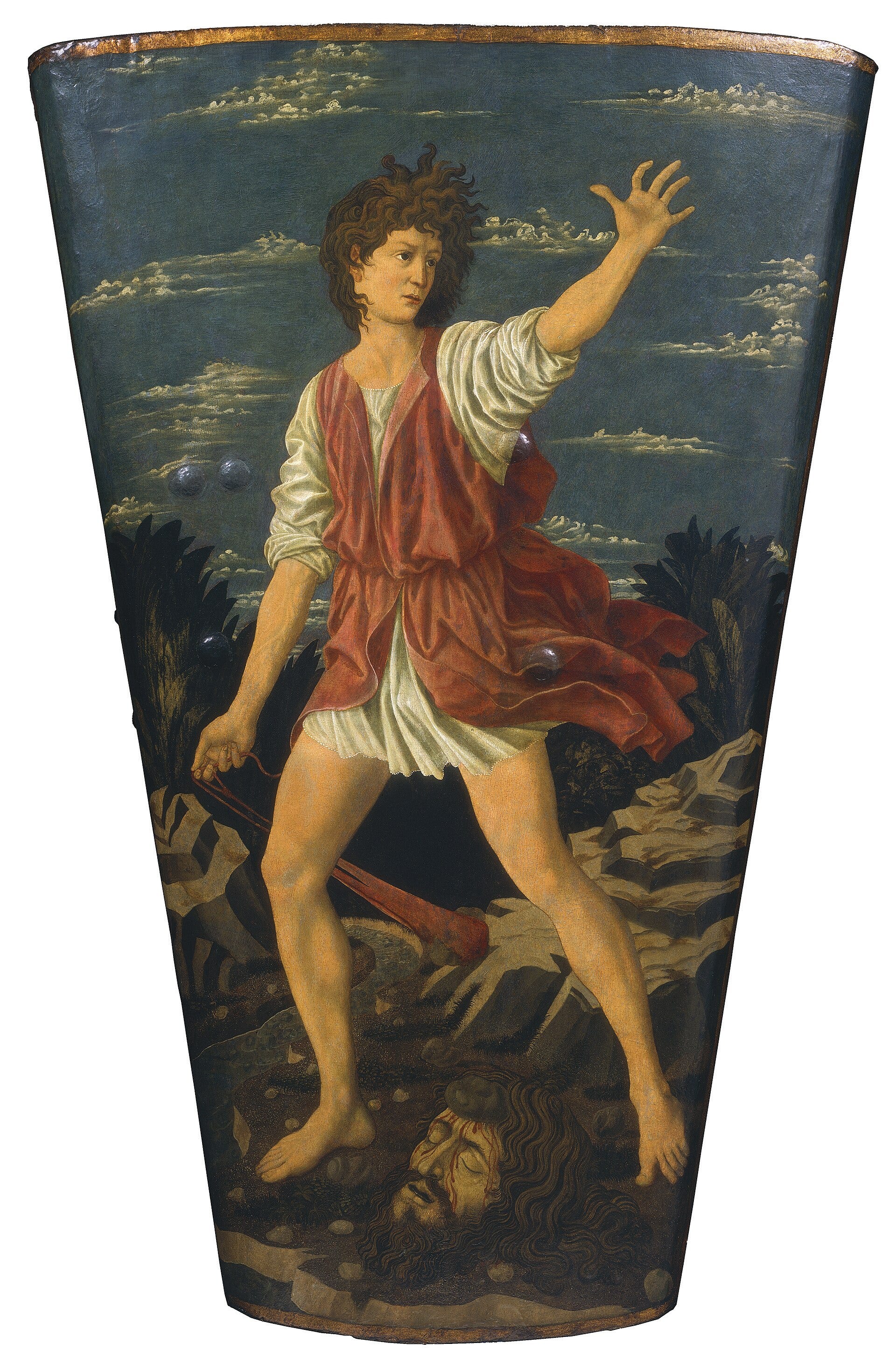
On this shield the fight is over before it has ended. The young David still swings his sling, hair and tunic blown back by the throw, yet Goliath's head already lies cut off between his feet. Andrea del Castagno painted it in Florence around 1450, on leather stretched over curved wood, and he had a good reason to squeeze two moments of the story into one image.