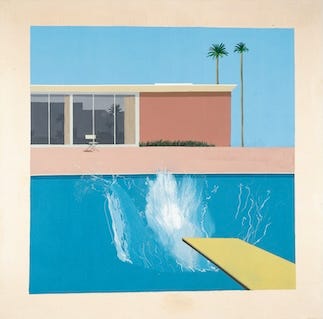
David Hockney: The Complete Story

David Hockney is the boy from Bradford who painted California's swimming pools and became Britain's most loved living artist. Born in 1937, he has repainted the act of looking for seven decades, from A Bigger Splash to an iPad in a Normandy garden.

Every time the art world decided painting was finished, Hockney found it a new pair of eyes. Here is the long game of the great enjoyer.

David Hockney at a glance:

  • 1937: born in Bradford, Yorkshire, fourth of five children of a conscientious objector who repaired bicycles.

  • 1962: takes the Royal College of Art's gold medal, having painted his own diploma when the college balked.

  • 1964: moves to Los Angeles and finds his subject within weeks: water, sunlight, and the blue rectangle of the pool.

  • 2007: Bigger Trees Near Warter, painted outdoors on 50 canvases, becomes the largest picture of his life; he gives it to the Tate.

  • 2018: Portrait of an Artist (Pool with Two Figures) sells for 90.3 million dollars, then a record for a living artist.

David Hockney Building, Bradford College (10th June 2019)

Bradford, London, gold medal

A Yorkshire clerk's son, Hockney reached the Royal College of Art in 1959 and left in 1962 with the gold medal, already famous among students for wit, bleached hair and pictures that smuggled his own life, openly gay before decriminalisation, into British Pop.

London expected him to stay its darling. In 1964 he left for Los Angeles.

California, and the splash

LA gave him his great subject: sunlight on money and water. 3 million dollars, at the time the highest auction price for any living artist.

The double portraits of those years, Mr and Mrs Clark and Percy among them, did for friendship what the pools did for pleasure.


Hooked on David Hockney? Get more art secrets and stories in your inbox, free.


More incredible painter stories

If David Hockney pulled you in, you will love these too:


The myth: the lightweight hedonist

Sunny subjects earned him decades of critical suspicion.

The record shows an obsessive investigator: the Polaroid joiners of the 1980s rebuilt Cubist vision with a drugstore camera; his 2001 book Secret Knowledge argued, with a wall of evidence, that the old masters used optical devices, and started fights in optics departments as well as art schools; and the Yorkshire and Normandy landscapes of his old age are studies in how seeing changes with time.

The pleasure was always research.


130,000 readers get one art story a week. No jargon, just the good parts.


The iPad decade

From 2010 he drew on an iPad daily, and in the locked spring of 2020, from his Normandy farmhouse, sent the world 116 flowering drawings under the message: do remember they can't cancel the spring. The Royal Academy's A Bigger Picture in 2012 and the immersive Bigger and Closer in 2023 filled halls with the results; at 86 he was still learning new machines.

Where to see Hockney

Tate Britain holds A Bigger Splash and Mr and Mrs Clark; Salts Mill in Saltaire, a Victorian mill near Bradford, keeps a permanent, free Hockney collection in his home landscape; and the Getty and LACMA anchor the California share.

The joiners

In 1982 he began sticking Polaroids into grids and called the results joiners: one scene assembled from dozens of instants, cubism from the drugstore.

David Hockney in 2017
Hockney in 2017. Photo Connaissance des Arts, CC BY 3.0.

Pearblossom Hwy., built from more than 700 prints, is the argument in one image: a photograph has one eye and one second, a painting has both of yours and the whole afternoon.

He dropped the technique once the point was proven. The joiners now read as ancestors of every stitched panorama in your phone.

Designing the opera

Between canvases Hockney built operas. His Rake's Progress for Glyndebourne in 1975 crosshatched the entire stage like a Hogarth engraving come to life.

The Magic Flute followed, then Tristan in Los Angeles and Turandot in Chicago: sets conceived as walk-in paintings, timed to music.

He credits the stage with retraining his eye for space at scale. The Yorkshire panoramas that came later are stage sets with weather.

Painting bigger than the eye

In his sixties he went home to Yorkshire and painted the Wolds outdoors through the seasons, on canvases bolted together into walls.

The late Hockney rule: when the subject is time passing, paint bigger than the eye can hold, so the viewer has to walk, and walking takes time.

The 90-meter Normandy frieze, the 50-canvas trees, the four-season video walls: one long campaign against the single glance.

The David Hockney questions that keep coming up

  • What is he known for? The California pool paintings, double portraits, joiners and iPad landscapes.

  • What is his auction record? Portrait of an Artist (Pool with Two Figures) sold for 90.3 million dollars in 2018.

  • What is Secret Knowledge? His 2001 thesis that old masters used lenses and mirrors, argued with reconstructions.

  • Where does he live? After decades in LA and Yorkshire, he settled in Normandy in 2019, then returned to London.

  • Is David Hockney still alive? Yes. Born in Bradford in 1937, he moved back to London in his late eighties and keeps drawing daily.

  • What about his hearing? He began going deaf in his forties and has worn hearing aids since. He claims the deafness sharpened his sense of space: seeing more as he hears less.


More secrets to unlock


Two Norman scrolls about time passing

In 2021 he answered the Bayeux Tapestry in its own town: A Year in Normandie, a 90 metre frieze of his iPad seasons, was hung in Bayeux, drawn on a device the tapestry's makers could not have imagined, at almost exactly their length. Nine centuries apart, two Norman scrolls about time passing.


Learn art the fun way. One email, every week, free.