
Each November, Mexico City's street printers sold cheap sheets of verse that buried the living in jest. Their joke, a grinning skeleton, became the face of a holiday. These twelve works trace that skeleton and the home altars set up beside it, from an Aztec god of the dead found under the city to a shrine for a film star.
Cool Stories About Art is a newsletter to learn art the fun way.
Join 200,000+ readers and get:
10 new art stories / month
The entire archive of content (140+ articles)
Comment, ask questions, and chat with other readers
What the Holiday Gave Artists
The Day of the Dead falls on November 1 and 2. It joins two Catholic feasts brought by Spain, All Saints and All Souls, to older Indigenous customs, and its origins are still debated. On those days families visit graves, cook for their dead and build an ofrenda, a home altar of photographs, food and marigolds.
Those customs gave artists two subjects. The ofrenda let them show a family keeping its dead close. The calavera, a skull or skeleton drawn, printed or modeled as if it were alive, let them mock the living. It is the closest thing to a name for Day of the Dead art.
Every work chosen here is a calavera or an ofrenda, with one exception, a figure older than the holiday itself.
12. Manuel Manilla and José Guadalupe Posada, Gran mole de calaveras (1902)
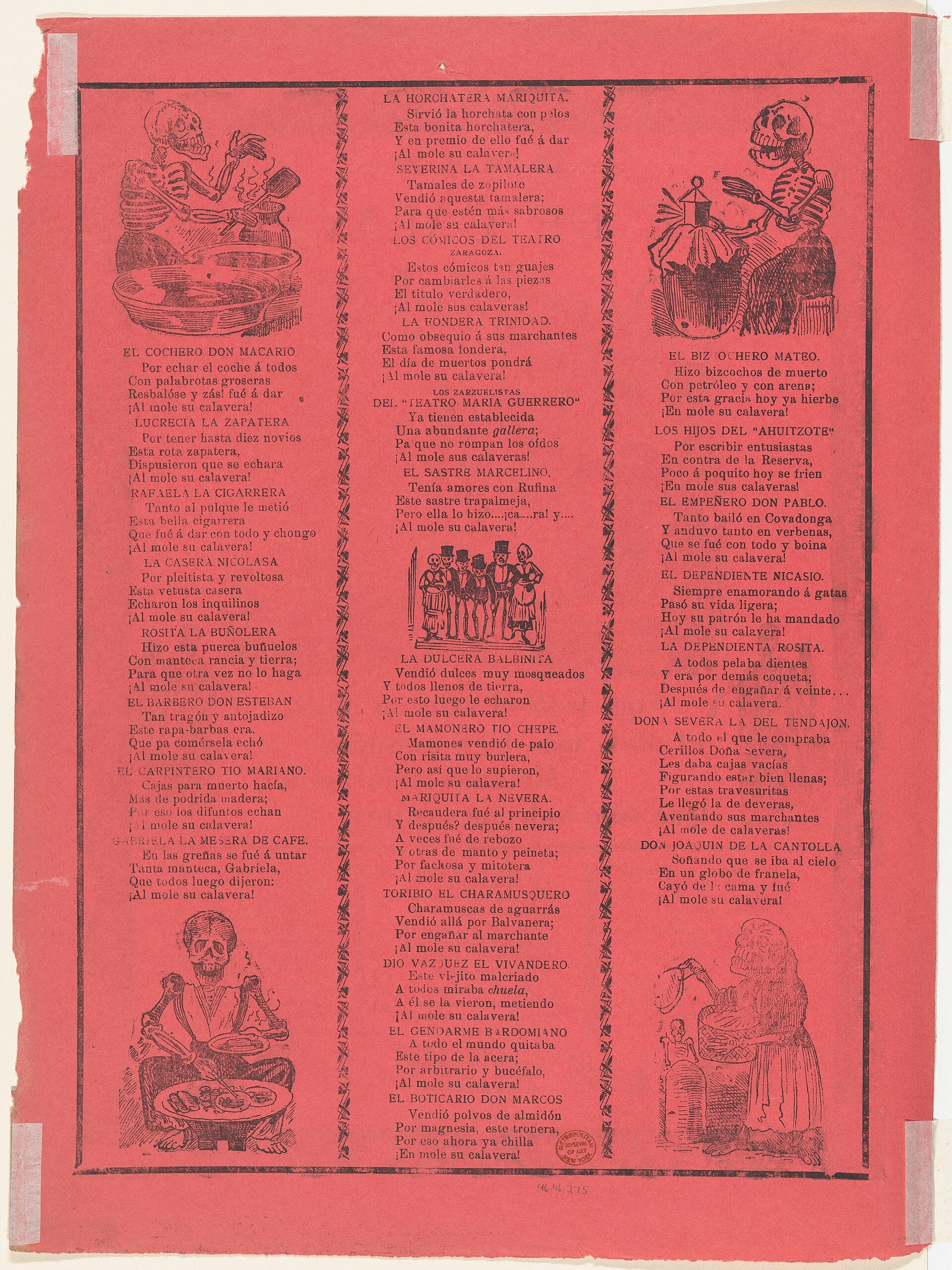
This pink sheet is framed by two skeletons with scythes, one standing guard on each side. Between them, a crowd of other skeletons sits among the graves of a cemetery, eating and drinking from their plates. The title above promises a "Gran mole de calaveras", a great feast of mole, the dark chili sauce of Mexican celebrations, served to skulls.
The joke made sense to anyone in Mexico City in 1902, when the sheet was printed. Its publisher, Antonio Vanegas Arroyo, sold broadsides, single sheets of news, songs and verse hawked in the street for a few cents. For the Day of the Dead he put out calaveras, verses that parodied real epitaphs and spoke of the living as if they were already dead.
The pictures on this sheet come from two different hands. The feasting skeletons in the middle are by José Guadalupe Posada, the engraver now credited almost everywhere with inventing the calavera. The guards on the sides are older. They are by Manuel Manilla, who began engraving for the same publisher in 1882 and made hundreds of prints for him, of circuses, bullfights and miracles.
Of Manilla himself, very little is known. He was the first to fit the calavera to these penny sheets, and Posada, who followed him, pushed its comedy and its satire much further. Manilla died around 1895. Seven years later, his plates were still framing the work of his successor.
On this page, then, the older skeletons keep watch over the newer ones. The Mexican historian Rafael Barajas Durán puts it in a single sentence: "Posada did not invent the calavera."
At a Glance
Artist: Manuel Manilla (about 1830 to about 1895) and José Guadalupe Posada (1852 to 1913), published by Antonio Vanegas Arroyo
Made: 1902
Medium: Zincograph, type-metal engraving and letterpress on pink paper
Size: 40 × 30.5 cm (15 3/4 × 12 in), sheet
Where to see it: The Metropolitan Museum of Art, New York
11. Unknown Mexica sculptor, Mictlantecuhtli from the House of the Eagles (late 15th century)
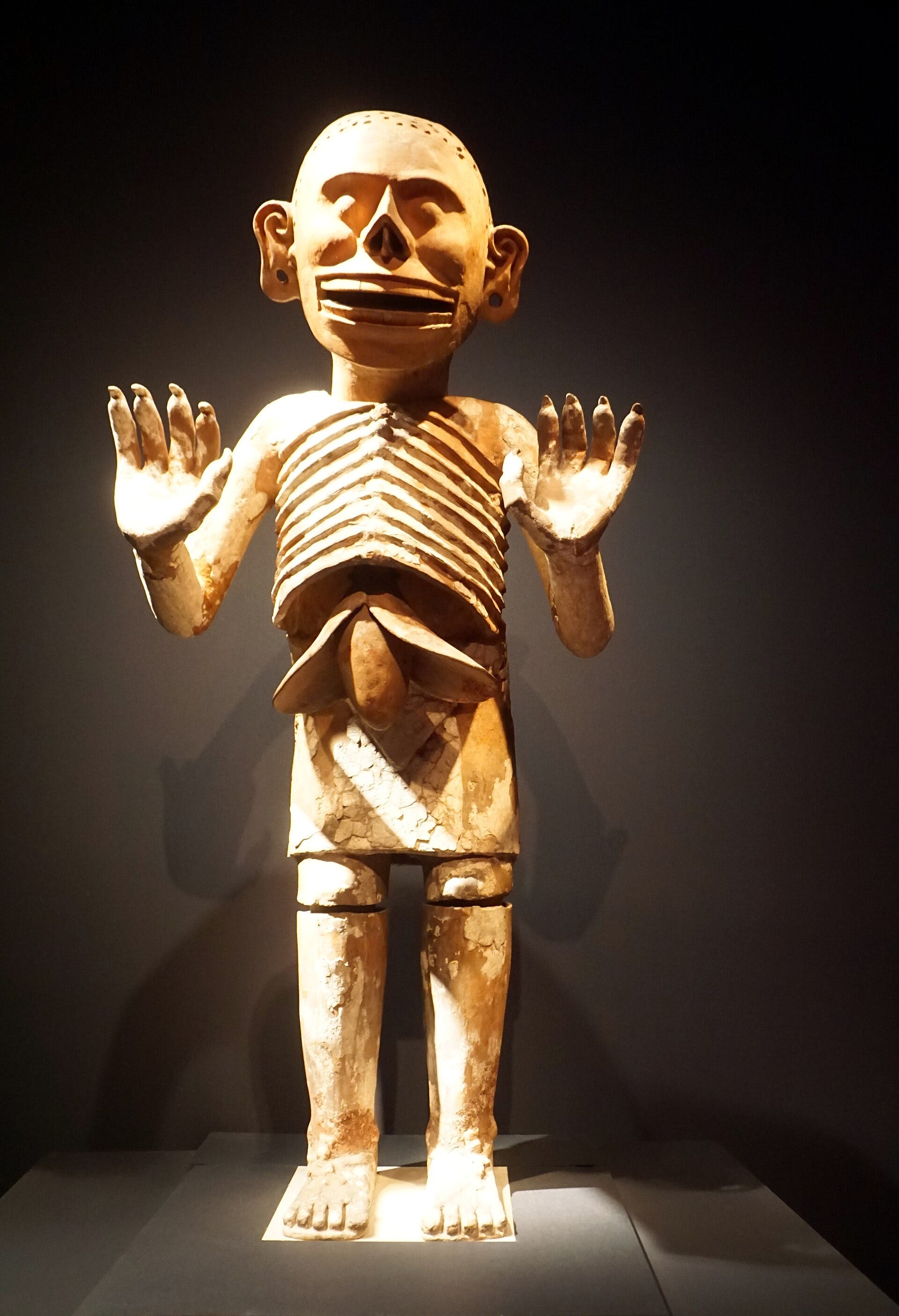
Two clay figures of the god of the dead stood guard at a buried doorway of the House of the Eagles, a building beside the Templo Mayor, the great temple at the heart of the old city, under the center of Mexico City. Archaeologists reached them in 1994, through two long tunnels dug beneath the walkway where visitors look down on the ruins. By then the damp earth had crushed both gods into fragments.