
In 1917, two Dutch painters launched a small magazine called De Stijl, "The Style," and set out to rebuild art from almost nothing: straight lines, three primary colors, and black, white and gray. Its painters and architects carried those rules off the canvas and onto furniture, shop fronts and houses, and then fell out over whether a line could ever be allowed to lean.
Cool Stories About Art is a newsletter to learn art the fun way.
Join 200,000+ readers and get:
10 new art stories / month
The entire archive of content (140+ articles)
Comment, ask questions, and chat with other readers
Straight Lines, Pure Colors, Every Object
The group asked its members to give up the subject of a picture altogether. What remained were horizontal and vertical lines, rectangles, the three primary colors, red, yellow and blue, and three "non-colors," white, black and gray.
Those rules were meant for more than paintings. The manifesto of November 1918 was signed by three painters, two architects, a poet and a sculptor, and they wanted the same forms for a canvas, a chair, a building and the letters of a printed page.
11. Robert van 't Hoff, Villa Henny (1915 to 1919)
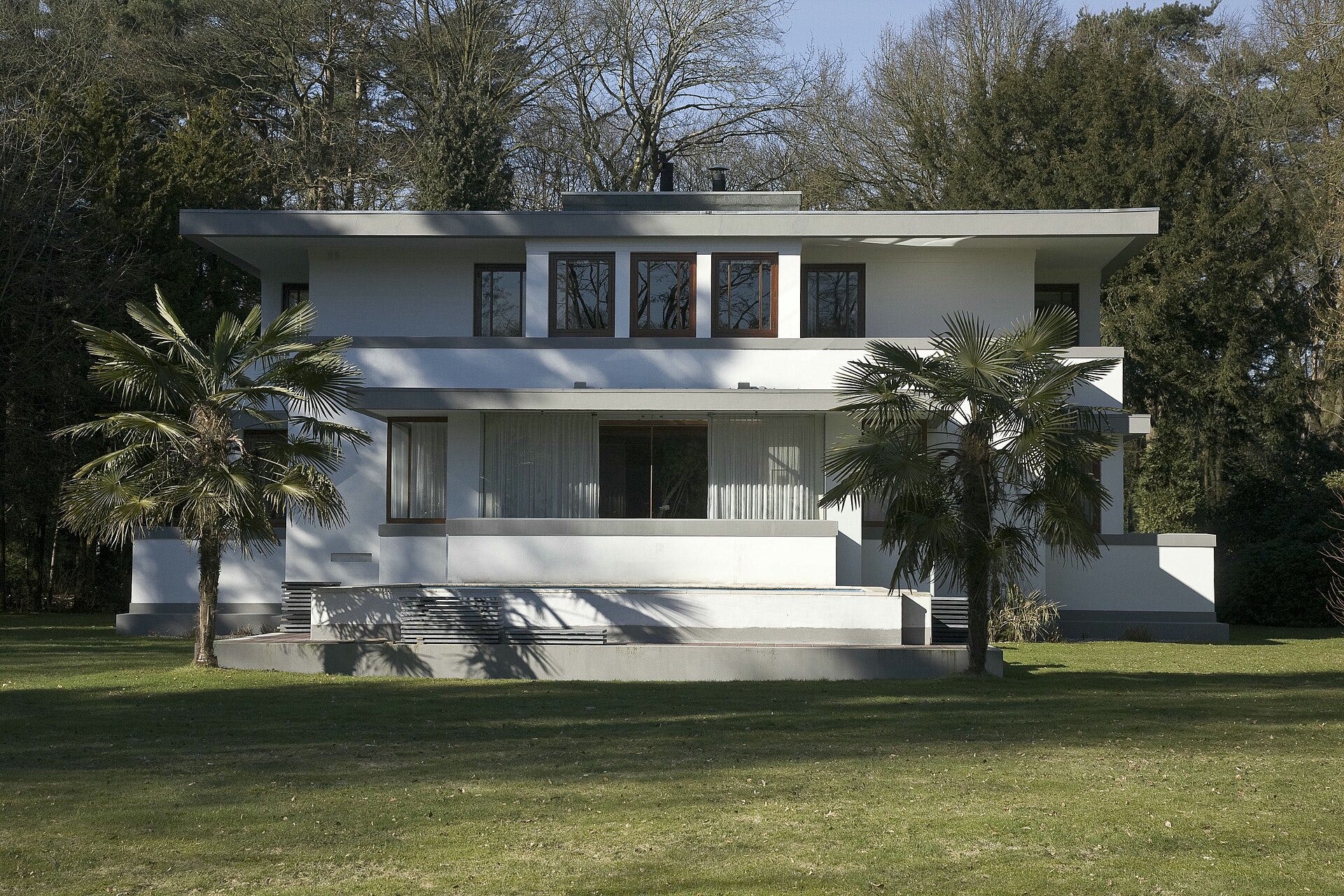
The flat roofs of this white villa reach far past its walls, like trays set down on top of a box. A roof can hang that far over empty air only if something inside it holds it up, and here that something is steel.
The house, begun in 1915 at Huis ter Heide, near Utrecht, is built of reinforced concrete, concrete with steel bars set inside it. It was among the first homes in the Netherlands built that way.
The man who drew those roofs had just come back from America. On a trip there in 1914, Robert van 't Hoff, a young Dutch architect, had met the American architect Frank Lloyd Wright, who pushed him toward a plainer, more abstract way of building. The long roofs may be where Wright's example shows most clearly.
That plainness brought the villa close to De Stijl. With its white walls and its flat, level roofs, it was built from the rectangles and the white that the group would soon make its own.
The house was still going up when the magazine De Stijl appeared in 1917, and Van 't Hoff joined the group that year. He signed its manifesto in November 1918 and left in October 1919, the year work on the villa came to an end.
At a Glance
Artist: Robert van 't Hoff
Made: 1915 to 1919
Medium: Reinforced concrete, rendered white
Size: Two-story detached house
Where to see it: Amersfoortseweg 11a, Huis ter Heide, near Utrecht (private house, seen from the road)
10. Theo van Doesburg, Composition VIII (The Cow) (about 1918)
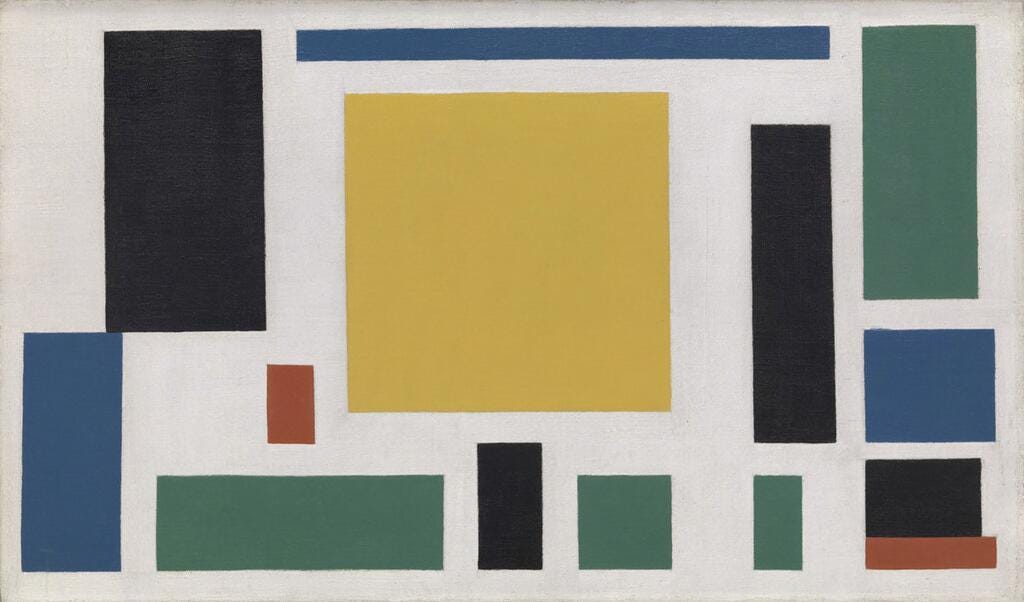
This long, low canvas has the proportions of an animal seen from the side, yet it holds nothing but small rectangles of color and black, set apart on a white ground. Theo van Doesburg got there by drawing the same cow over and over, on sheets hardly bigger than a postcard, and eight of those drawings survive. Years later he published the steps in a book for a German art school, and the sequence did not begin with a drawing.