
For four centuries, painters kept setting the same pair side by side: a young woman in her prime and the corpse sent to take her. The meeting began as an assault and turned into an embrace. Some versions fit in the palm of a hand, and one hides on the back of a panel whose front shows a woman at her bath.
Cool Stories About Art is a newsletter to learn art the fun way.
Join 200,000+ readers and get:
10 new art stories / month
The entire archive of content (140+ articles)
Comment, ask questions, and chat with other readers
A Corpse, a Young Woman and Four Centuries
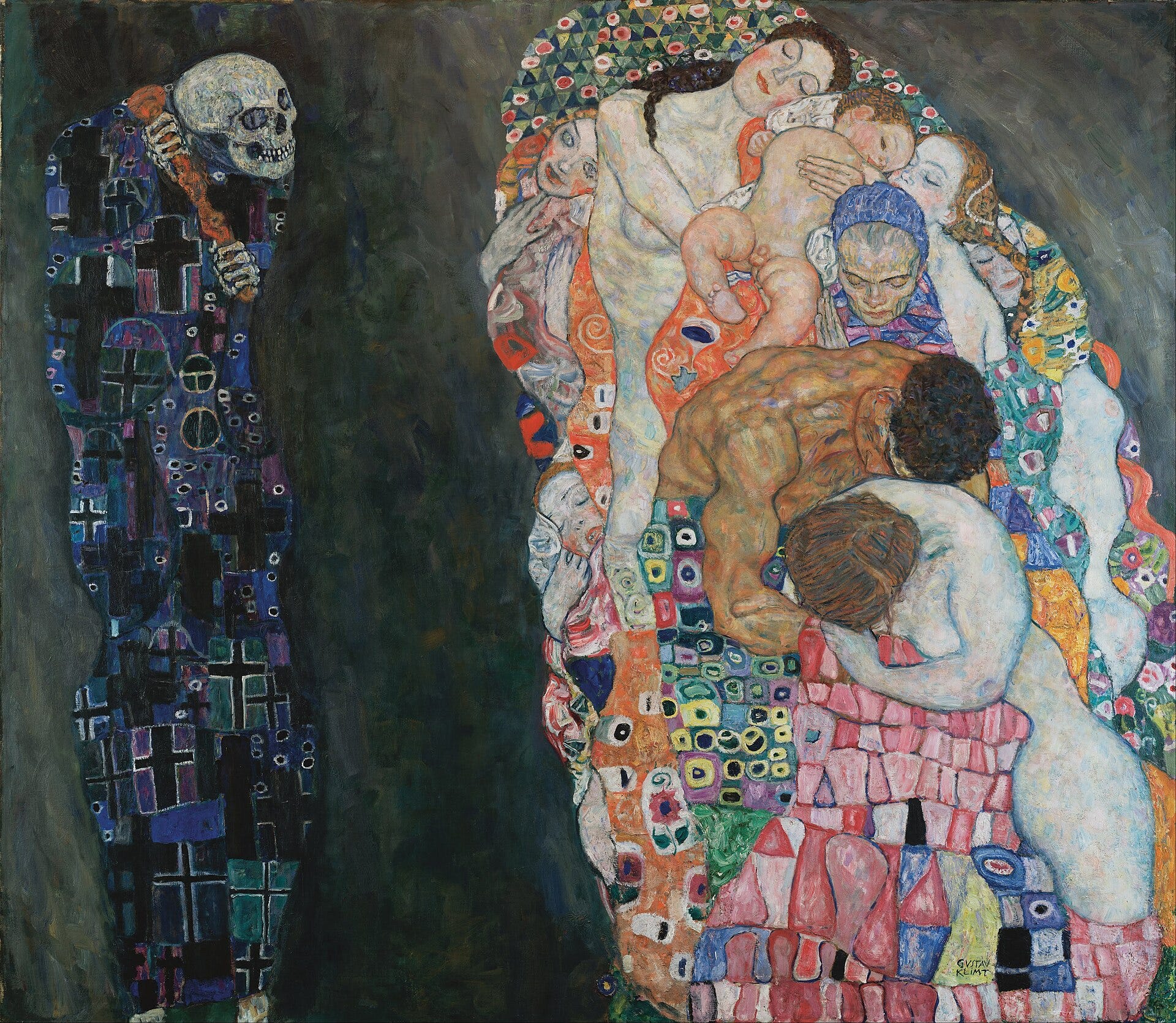
The theme asked painters to set a young body beside a dead one and make the distance between them feel short. Its message was a warning that youth and beauty protect no one, and that warning gave artists a reason to paint a nude.
At first Death came as an attacker, a corpse gripping a woman who resists. After Schubert set the subject to music in 1817, painters made him gentler, and by 1900 the two had become a couple, with a kiss in place of the struggle.
Only pictures where Death and a young woman share the frame made the cut. The theme took shape in Germany and Switzerland in the half century after 1495, and many of the early versions come from there.
12. Sebald Beham, Death and Three Nude Women (about 1546 to 1550)
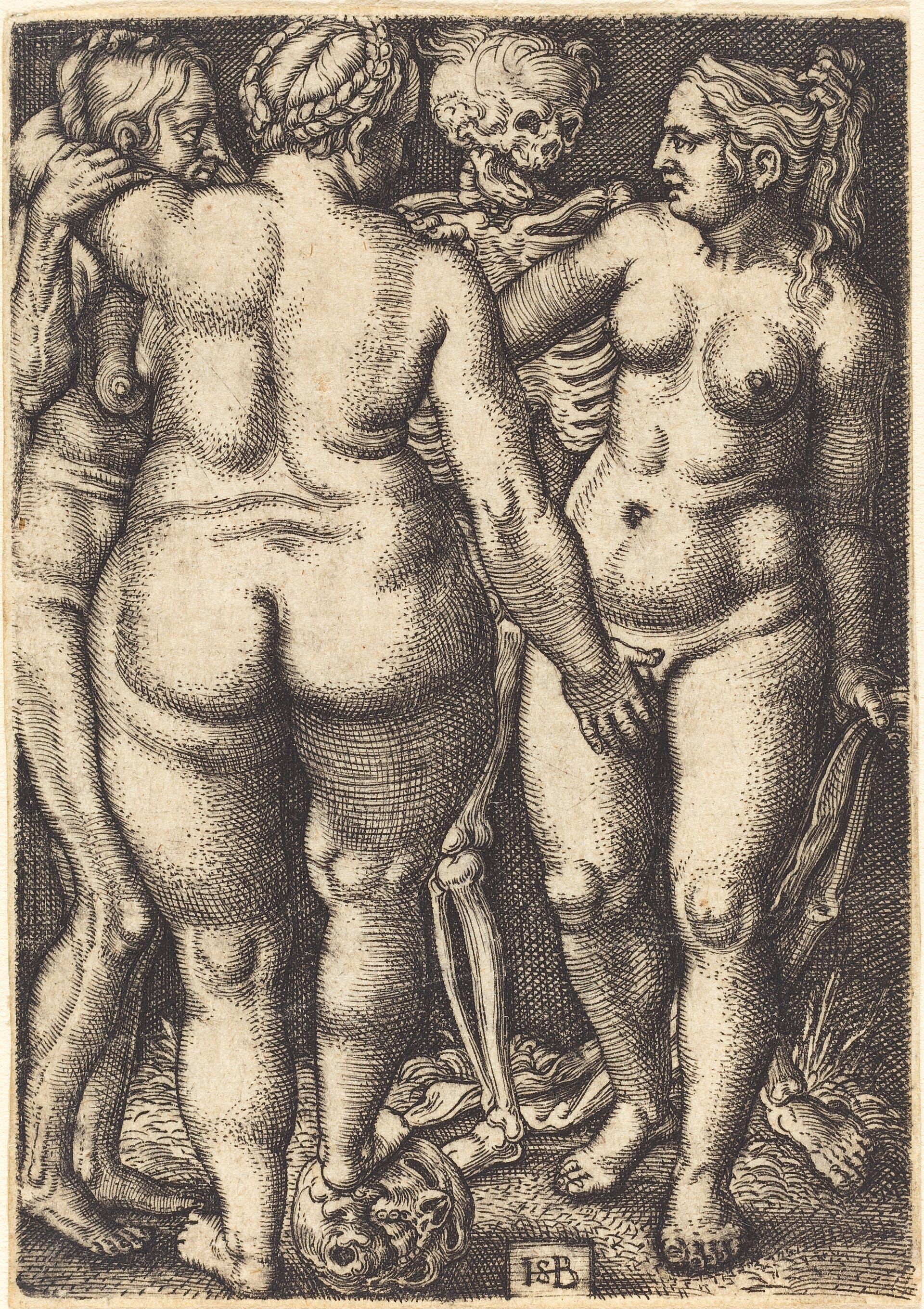
A skeleton turns toward the youngest of three naked women. Beside her, a middle-aged woman rests her foot on a skull and holds an old woman by the shoulder. The engraving, Death and Three Nude Women, fits on a sheet about eight centimeters tall, roughly three inches. Sebald Beham made it around 1546 to 1550, and it sets the three ages of a woman's life in front of Death.
Twenty years earlier, Beham had been in serious trouble. On January 26, 1525, the city of Nuremberg expelled him, his younger brother Barthel and a third young engraver, whom the city records call "the godless painters."
At their hearing, the three had denied believing in baptism, in Christ, and in the bread and wine of Mass becoming the body of Christ. Barthel had also refused to accept the city council as the highest authority.
The exile was short, since all three were allowed back before the year was out, but after it the brothers' paths split. Barthel went to Munich to paint for Duke William IV of Bavaria, who paid for a journey to Italy, and he died there in 1540.
Sebald settled in Frankfurt around 1531 and engraved close to two thousand prints, nearly all of them tiny. That habit places the brothers among the Little Masters, the name given to the German engravers of very small prints.
This late sheet goes back to a design by Barthel. Nobody knows why Sebald took up his dead brother's drawing years after Barthel's death, but he gave it more erotic detail than the theme usually carried. The skull and the aging bodies still hold the old warning about passing beauty, while the youngest woman, the one the skeleton watches, is drawn with an openly erotic eye.
At a Glance
Artist: Sebald Beham (1500 to 1550)
Made: About 1546 to 1550
Medium: Engraving
Size: 7.9 × 5.7 cm (3.1 × 2.2 in), sheet
Where to see it: National Gallery of Art, Washington, and Blanton Museum of Art, Austin
11. Niklaus Manuel, Death and the Maiden (1517)
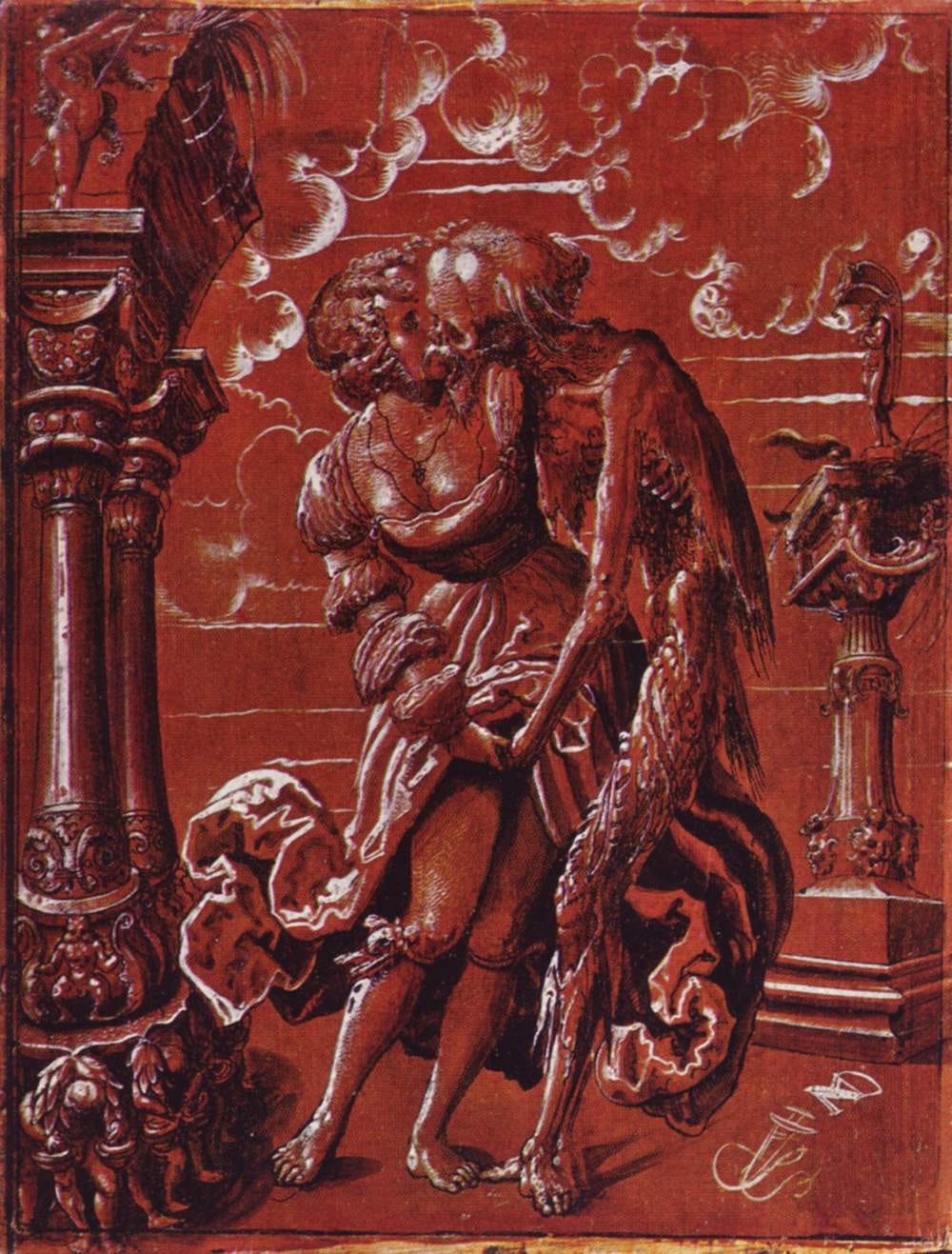
On one side of this small panel by Niklaus Manuel, Death wears the slashed clothes of a Swiss mercenary and kisses a young woman, his hand already under her skirt. On the other side, Manuel painted Bathsheba at her bath, the woman King David watched from his roof, a biblical subject that excused a nude. In 1517 he set these two women back to back on one board, and the pairing reflects the life he was leading.