
Nobody saw Cleopatra die, and the ancient writers who told the story were never sure how she did it. Rome made a picture of her death all the same. Octavian, the Roman who had defeated her, had an image of the queen with a snake carried through the city in his triumph, and artists have been redrawing that picture ever since.
Cool Stories About Art is a newsletter to learn art the fun way.
Join 200,000+ readers and get:
10 new art stories / month
The entire archive of content (140+ articles)
Comment, ask questions, and chat with other readers
Before the Bite or After
The snake comes from Plutarch, a Greek writer working more than a century after her death. He tells of an asp smuggled to her under a basket of figs, then admits that this is only one account among several. Painters held on to it because it gave them something to show.
The story behind it is short. Rather than be shown to the Roman crowd as a captive, the queen chose to die. The scene asks for almost nothing: a woman, a snake, one or two maids in a closed room. What each artist has to decide is the moment, before the bite or after it.
Every work here shows her death or the choice that leads to it, in paint, chalk or marble, from the 1520s to 1890. Pictures of Cleopatra alive, as a lover or a ruler, were left out.
12. Edmonia Lewis, The Death of Cleopatra (1876)
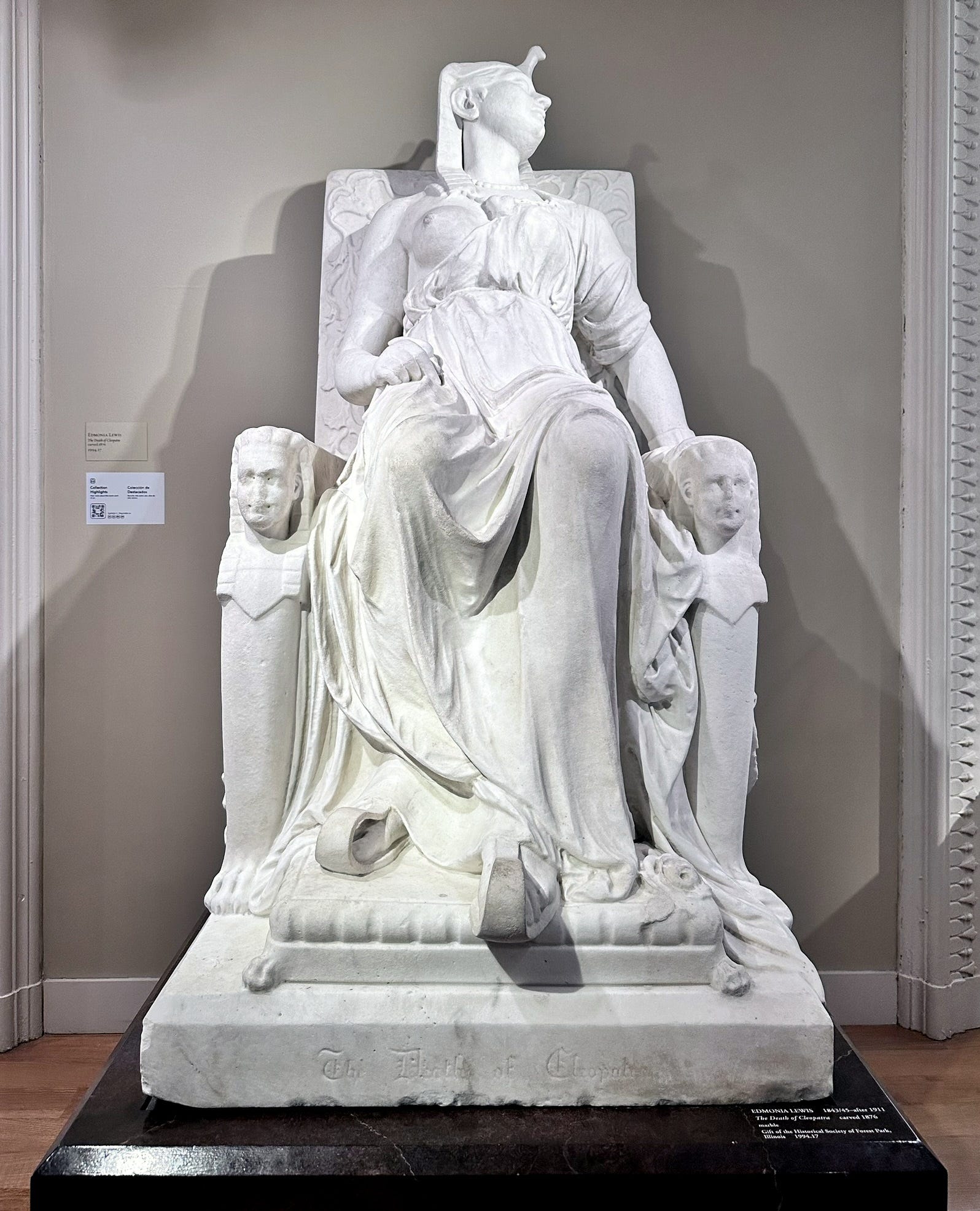
Still crowned, her head fallen back and her left arm hanging loose, a marble queen sits on a throne carved with Egyptian heads. The asp is in her right hand. Edmonia Lewis carved this Death of Cleopatra and sent it to Philadelphia in 1876, to the Centennial Exhibition that celebrated a hundred years of American independence.
Lewis herself was an unusual exhibitor. She was the daughter of a Black father and a mother of Ojibwe descent, and in 1865 she moved to Rome to work in marble, where she joined a circle of American women sculptors.
In Philadelphia her queen stood among more than five hundred sculptures, and crowds gathered around it. J. S. Ingram, who wrote a chronicle of the fair, called it the most remarkable piece of sculpture in the American section.
The same statue also unsettled its visitors. The Neoclassical style of the day kept strong emotion out of marble, and Lewis had carved the queen after the bite. In 1878 the critic William J. Clark Jr. judged the work original rather than beautiful, and asked whether so direct an image of death still belonged to art.
After that the queen disappeared from view. She weighed about two tons, and when a showing in Chicago in 1878 brought no buyer, Lewis put her in storage. Around 1892 the statue resurfaced in a saloon on Clark Street, in Chicago.
Its next owner was a gambler and racehorse owner known as Blind John Condon. He placed the marble queen on the grave of his favorite horse, also called Cleopatra, in front of the grandstand of his track in Forest Park, Illinois.
The ground around her kept changing. The track became a golf course, then a torpedo plant in the Second World War. When a postal center went up on the site in the early 1970s, the statue was hauled to a contractor's yard in Cicero, and a fire inspector, Harold Adams, had his son's Boy Scout troop clean it and paint it.
In 1985 the Forest Park historical society took her in. Marilyn Richardson, an independent curator writing a biography of Lewis, set out to find the statue and tracked it down in a storeroom of a local shopping mall. The queen who had drawn crowds in Philadelphia was still sitting on her throne.
At a Glance
Artist: Edmonia Lewis (about 1844 to 1907)
Made: 1876
Medium: Marble
Size: 160 × 79.4 × 116.8 cm (63 × 31¼ × 46 in)
Where to see it: Smithsonian American Art Museum, Washington, D.C.
11. Michelangelo, Cleopatra (about 1535)
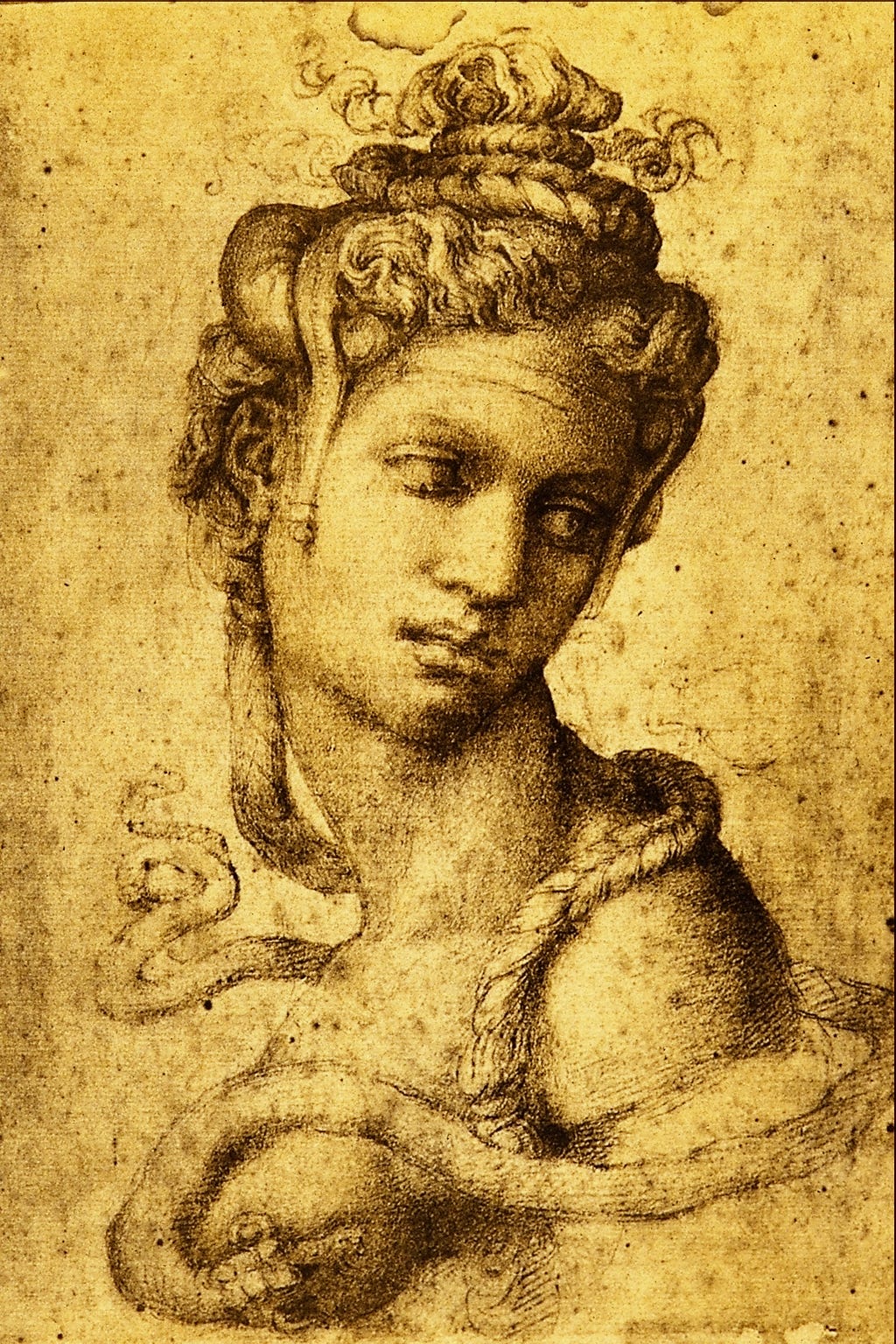
A snake slides out of the young woman's braided hair and winds around her neck and shoulder, while she turns her face aside and lowers her eyes. Michelangelo drew this Cleopatra in black chalk around 1535, as a gift for Tommaso de' Cavalieri, a young Roman nobleman he had met three years before. Cavalieri kept it for almost thirty years, until he was forced to give it up.