
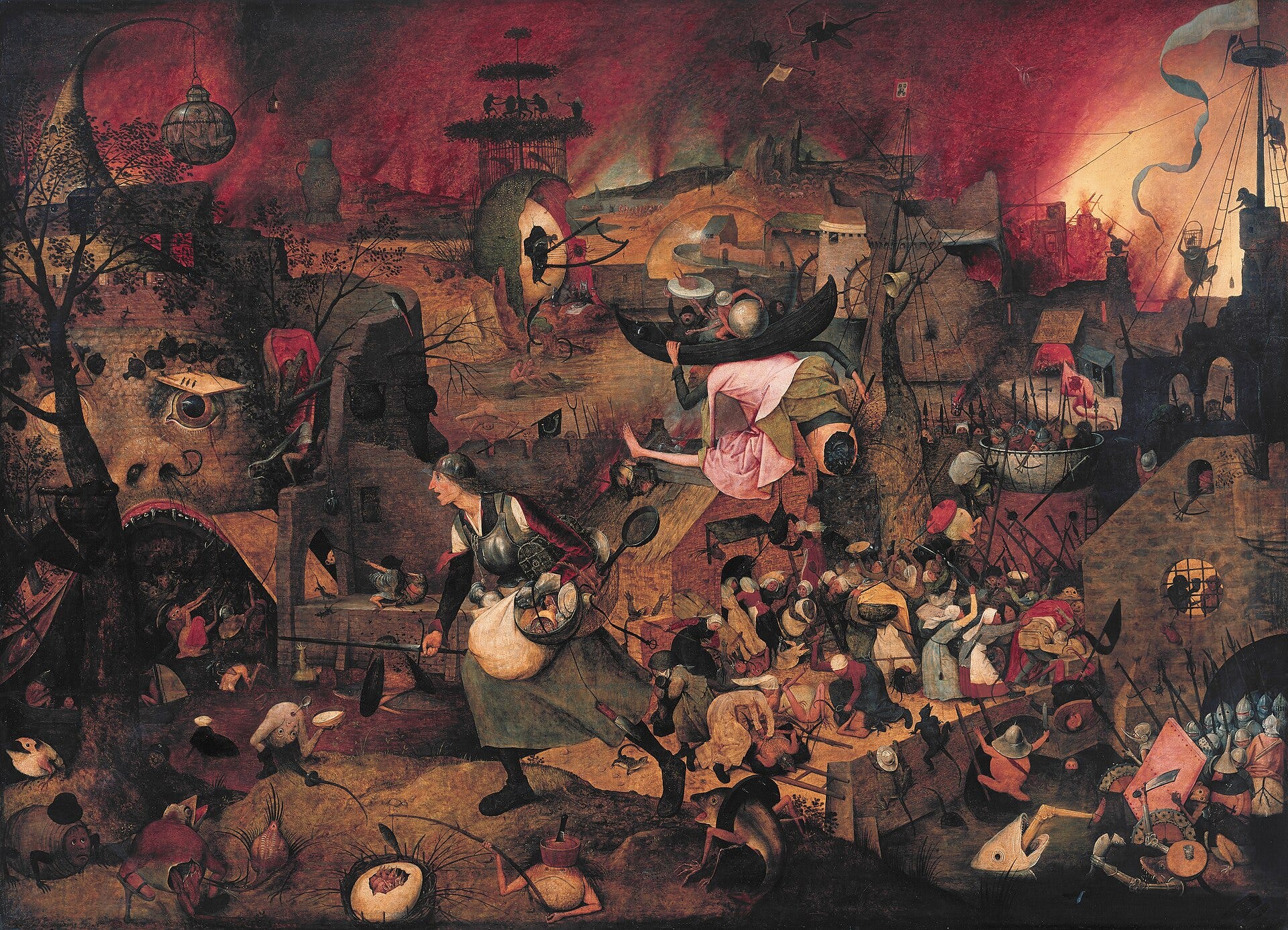
No one has ever met a demon, and still painters had to paint thousands of them, tormenting saints, hauling sinners off to hell, serving heroes in chains or haunting an emperor's fever. With nothing to copy, artists built them from whatever they could study, down to the scales of a fishmonger's catch.
Cool Stories About Art is a newsletter to learn art the fun way.
Join 200,000+ readers and get:
10 new art stories / month
The entire archive of content (140+ articles)
Comment, ask questions, and chat with other readers
A People Nobody Had Seen
A demon is not the Devil. The Devil is one figure, the fallen angel who rules hell. Demons come in numbers, as servants, soldiers, jailers and spirits of the house or the night, who can be chased off, chained or put to work, in Europe as in Persia, China and Japan.
Inventing their bodies kept artists busy for centuries. For a long time the work belonged to sacred art: demons filled church walls, prayer books and altarpieces, where they showed what a saint or a sinner had to face. Later they slipped out of churches and into bedrooms and dreams.
Every work here gives demons a part of their own to play, never as hell's scenery and never as Satan himself. Together the twelve show where demons were thought to live: in hell and its workshops, over a city at war, in a hermit's desert, inside a bedroom and inside a sleeper's head.
12. Martin Schongauer, Saint Anthony Tormented by Demons (about 1470 to 1474)
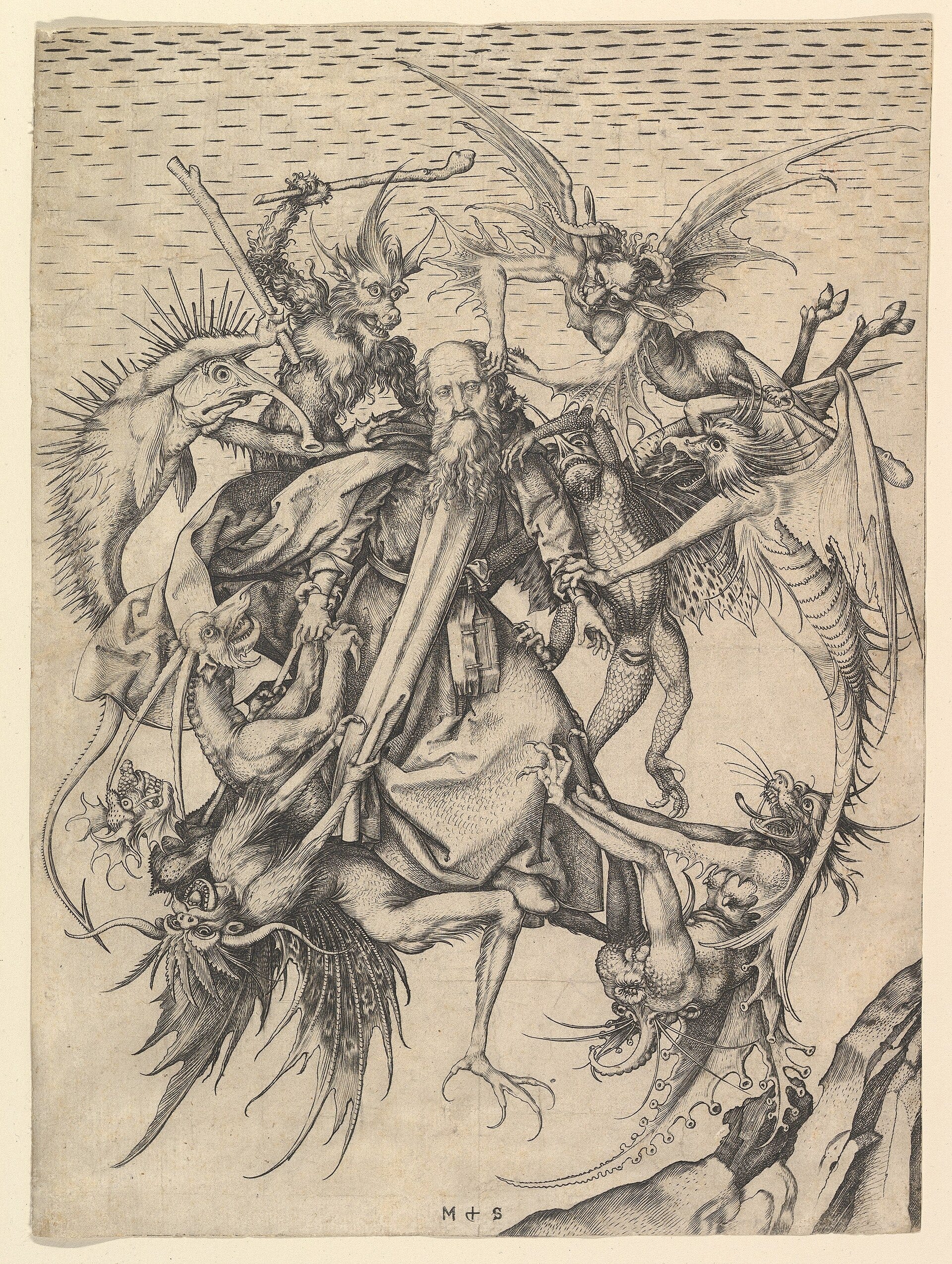
Fish scales cover the bodies of several demons in this engraving. Others bristle with spines or beat the wings of bats, and all of them have sunk their claws into an old hermit they have hoisted into the sky. He is Saint Anthony, and the print, Saint Anthony Tormented by Demons, was engraved by Martin Schongauer about 1470 to 1474.
Schongauer, like every artist who drew demons, had no model to copy. He worked on the Upper Rhine, the river country between present-day France and Germany, and this is one of his first prints, probably the most influential he ever made. So he borrowed from creatures he could observe, and the fur and scales are so precise that he seems to have studied real animals.
That precision caught the eye of a boy in Florence some fifteen years later. He was twelve or thirteen, his name was Michelangelo, and his two early biographers, Ascanio Condivi and Giorgio Vasari, both say that his first work was a painted copy of this print.
The boy wanted his monsters to look more convincing than the ones on paper, so, the biographers add, he went to the fish market to study the colors and scales of the fish. Infrared images of his panel, The Torment of Saint Anthony, show that he also reworked and enriched the composition. Specialists defend the attribution to Michelangelo strongly, though it is not certain.
Through the whole attack, Schongauer's saint never fights back. His face stays calm, and he gazes past the frame while the demons tug at him from every side.
At a Glance
Artist: Martin Schongauer (about 1435/1450 to 1491)
Made: About 1470 to 1474
Medium: Engraving
Size: 30 x 21.8 cm (11.8 x 8.6 in), sheet of the Met impression
Where to see it: Impressions in major print rooms, including The Metropolitan Museum of Art, New York
About This Print
Where is The Torment of Saint Anthony now?
The small panel that Michelangelo painted after this engraving, about 1487 to 1488, is at the Kimbell Art Museum in Fort Worth, Texas.
11. Gong Kai, Zhong Kui Traveling (late 13th to early 14th century)

Small, misshapen demons carry a sedan chair along this scroll, and the man riding in it once saved an emperor of China. The emperor lay sick with fever, and in his dream a demon was tormenting him. Another spirit came into the dream, caught the demon and killed it, and when the emperor woke, the fever was gone. His rescuer had once been a living man, and he had died in disgrace.