
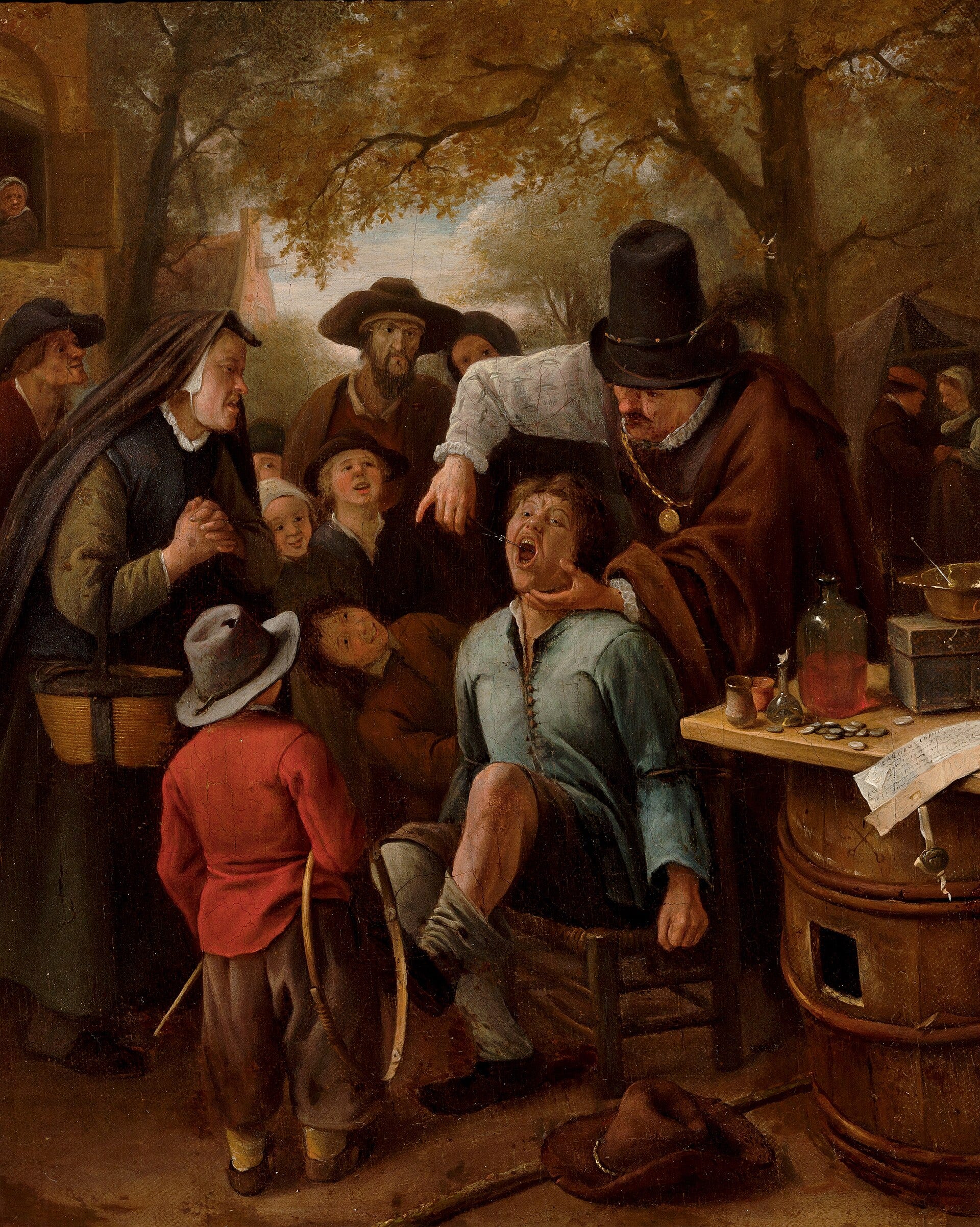
For centuries, a bad tooth came out in public. The patient sat on a stool in the market square, neighbors stopped to watch, and the man holding the pliers often sold ointments from the same table. Over four centuries, painters followed the trade from the fairground into a quiet room with a head lamp and an X-ray machine.
Cool Stories About Art is a newsletter to learn art the fun way.
Join 200,000+ readers and get:
10 new art stories / month
The entire archive of content (140+ articles)
Comment, ask questions, and chat with other readers
Pulling Teeth Before Dentistry Existed
Long before dentistry became a profession, teeth were pulled by barber-surgeons, by traveling tooth-drawers who went from fair to fair, and by quacks with a cure for everything. Painters found the scene ready-made for comedy, since the pain fell on one man and the entertainment on everyone around him.
Every work chosen here shows a tooth-puller, a dentist, a pulled tooth or a damaged mouth, and each holds a detail that someone in the profession can still read today: how the patient is held, where the light falls, which instrument is in use, what the operator does to win trust.
Pictures that used the dentist only as an excuse for a joke, with no actual work in view, stayed out.
12. Thomas Rowlandson, Transplanting of Teeth (1787)
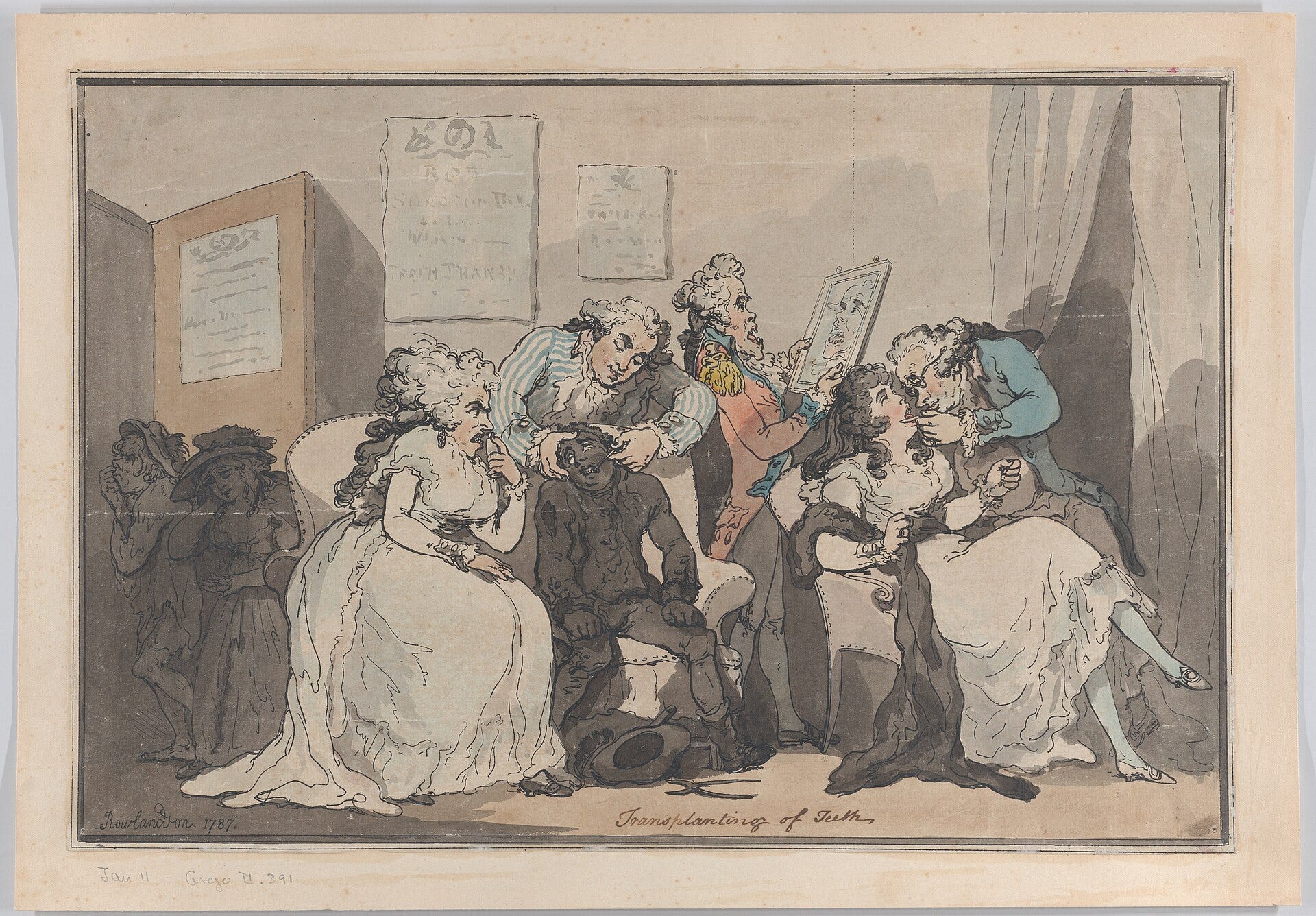
Nothing is wrong with the teeth of the young chimney sweep waiting in this crowded room. One of his healthy teeth is about to be pulled for the lady seated beside him, whose own has just come out.
Thomas Rowlandson, the London caricaturist, published this print, Transplanting of Teeth, in 1787, and the operation it mocks was perfectly real. In 1771 the surgeon John Hunter had explained, in The Natural History of Human Teeth, how a freshly pulled tooth could be pushed into someone else's empty socket and tied to the neighboring teeth with silk thread.
Everything depended on freshness. A transplanted tooth stood a chance only if it went straight from one mouth into the other, so donor and receiver had to be in the same room at the same moment, and the donors were poor people paid very little for a sound tooth. Rowlandson shows what that rule meant in practice: a fashionable treatment supplied by poor children.
The work itself goes on across the room. On the right, a dentist in spectacles operates inside a young woman's mouth while she clenches both fists, and behind them an officer inspects his teeth in a mirror.
The method did not last. Grafted teeth often worked loose, they could pass an infection from donor to receiver, and once porcelain dentures improved, transplanting was largely abandoned by the nineteenth century.
Long before it faded, Rowlandson had put its real cost on the left side of the print. Two children in rags are walking out, each with a hand pressed to the jaw, and the girl holds a coin in the other.
At a Glance
Artist: Thomas Rowlandson (1757 to 1827)
Made: 1787 (published by John Harris)
Medium: Hand-colored etching and aquatint
Size: 29.6 × 44.3 cm (11 5/8 × 17 7/16 in), sheet
Where to see it: Metropolitan Museum of Art, New York (other impressions at the British Museum, London)
11. Lucas van Leyden, The Dentist (1523)
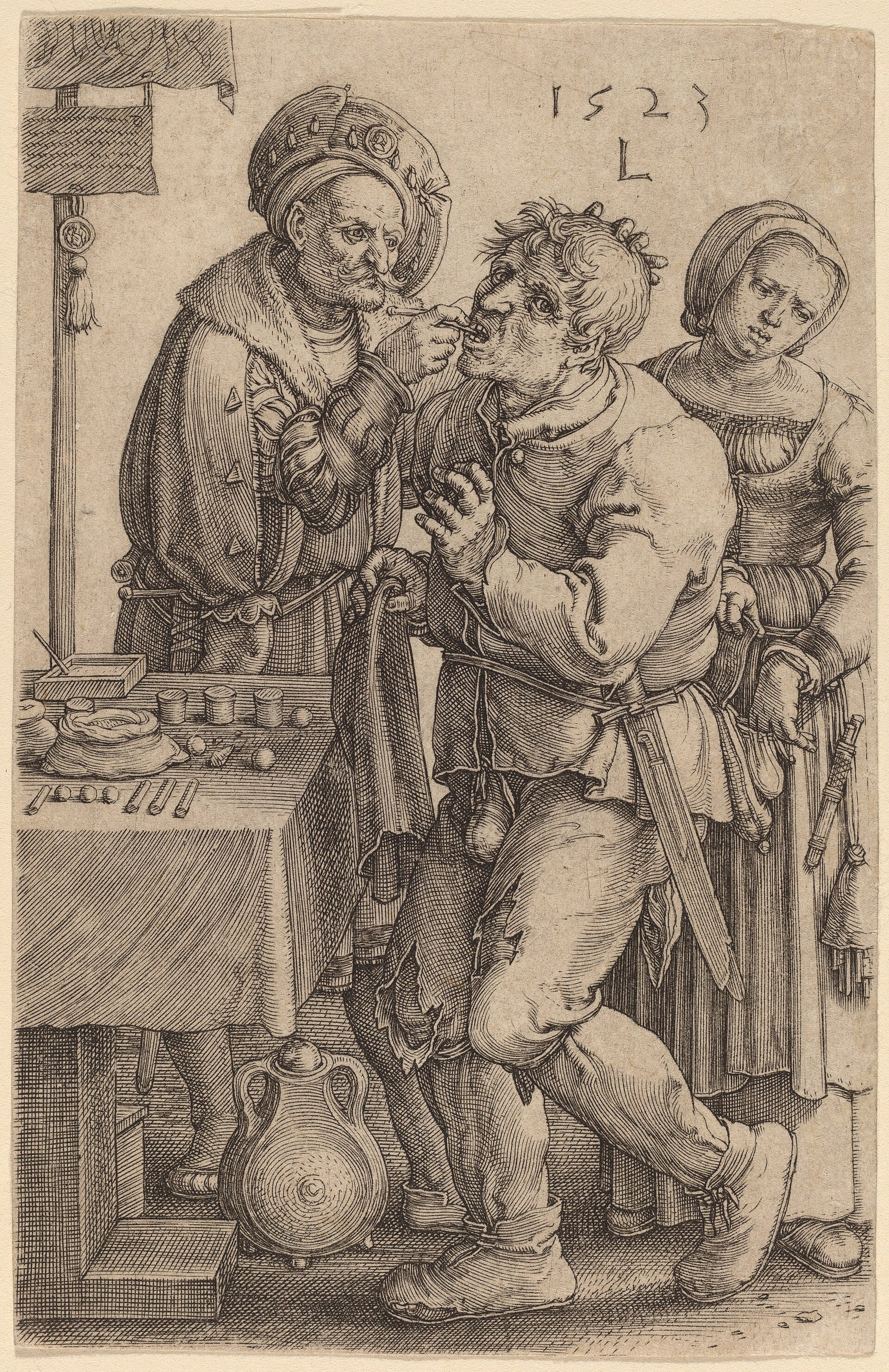
Head tipped back, mouth wide open, a peasant stands outdoors while a tooth-drawer leans over him and works inside it. Nothing supports his head, and there is no chair. Staring upward, he cannot see the woman just behind him, whose hand has crept toward the purse hanging at his belt.