
Deserts in painting are where Western art sent its saints, its armies and its nightmares. Twelve canvases of sand and rock, including the Sphinx painted before the excavations, a lion that made Paris argue for a century, and Dali’s emptiest landscape. The opposite subject, crowded harbours and working ports, gets the same treatment in Harbours and Ports in Painting.
Water break
One painter travelled to Egypt and Palestine and dragged a real goat to the Dead Sea to paint it there.
One desert lion has been debated since 1897 because nobody agrees if it is about to eat the sleeper.
The Sphinx appears here buried to the shoulders, which is how travellers actually found it.
One saint spent decades in the desert so painters could give him a skull and a lion.
The most famous melting clocks sit in a landscape modelled on a Catalan coastline, not a desert at all.
Learn art the fun way
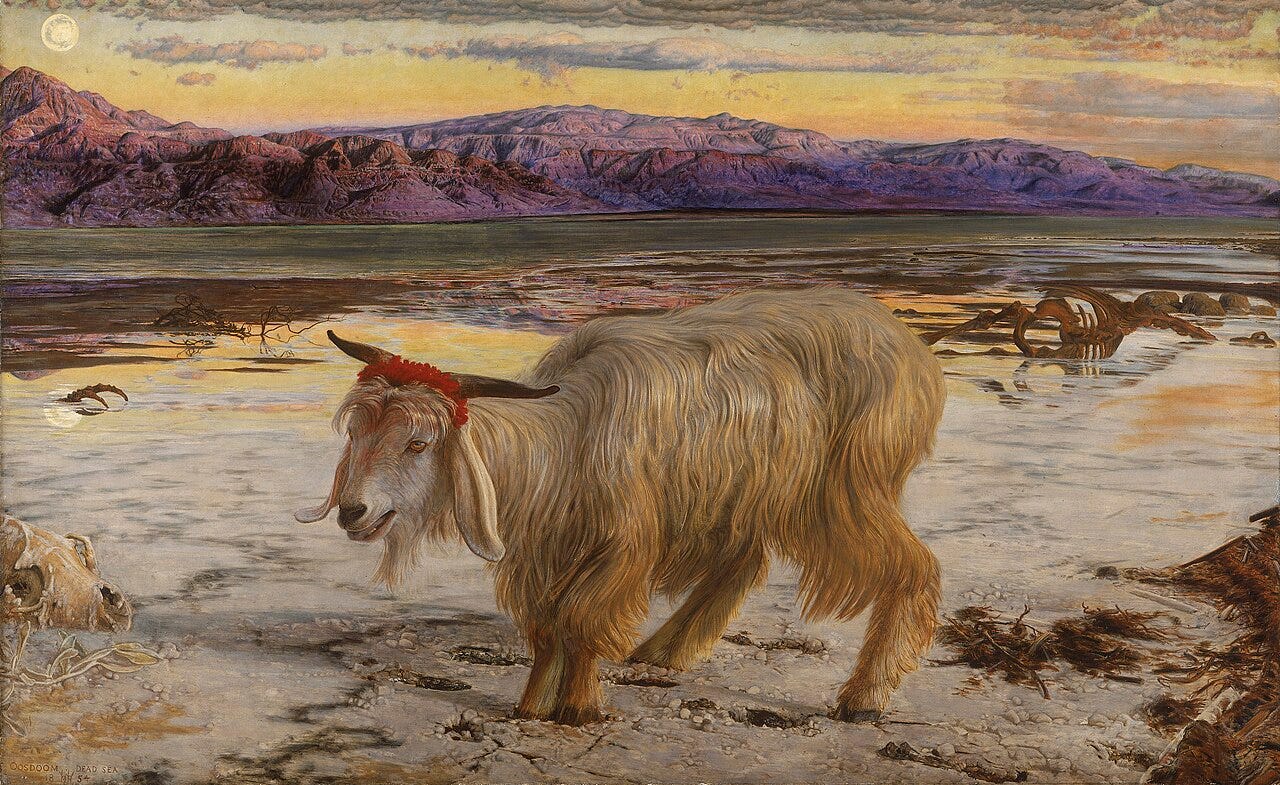
1 | The Scapegoat, William Holman Hunt (1856)
A white goat stands dying on the salt crust of the Dead Sea, horizon burning behind it. Hunt took a real goat to the shore and painted on site, guarded against bandits.
The first goat died on the journey. He bought another. The Pre Raphaelite fanatic I cover that in William Holman Hunt.
2 | The Sleeping Gypsy, Henri Rousseau (1897)
A lion sniffs a sleeping musician under a full moon on flat sand. Rousseau described it plainly and never explained whether the lion is hungry.
He never left France. The customs officer who invented his own world More of it in Henri Rousseau.
Rousseau painted it in 1897 and tried to sell it to the mayor of his home town, Laval, for two hundred francs. The mayor refused. It surfaced in a Paris coal merchant’s shop in 1923 and reached MoMA in 1939.
3 | Bonaparte Before the Sphinx, Jean Leon Gerome (1886)
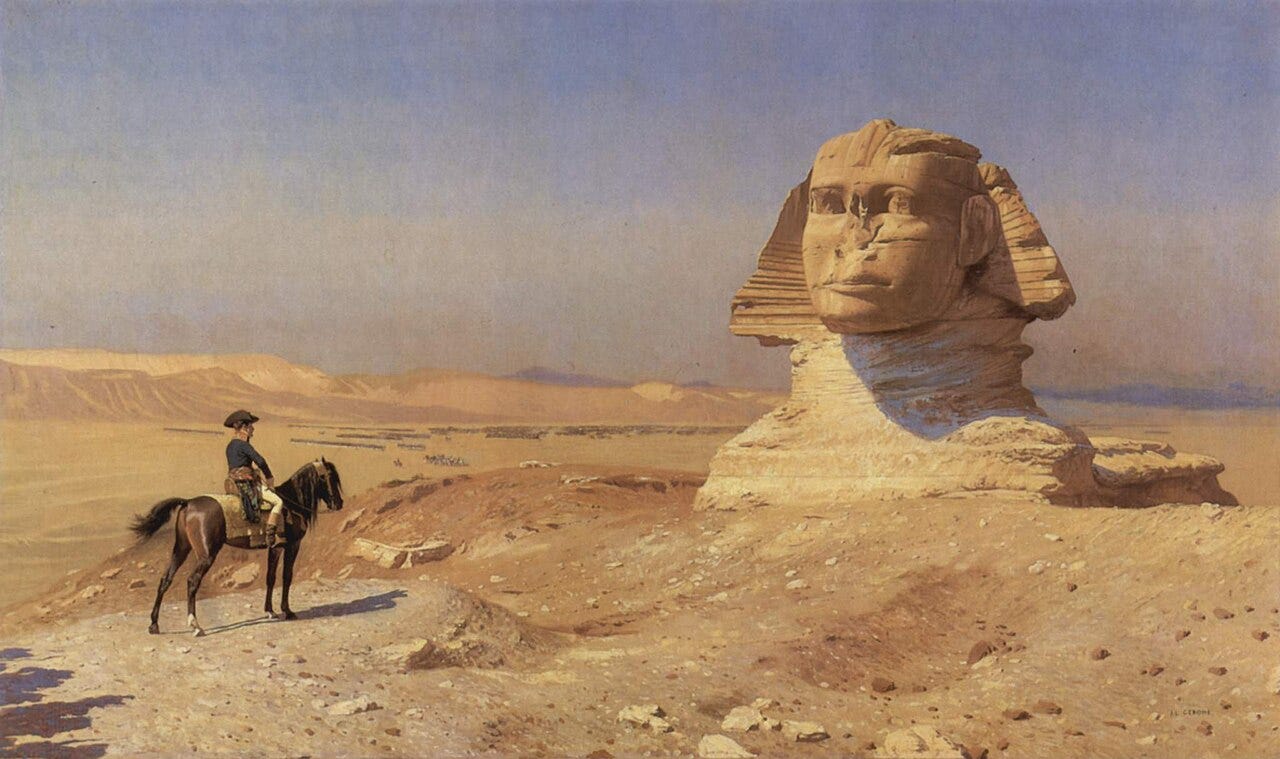
Napoleon on horseback faces the Sphinx buried to its shoulders, his army a thin line behind. Gerome painted it 80 years after the campaign.
The excavation that freed the Sphinx from the sand only finished in the 1930s. The Orientalist machine is in what is orientalism in art.
4 | Saint Jerome in the Wilderness, Leonardo da Vinci (about 1480)
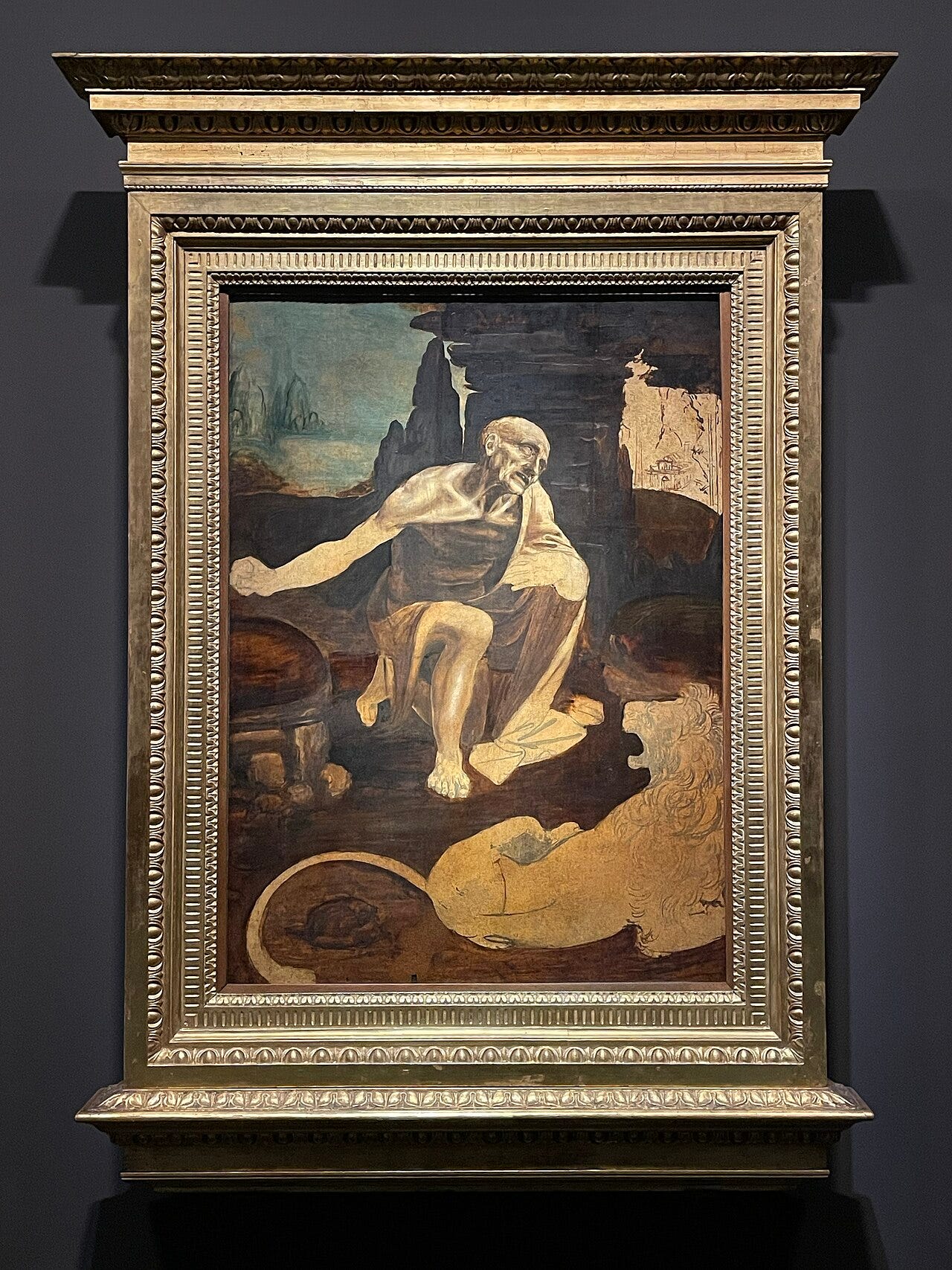
An unfinished panel of a starved saint kneeling on rock with a lion curling at his feet. The anatomy of the neck is drawn as if the skin were transparent.
It was found cut in two, one half used as a tabletop. I go into his whole story in Leonardo da Vinci.
5 | The Temptation of Saint Anthony, Hieronymus Bosch (about 1501)
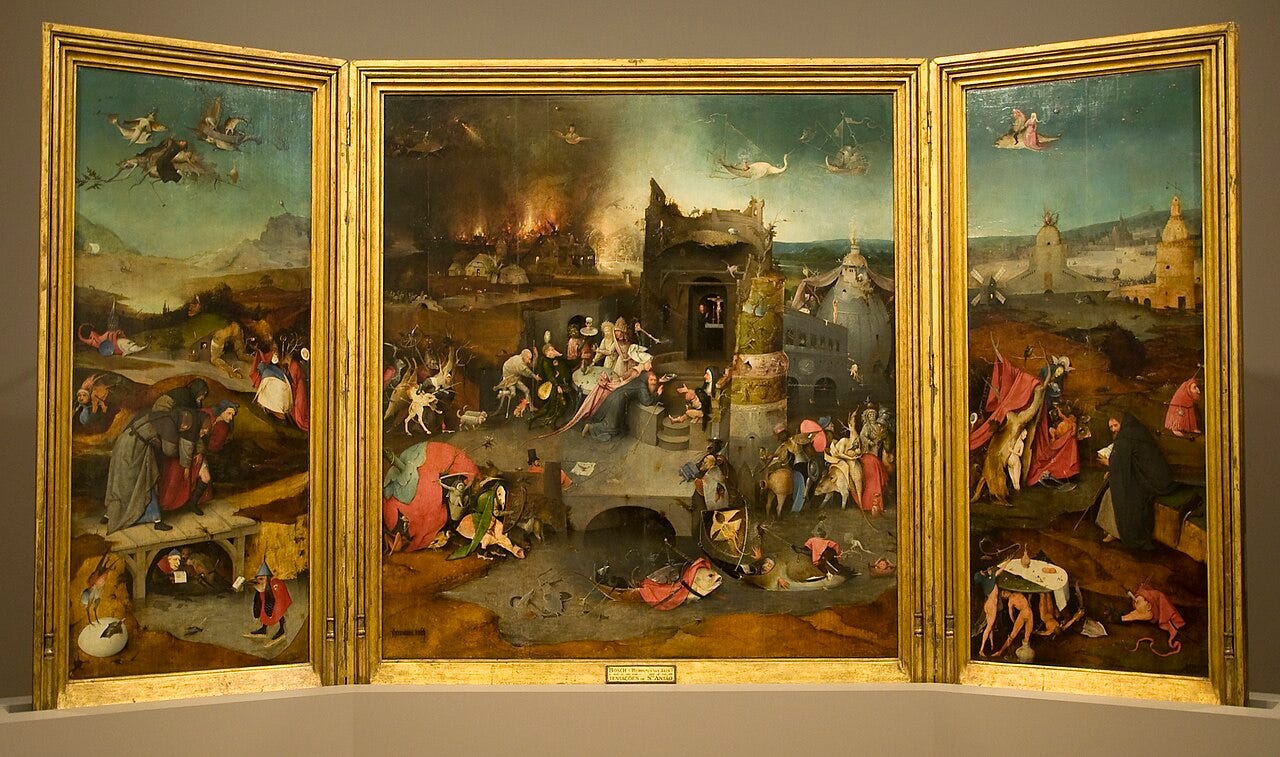
The Egyptian desert as a hallucination: fish flying, buildings walking, demons holding meetings. Anthony kneels in the middle of it, unmoved.
The desert fathers gave painters permission to draw anything. Bosch The full account is in Hieronymus Bosch.
Anthony withdrew into the Egyptian desert around 270, and the desert in Bosch is a landscape of ruins and hybrids rather than sand. The Lisbon triptych is the fullest version.
6 | The Snake Charmer, Jean Leon Gerome (about 1879)
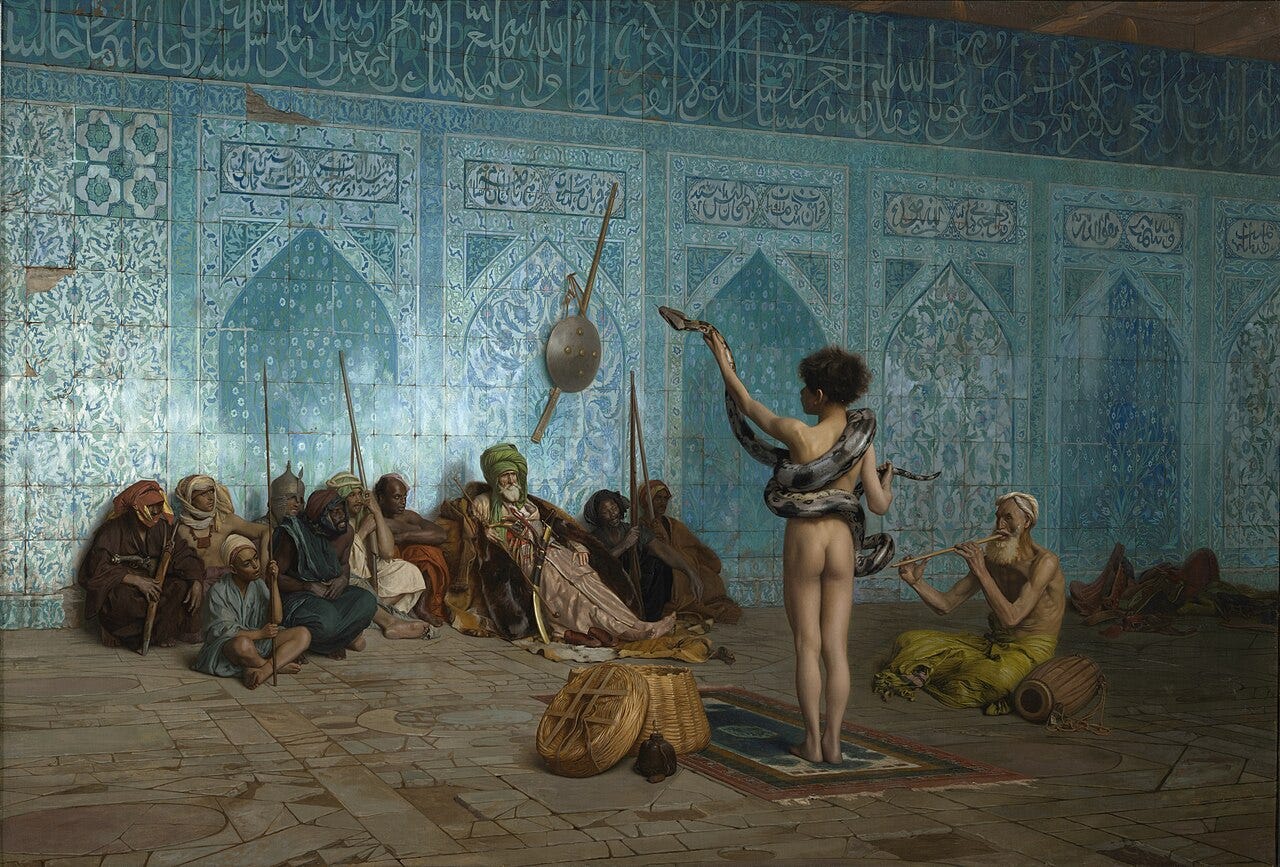
A boy handles a python before seated men against a tiled wall. Edward Said put this painting on the cover of Orientalism in 1978 and made it an argument.
The tiles, the weapons and the pose are assembled from different countries. It is a studio fantasy of a place.
7 | The Persistence of Memory, Salvador Dali (1931)
Soft watches drape over a branch and a shelf in an empty plain, with the cliffs of Cap de Creus in the distance. The desert here is mental.
Dali said the watches came from Camembert melting in the sun. More on him in Salvador Dali.
8 | The Flight into Egypt and the painted wilderness
The Holy Family crossing the desert gave landscape painters a licence to paint rocks, palms and empty distance for six centuries.
Poussin, Caravaggio and Elsheimer all used the journey as an excuse to paint nothing but land and sky.
Matthew 2 gives no detail, so painters filled the desert with a palm that bends to offer fruit, from an apocryphal gospel. Caravaggio put an angel playing the violin in the middle of it.
9 | The Desert of the American West, Frederic Remington (1900s)
Remington painted the arid West at dusk, cavalry and horses reduced to blue shapes, then wrote that he had painted the last of a vanishing frontier.
The vanishing was largely his own invention. It sold enormously well.
Frederic Church and the Hudson River painters travelled with survey expeditions, and the pictures were used to argue for settlement and for national parks. The scale was a political argument as much as a view.
10 | Grand Canyon, Thomas Moran (1873)
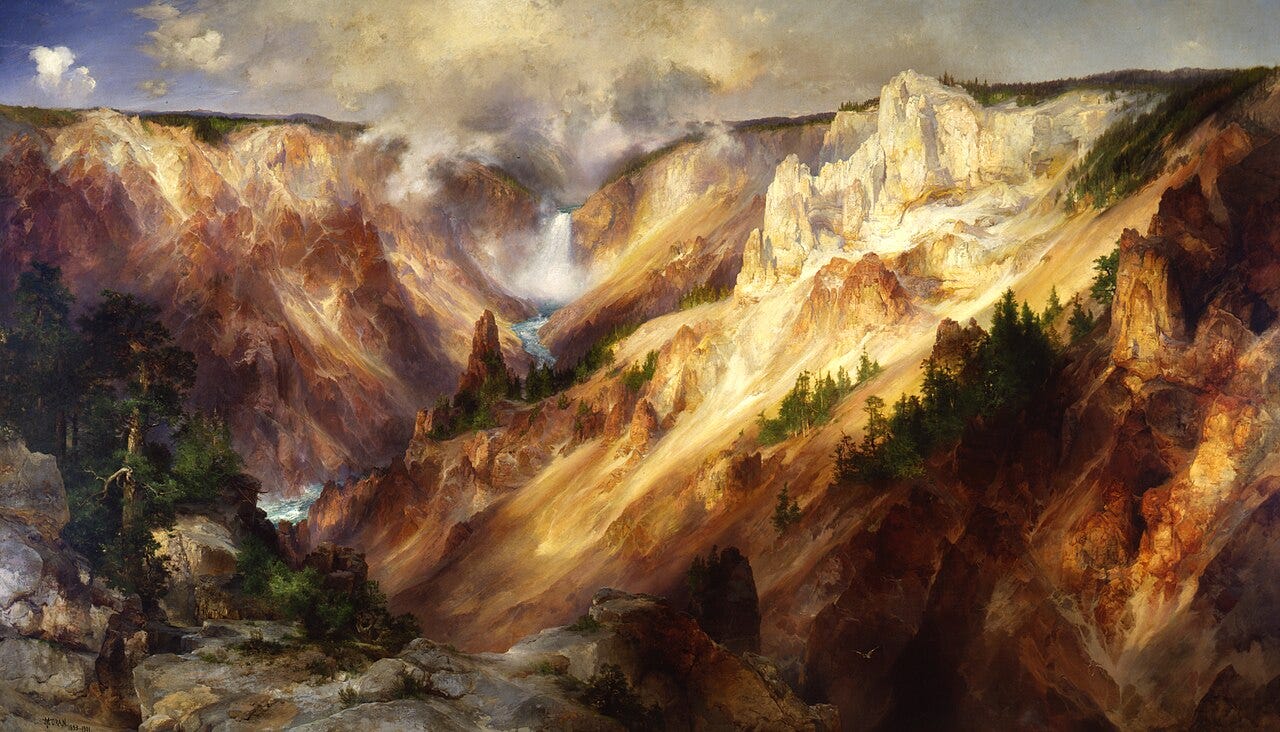
Moran travelled with the Hayden survey and turned geology into spectacle. Congress bought his canvas and used the image to help create the national parks.
Paintings that changed the law. The rest of his life is in Thomas Moran.
Moran travelled with the Powell survey in 1873. Congress bought his Grand Canyon of the Yellowstone for ten thousand dollars and hung it in the Capitol, and the park was created the year before.
11 | The Sahara, Gustave Guillaumet (1867)
An empty stretch of Algerian sand with a camel skeleton in the foreground and a caravan barely visible on the horizon. No romance at all.
Guillaumet lived in Algeria for long periods and painted hunger and heat rather than harems. Orsay owns it.
Guillaumet exhibited it at the Salon of 1868, with a single camel carcass in an empty plain and the horizon set very low. He crossed the Algerian desert several times and nearly died of fever on the first trip.
12 | The Israelites in the Desert and Old Testament sand
Manna, thirst, golden calves and forty years of walking: the Exodus gave European painters their biggest desert commissions.
Poussin’s Gathering of the Manna was the painting the French Academy used to teach how to compose a crowd. I cover him properly in Nicolas Poussin.
The Met holds the largest public group of these desert scenes, and the Rijksmuseum has the biblical wilderness side.
Sand and saints: what readers ask
Which one would I put first? Rousseau’s Sleeping Gypsy, with Dali’s Persistence of Memory as the psychological desert.
Did Holman Hunt really paint at the Dead Sea? Yes, with a real goat and an armed guard. The first goat died before he could finish.
Why is the Sphinx shown buried? Because it was. Sand covered it to the shoulders until excavations completed in the 20th century.
Is the lion in The Sleeping Gypsy dangerous? Rousseau never said. He described the scene flatly and left the threat entirely open.
Where is The Scapegoat today? MoMA for Rousseau and Dali, Manchester for the Scapegoat, Orsay for Guillaumet, the Vatican for Leonardo’s Jerome.
A final note from the archives: when Congress bought Thomas Moran’s Grand Canyon for 10,000 dollars in 1874, it was the first landscape the United States government ever purchased. The painting helped argue the parks into existence.
This subject is one thread in a wider theme. See how it fits into Cities and Places in Painting.