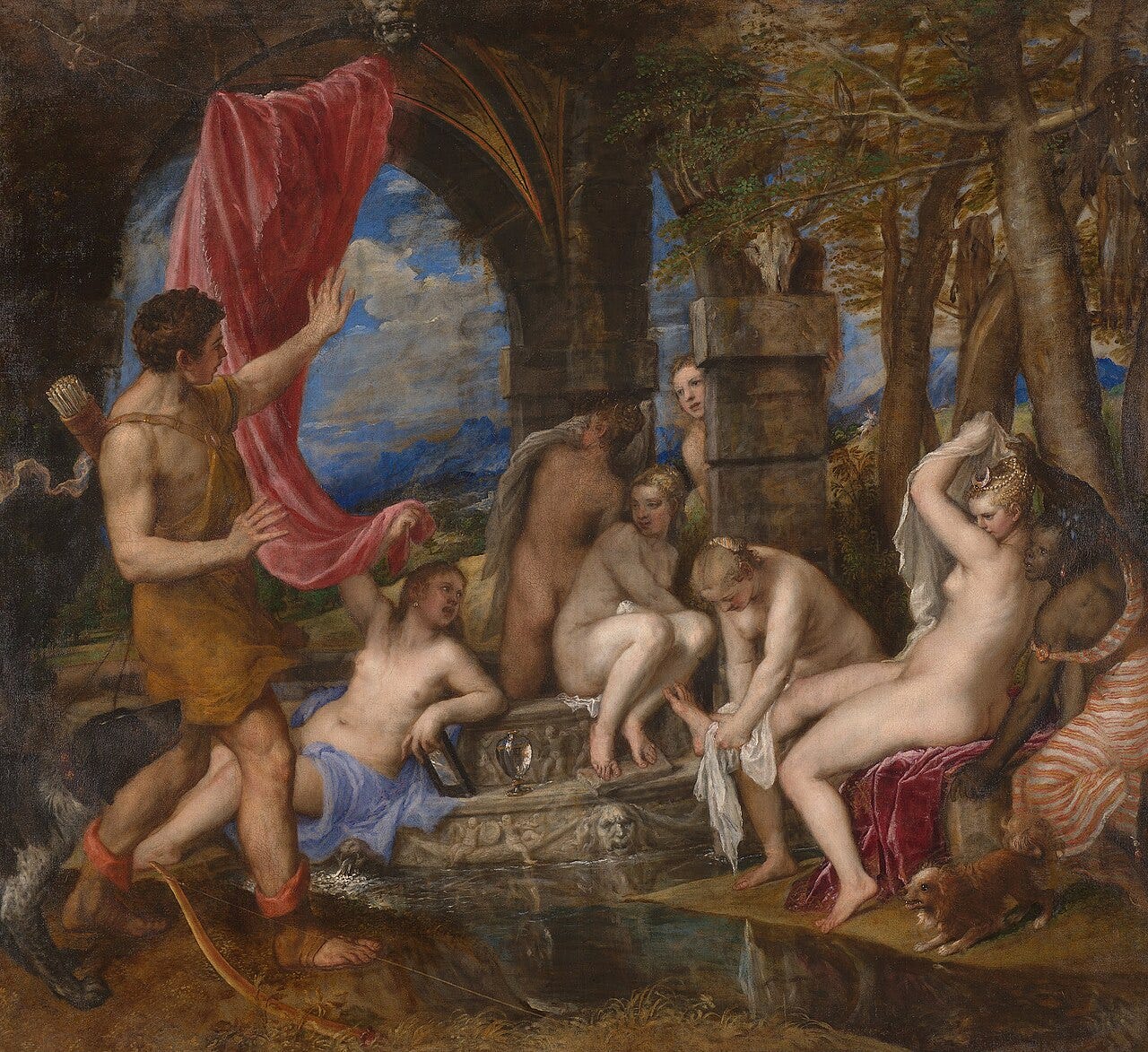
Diana and Actaeon in Painting: Titian, Myth, Meaning

In 2009, two national museums pooled 50 million pounds to buy a single canvas. The National Gallery in London and the National Galleries of Scotland now own it together, and they trade custody every five years, like divorced parents sharing a child.

Titian's Diana and Actaeon, the hunter stumbling on the goddess and her bathing nymphs
Titian, Diana and Actaeon, 1556 to 1559, National Gallery, London, and National Galleries of Scotland

Diana and Actaeon was painted by Titian between 1556 and 1559 for King Philip II of Spain. Since 2009 it has been jointly owned by the National Gallery, London and the National Galleries of Scotland, which acquired it from the Bridgewater Collection for 50 million pounds.

That price tag tells you how the art world ranks this picture. The myth behind it explains why painters kept returning to the subject for centuries.

The painting Philip II ordered

Titian's Diana and Callisto, a companion piece to Diana and Actaeon for Philip II
Titian, Diana and Callisto, 1556 to 1559, National Gallery, London, and National Galleries of Scotland

Between 1549 and 1562, Titian produced six large mythological paintings for Philip II of Spain. He called them poesie, poems in paint, scenes drawn from classical myth and treated with the freedom of a poet rather than the duty of an illustrator.

Diana and Actaeon, oil on canvas, 184.5 by 202.2 centimeters, was finished between 1556 and 1559. Titian conceived it as a pair with Diana and Callisto, another scene of the goddess and her nymphs, and the two canvases still travel together.

The composition catches the exact second everything goes wrong. Actaeon, a hunter, pushes aside a curtain of fabric at the left edge and freezes. In front of him, Diana and her nymphs bathe nude in a secluded grotto, and the goddess turns, caught in the instant of being seen.

Nothing violent has happened yet. That is the point. Titian paints the silence before the sentence.

The myth in full

The story comes from Greek mythology, where Diana is Artemis, goddess of the hunt and of chastity. Actaeon was out hunting with his hounds when he wandered, by pure accident, into a hidden grove where the goddess was bathing with her nymphs.

He did not spy. He stumbled. It made no difference.

Furious that a mortal man had seen her naked, Diana splashed him with water and transformed him into a stag. His human mind stayed trapped inside the animal body, but his voice was gone.

He could not speak. He could not call off his own hunting dogs, who no longer recognized their master. His pack chased him down and tore him apart.

New here? Learn art the fun way. Free stories every week, no boring lectures.

Two moments, often confused

Actaeon transformed with antlers and killed by his hounds in Titian's Death of Actaeon
Titian, The Death of Actaeon, about 1559 to 1575, National Gallery, London

Titian painted this story twice, and the two canvases show different points in the tragedy. People mix them up constantly.

Diana and Actaeon shows the discovery. Actaeon is still fully human, still holding his gear, just glimpsed by the group. His death exists only in Diana's turning glance.

The Death of Actaeon, a later canvas by Titian, shows the ending. There Actaeon is already transformed, antlers on his head, and his hounds are killing him while Diana strides through the foreground.

Same story, same painter, two separate pictures. If you see antlers, you are looking at the punishment. If you see a man, you are looking at the mistake.

How to recognize a Diana and Actaeon scene

Rubens's Diana and her nymphs surprised while bathing, a related bathing scene
Peter Paul Rubens, Diana and her Nymphs Surprised by the Fauns, about 1638 to 1640, Museo del Prado, Madrid

The subject has a fixed set of identifiers, and once you know them you can spot it across centuries of painting.

The setting is always a grotto or a secluded bathing spot near water. The scene needs multiple nude or partially nude female bathers, Diana and her nymphs, caught by surprise.

At the edge stands the intruder, a male hunter, often still holding a spear or accompanied by dogs. His position matters. He is on the threshold, arriving, not part of the group.

Then check his head. No antlers means the discovery moment, the version Titian chose for Philip II. Stag antlers sprouting from a human skull mean the painter chose the transformation, or the seconds just after it, when the story tips into horror.

FAQ

Why did Diana punish Actaeon so harshly?

Because he was a mortal man who saw a virgin goddess naked. In Greek myth, the offense counts even when it is accidental. Diana's domain was chastity as much as hunting, and the transgression demanded punishment regardless of intent.

Where can I see Titian's Diana and Actaeon?

It alternates between the National Gallery in London and the Scottish National Gallery in Edinburgh, switching venues on five year terms along with its companion Diana and Callisto. Check the current host institution before visiting.

Is Diana and Actaeon the same painting as The Death of Actaeon?

No. Diana and Actaeon, finished between 1556 and 1559, shows the hunter still human at the moment of discovery. The Death of Actaeon is a separate, later Titian showing him transformed into a stag and killed by his hounds.

What is the poesie series?

Six large mythological paintings Titian made for King Philip II of Spain between 1549 and 1562. Diana and Actaeon and Diana and Callisto belong to this group, conceived as a pair.

Enjoyed this? Join the readers who learn art the fun way, free every week.

The 2009 purchase from the Bridgewater Collection cost exactly 50 million pounds, raised through a joint public campaign, for a canvas measuring 184.5 by 202.2 centimeters.

Related reading