Diego Rivera: The Complete Story
Diego Rivera was the Mexican painter who covered walls with vast murals of workers, farmers, machines and revolution. The giant of the Mexican Mural Movement, he revived fresco on a public scale, put ordinary Mexicans at the center of national history, and married, twice, the artist Frida Kahlo.
He was enormous in every sense: in size, in appetite, in politics and in ego. His art was meant for the street and the factory, not the private collector.
Born: Guanajuato, Mexico, 1886
Known for: public murals, the Mexican Mural Movement
Died: Mexico City, 1957
More incredible painter stories
If Diego Rivera pulled you in, you will love these too:
Diego Rivera at a glance
1886. Born in Guanajuato, Mexico, a twin whose brother died at two.
1913. Deep in Cubism in Paris, exhibiting alongside the avant garde.
1929. Married Frida Kahlo, the first of their two marriages.
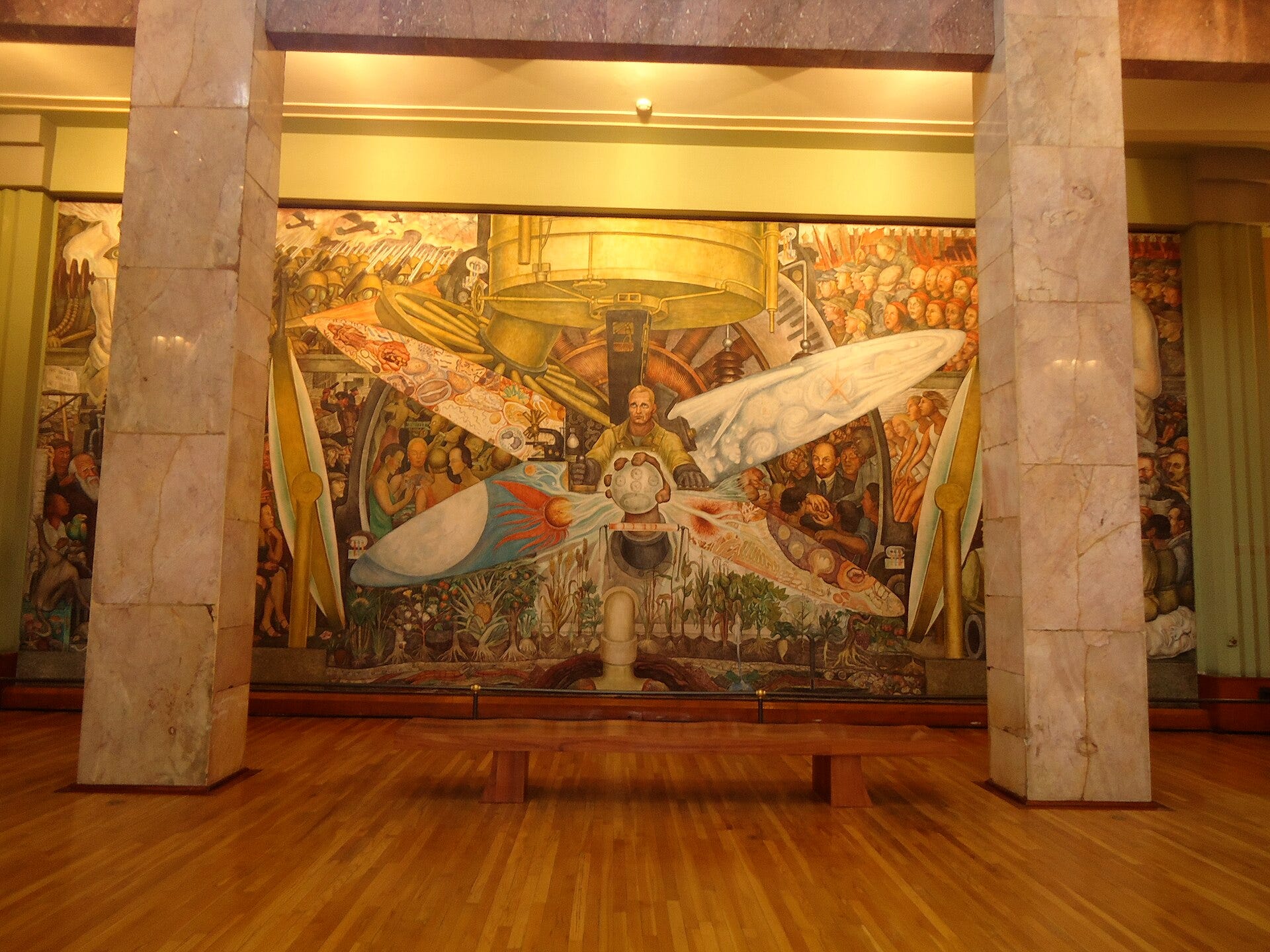
1933. His Rockefeller Center mural was halted over a portrait of Lenin, then destroyed the next year.
1957. Died in Mexico City. His studio and his stone museum, Anahuacalli, are both open today.
Murals for the people
After years in Europe absorbing Cubism and studying Italian fresco, Rivera returned to Mexico in the 1920s, when the new government wanted art that could teach a largely illiterate nation its own history.
He painted huge frescoes on public buildings, telling the story of Mexico from the Aztecs to the revolution.
His style is strong and clear, crowds of solid, dignified figures, designed to be read from across a courtyard. See the technique behind it in what is fresco painting.
Politics on the wall
Rivera was a committed Communist, and his murals are full of workers, peasants and class struggle. That politics made him famous and got him into trouble.
His mural at New York's Rockefeller Center was destroyed in 1934 because he refused to remove a portrait of the Soviet leader Lenin.
He simply repainted the work later in Mexico. His Detroit Industry murals, celebrating the auto workers, are among his greatest.
Diego and Frida
Rivera's marriage to Frida Kahlo is one of the most famous and turbulent in art. They wed, divorced and remarried, and both had many affairs, including Rivera with Frida's own sister.
She called him the second great accident of her life, after the bus crash that injured her. Their story is told in the paid feature the tragic life of Frida Kahlo.
The Cubist decade nobody expects
Before the walls, Rivera spent the 1910s in Paris painting Cubism, around two hundred canvases of it.
He knew Picasso, quarreled with the critics, and mastered the style well enough to be accused of copying too closely.
When he sailed home in 1921, he dropped it almost overnight. Mexico needed walls, not still lifes.
Anahuacalli, the temple he built
Rivera collected pre Hispanic sculpture obsessively, some fifty thousand pieces.
To house them he designed Anahuacalli, a pyramid of black volcanic stone south of Mexico City.
He poured mural money into it for years. It opened to the public after his death and still holds the collection.
Painted in front of a paying crowd
At the Golden Gate exposition in San Francisco in 1940, Rivera painted Pan American Unity on a scaffold in public view.
Visitors bought tickets partly to watch him work, brush in one hand, cigar nearby.
At over twenty two meters wide, it is among the largest things he ever made.
The Diego Rivera questions that keep coming up
What is Diego Rivera famous for?
Monumental Mexican murals of history, labor and revolution.
Was he married to Frida Kahlo?
Yes, twice. More surprising details in interesting facts about Diego Rivera.
Why was his Rockefeller mural destroyed?
He refused to remove a portrait of Lenin, so it was demolished.
Was Diego Rivera a Cubist? Yes, for nearly a decade in Paris in the 1910s, painting around two hundred Cubist works before dropping the style when he returned to Mexico.
What is Anahuacalli? The black volcanic stone museum Rivera built south of Mexico City for his collection of tens of thousands of pre Hispanic pieces.
More secrets to unlock
Why the walls still speak
Rivera made art a public, political force and gave a nation images of itself that still shape Mexican identity. His walls turned history into something a whole country could walk up to and read.
He was so large and colorful that he spun his own myths, claiming at times to have eaten human flesh as an experiment, a tall tale that says more about his showmanship than his diet.