
Diego Velazquez was the greatest painter of Spain’s Golden Age and the court painter to King Philip IV. His greatest work, Las Meninas, is often called the finest painting in the world.
Working over thirty years at the court of Philip IV, he painted royals, jesters and an enslaved assistant with the same unflattering honesty, in brushwork so loose it looks centuries ahead of its time, and he was knighted before his death in 1660.
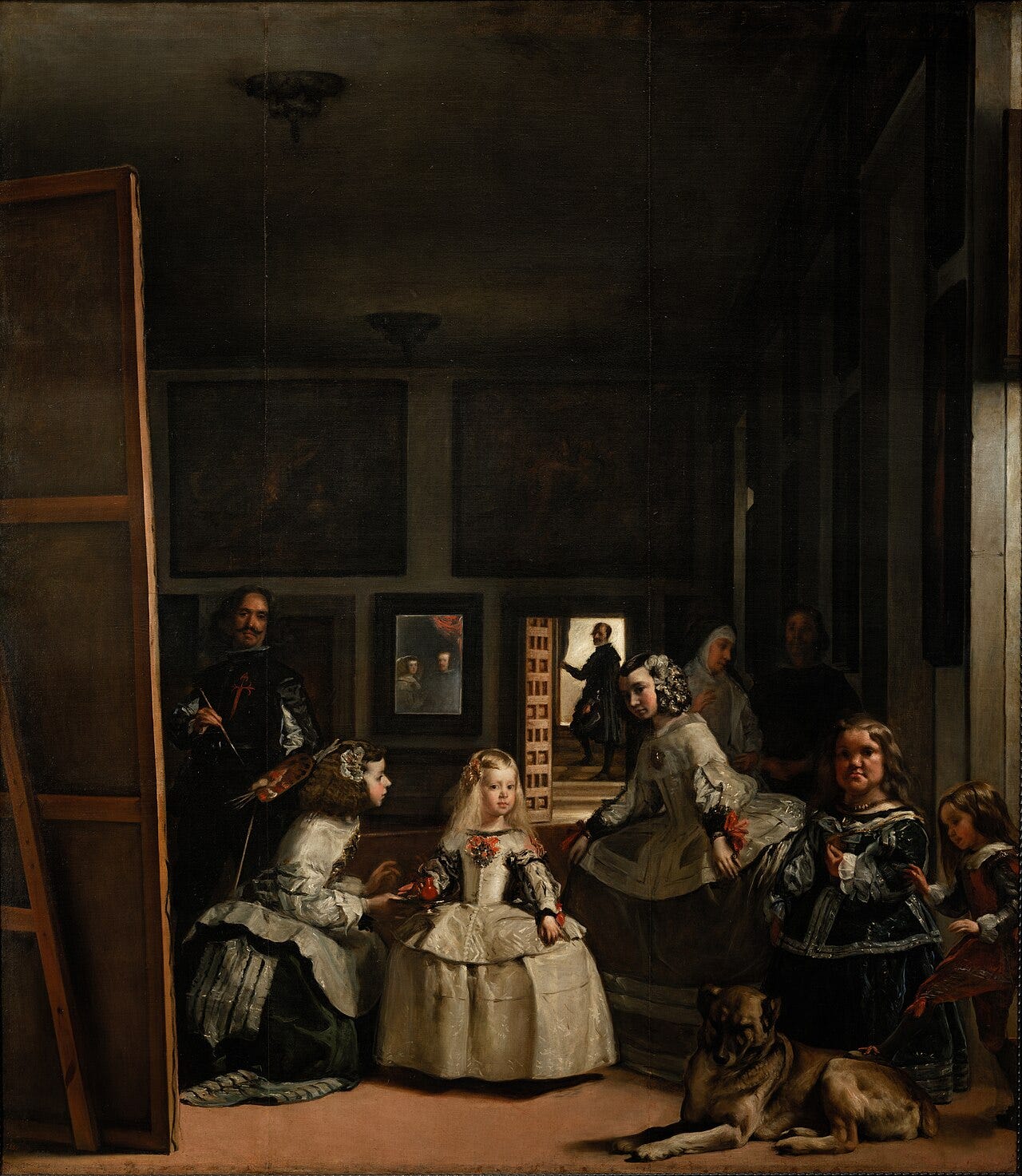
He painted kings and queens, but also dwarfs, jesters and an enslaved assistant, all with the same calm, unflinching dignity. Up close his brushwork dissolves into loose, modern strokes; step back, and it snaps into breathing life.
More incredible painter stories
If Diego Velazquez pulled you in, you will love these too:


Centuries later, Manet called him the painter of painters, and Picasso obsessed over him. Here is the whole story.
Diego Velázquez at a glance
1599. Born in Seville, apprenticed young to Francisco Pacheco.
1623. One trial portrait of Philip IV made him court painter at 24.
1650. Painted Juan de Pareja in Rome and signed his freedom papers the same year.
1656. Las Meninas.
1660. Died in Madrid weeks after staging a royal wedding on the French border, a knight of Santiago for barely a year.
The Spanish Golden Age
Velazquez worked at the height of Spain’s power, in the era of Baroque art, when painting aimed for drama, realism and grandeur.
The eye that refused to flatter
Velazquez is famous for Las Meninas and for a kind of truth no one had matched.
He refused to flatter. His portraits show real faces, tired eyes, weak chins and all, and he gave the same serious attention to a court dwarf as to the king. That radical equality of gaze is why artists still treat him as a god.
Loose up close, alive from afar
A Velazquez rewards stepping close, then back.
Loose brushwork. Up close, faces and lace become free, sketchy strokes, astonishingly modern for the 1600s.
Real light and air. He painted the space and atmosphere between figures, not just the figures.
Calm dignity. No melodrama. His sitters simply are, watchful and alive.
Silvery color. Cool greys, blacks and pinks rather than gaudy brightness.
His early Seville work leans on the dark shadows of tenebrism, close to Caravaggio.
Kings, dwarfs, and an enslaved painter
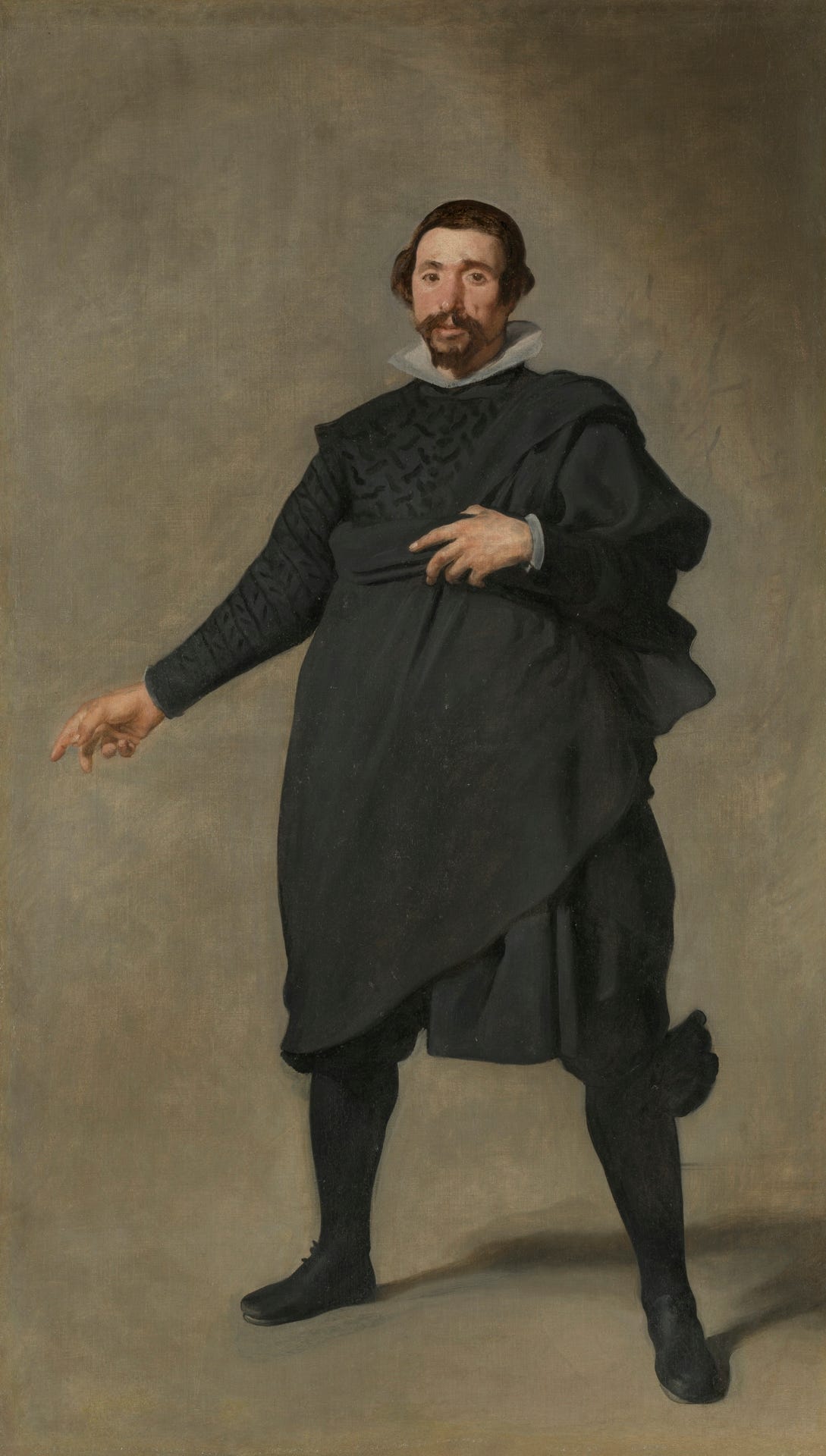
Velazquez is unique for who he chose to take seriously. Alongside Philip IV and the royal children, he painted the court’s dwarfs and jesters as full human beings, thoughtful and proud, never as objects of fun.
Las Meninas
His supreme work, Las Meninas, shows the little princess and her maids in his studio, with the king and queen appearing only as a reflection in a mirror, and Velazquez himself at his easel, looking out at us.
Who is the real subject? Where do we, the viewers, stand? It has fascinated philosophers and painters for 350 years. For me it is the deepest picture ever made, and Picasso agreed enough to repaint it 58 times in 1957.
What Titian and Rubens gave him
Velazquez learned from Spanish realism and from the giants of Italy and Flanders.
A painter who became a nobleman
Velazquez was as ambitious at court as at the easel. He climbed through palace ranks, spending much of his energy on royal ceremonies and decoration.
Near the end of his life he was made a knight of the noble Order of Santiago, a rare honor for a painter, and its red cross appears on his chest in Las Meninas.
How Velazquez died
In 1660 Velazquez organized the lavish festivities for a royal wedding on the French border, an exhausting job.
He returned to Madrid worn out, fell ill, and died that summer at 61. His wife died just days after him.
The Prado, above all
One museum holds the heart of his work.
The Museo del Prado, Madrid. The essential stop, home to Las Meninas and most of his greatest works.
Major museums abroad. The National Gallery in London, the Met and others hold key portraits.
Abroad, the Metropolitan Museum of Art in New York holds his portrait of Juan de Pareja, once a record breaking auction sale.
The boy from Seville, born in 1599
Diego Velazquez was born in Seville in 1599 and baptized there on the sixth of June that year. His full name was Diego Rodriguez de Silva y Velazquez.
His father was a lawyer of Portuguese descent, and the boy took his mother's family name, Velazquez, as painters often did.
Seville then was the richest city in Spain. Ships from the Americas unloaded silver on its docks, and the money paid for churches, convents and portraits.
A clever child with a steady hand had somewhere to go. By his early teens Diego was already set on paint, and his family placed him with the best teacher in town.
He would leave Seville young and spend most of his life in Madrid, but the plain, direct looking he learned as a boy never left his work.
The workshop of Francisco Pacheco
Around 1611 the young Velazquez entered the studio of Francisco Pacheco for a six year apprenticeship.
Pacheco was a scholar and writer as much as a painter. His workshop ran like a small school, teaching drawing, church rules for religious images, and the trade of running a studio.
Two other Seville painters, Zurbaran and Alonso Cano, passed through the same rooms.
The bond went beyond training. In 1618 Velazquez married Pacheco's daughter, Juana, when he was about eighteen. Pacheco later wrote proudly that he gave his daughter to his pupil for his virtue and his promise.
The couple had two daughters. The connection also gave Velazquez his first real network of church and city patrons.
Kitchen pots and a glass of water
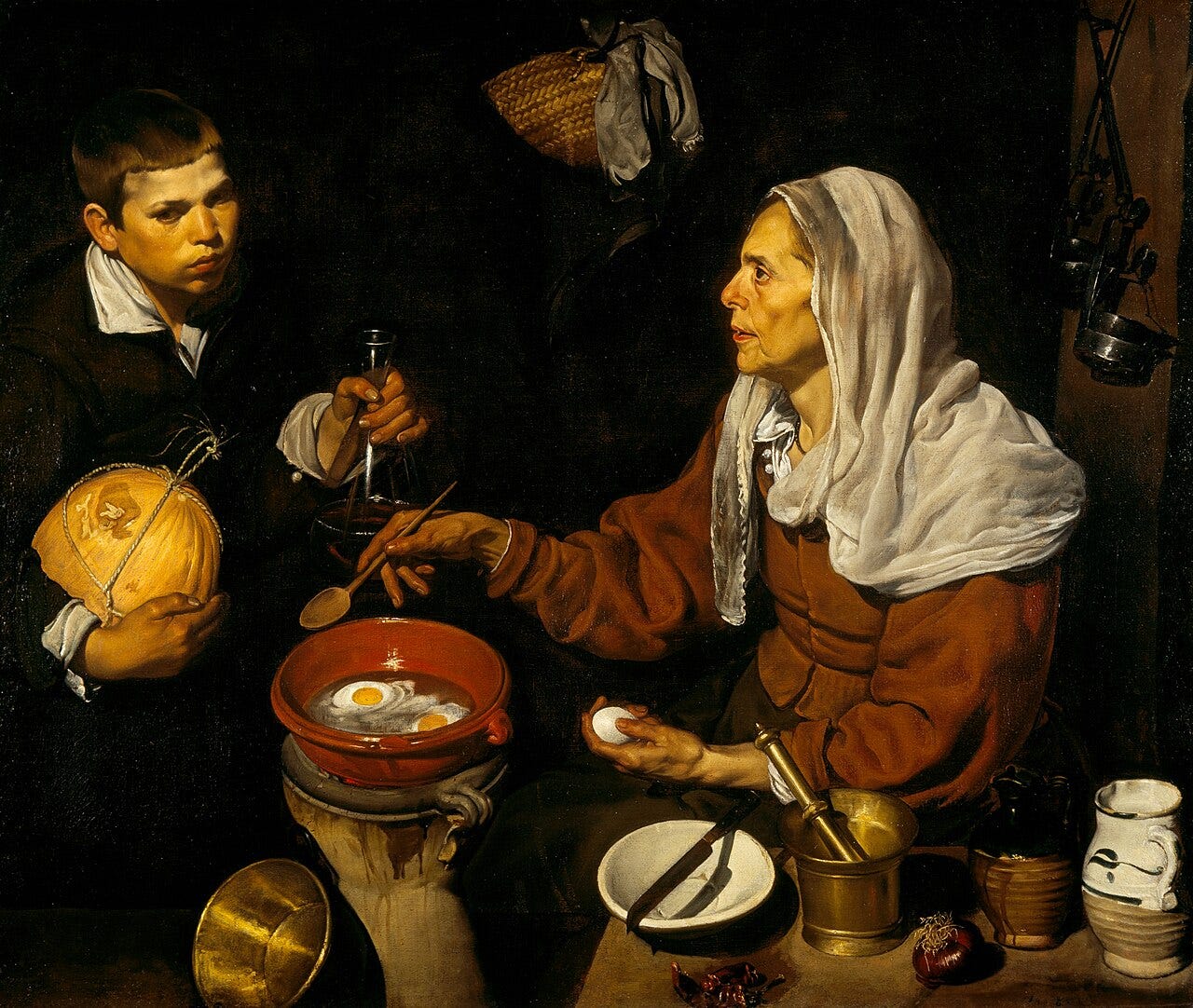
Before he ever painted a king, Velazquez painted cooks, beggars and cheap crockery. These early Seville pictures are called bodegones, a word that points to taverns and kitchens.
The Old Woman Frying Eggs, dated 1618, shows an old woman at her pan while a boy holds a melon and a flask. You can almost weigh the brass pot and the clay bowls.
The Waterseller of Seville, painted around 1620, is stranger still. A ragged man hands a glass of water to a boy, and a single drop runs down the side of a huge earthenware jar.
He was still a teenager, painting poor people with the care most artists saved for saints. That refusal to look away became his whole method.
The trial portrait that changed his life
In the summer of 1623 Velazquez was called to Madrid to paint the young king, Philip IV.
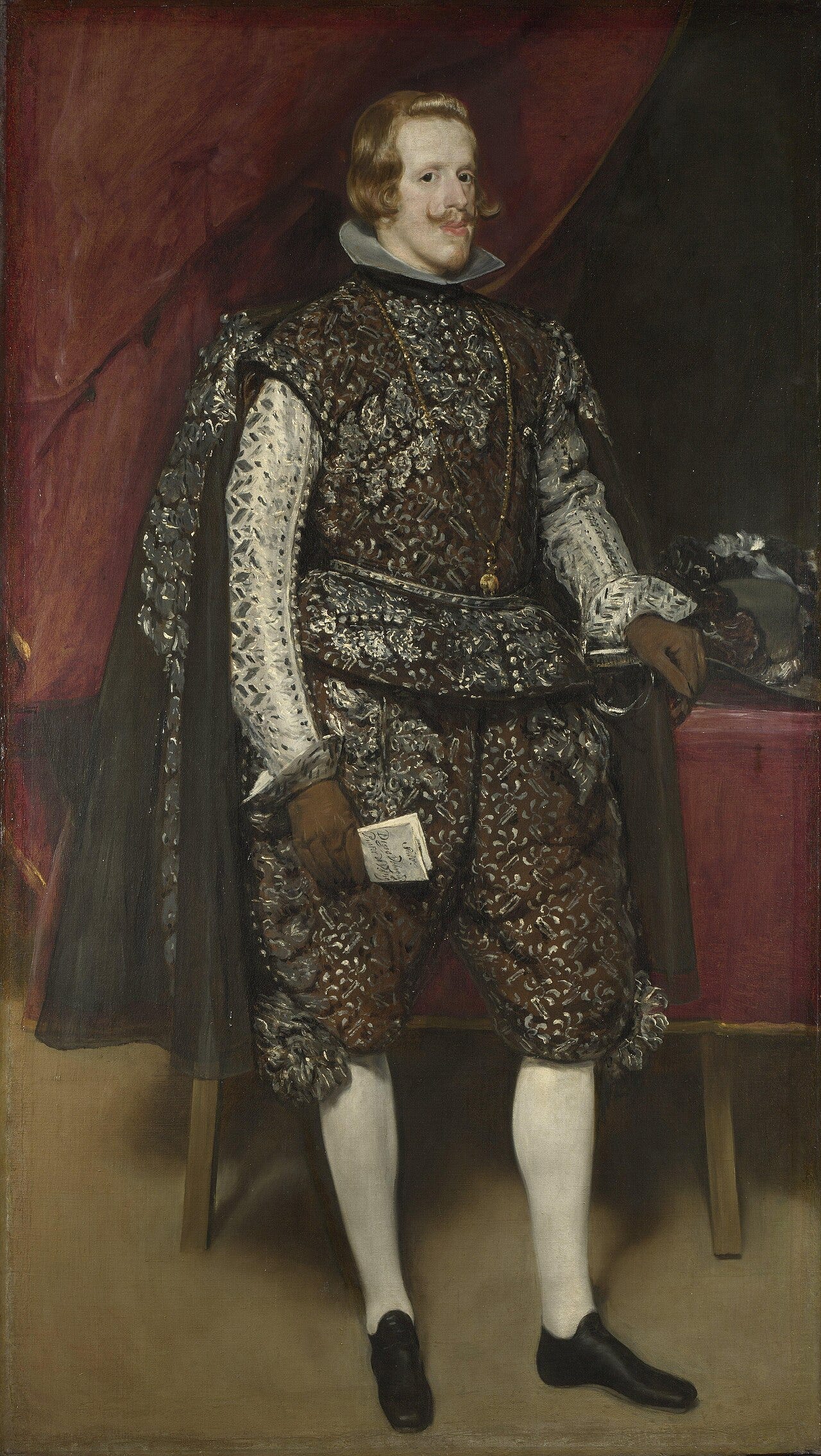
Philip was eighteen. Velazquez was twenty four. The first portrait pleased the king so much that it led to Velazquez being named official painter to the crown.
The reward was total. The king declared that from then on only Velazquez would paint his portrait, and the artist stayed tied to the court for the rest of his life.
He never really worked for anyone else again. Everything after this, the equestrian pictures, the little princesses, the dwarfs, Las Meninas, grew out of that one trial canvas.
For a provincial painter of twenty four, it was the rarest kind of luck.
The first journey to Italy, 1629 to 1631
Velazquez made his first trip to Italy from June 1629 to January 1631.
The timing matters. The great Flemish painter Peter Paul Rubens had spent months at the Madrid court not long before, copying the king's Titians and talking with Velazquez.
Rubens is often credited with encouraging the younger man to go and see Italy for himself.
With the king's leave and a small allowance, Velazquez sailed for Genoa, then moved on to Venice and Rome. In Rome he painted two large canvases, The Forge of Vulcan and Joseph's Coat, both now in Spain.
In them you can see him testing everything Italy had to teach about the human body, deep space, and warm light.
The second journey to Italy, 1649 to 1651
Nearly twenty years later the king sent Velazquez back to Italy, this time as a buyer.
The trip ran from 1649 to 1651. Its main purpose was to gather paintings and antique sculptures for the royal collection in Madrid. Velazquez visited Venice, Naples and Rome, spending the king's money on works by the Venetian masters he loved.
He was now a famous man abroad, not a student. Along the way he painted some of his sharpest portraits, including the one of his assistant Juan de Pareja and the picture of the pope.
The king grew impatient and wrote asking him to come home. Velazquez, enjoying Rome and its art, took his time before finally returning to Spain in 1651.
The pope who found it too truthful
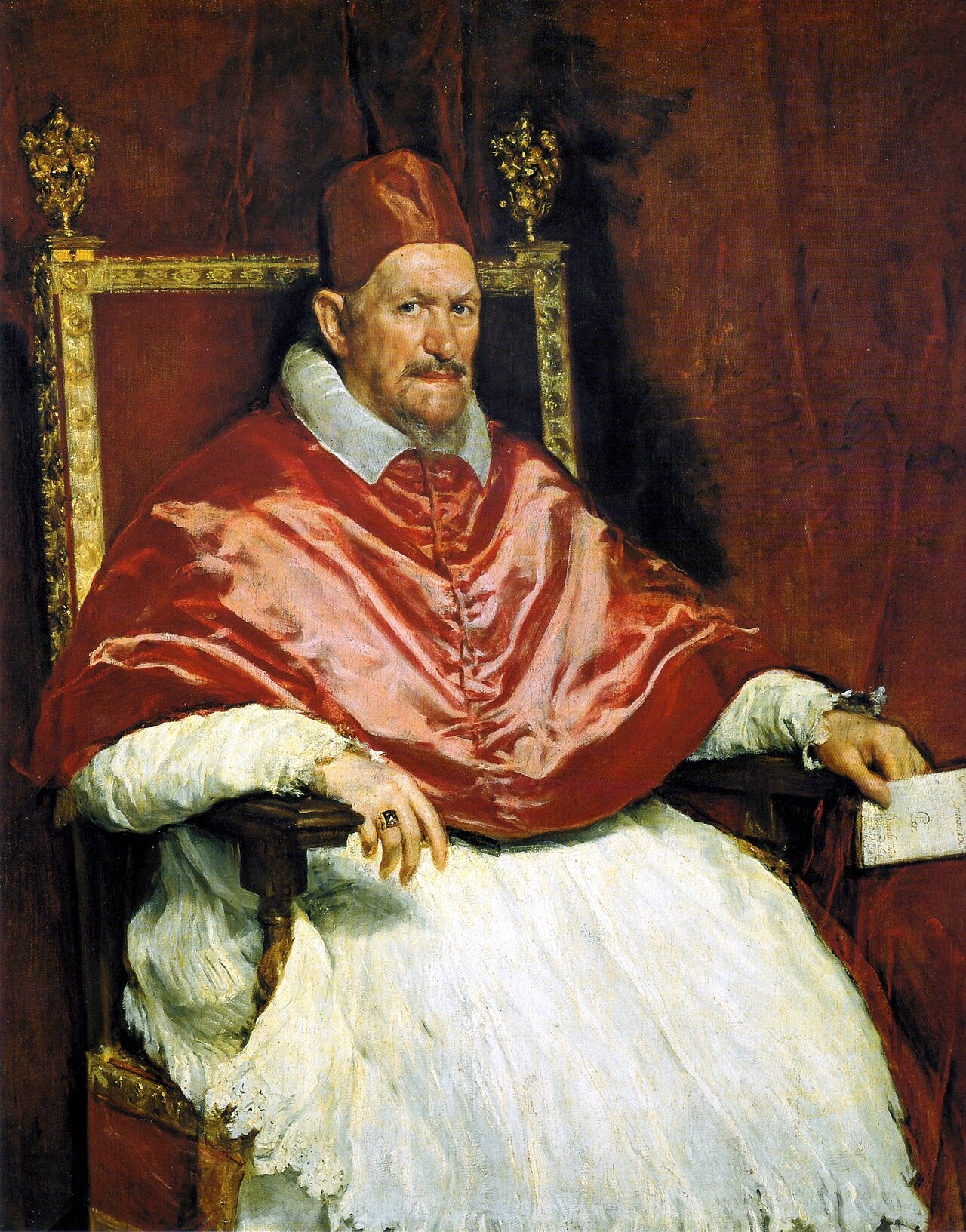
In 1650, during his second Roman stay, Velazquez painted Pope Innocent X. Of every painter then in Rome, Velazquez alone was allowed to portray the pope. The result hangs today in the Galleria Doria Pamphilj in Rome.
The pope sits in red, one hand gripping a paper, his face wary and hard. There is no flattery in it at all. According to the old story, when Innocent X saw the finished head he muttered that it was troppo vero, too truthful.
He kept it anyway, and he paid well. Painters flocked to copy it. Three centuries later Francis Bacon built a whole series of screaming popes on the shape of this one picture. Few portraits have ever unsettled so many people.
The papers that freed Juan de Pareja
Juan de Pareja, born around 1608, was a man of African descent who was enslaved in Velazquez's studio and household for at least twenty years.
In Rome in 1650 Velazquez painted him. The portrait was so lifelike that, when it was shown, viewers stood in wonder. Within months Velazquez signed papers that would set Pareja free by 1654.
Pareja went on to become a painter in his own right, and several of his large canvases survive in Spain. The portrait itself made history again in the modern age.
In 1971 the Metropolitan Museum in New York acquired it, and the price set a record for any painting sold at auction at that time.
The Rokeby Venus, his only nude
Spain under the Inquisition was a hard place to paint a naked body, which makes the Rokeby Venus rare.
It shows Venus stretched on a bed, her back to us, gazing into a mirror a winged Cupid holds. It hangs in the National Gallery in London.
People often call it his only nude. It is more exact to say it is his only surviving female nude, since old inventories mention others by his hand, now lost.
The picture has a violent modern footnote. In 1914 a suffragette named Mary Richardson slashed the canvas in protest, and the National Gallery had to repair long cuts across Venus's back.
Look closely today and conservators can still trace where the wounds were mended.
A slow output, and a long reach
A myth clings to court painters, that they must have turned out canvases by the hundred. Velazquez did not.
Only around 120 paintings by him survive. He worked slowly and carefully, and much of his time went not to the easel but to palace duties, arranging rooms, lodgings and ceremonies as a senior household officer for the king.
That thin, careful body of work shaped modern art out of all proportion to its size. In the 1860s the French painter Edouard Manet studied Velazquez in the Prado and called him the painter of painters.
Almost a century later Pablo Picasso shut himself away in 1957 and produced 58 variations on Las Meninas alone. Two hundred years of painters have gone to school on those 120 pictures.
More secrets to unlock


Diego Velazquez left Seville for the royal court in Madrid while still in his twenties; Bartolome Esteban Murillo stayed behind and became the city's leading painter of religious scenes for the churches and convents Velazquez had left.
The Diego Velazquez questions that keep coming up
What is he known for? Las Meninas, royal portraits, and his loose, truthful brushwork.
When did he live? Born in 1599, died in 1660.
Where was he from? Seville, in Spain.
Who did he work for? King Philip IV of Spain, as court painter.
Why do artists revere him? For his honesty and his astonishingly modern brushwork.
Who taught Velazquez to paint? He trained in Seville under Francisco Pacheco, a painter and writer, in a six year apprenticeship that began around 1611. Pacheco ran his studio like a school. In 1618 Velazquez married Pacheco's daughter Juana, tying teacher and pupil together for life.
How many paintings did Velazquez make? Only about 120 paintings by Velazquez survive. He painted slowly and with great care, and his job at the royal court took much of his time, since he served the king as a household officer as well as an artist. Quality, not volume, is what he left behind.
What else is worth knowing about Velazquez? He left only around 120 paintings behind, freed the assistant he had once enslaved, and wears in one portrait a cross a king is said to have painted himself. More surprising facts are gathered separately.