Dreams in Art: 12 Famous Dream Paintings

The most famous dream paintings run from Fuseli’s Nightmare to Rousseau’s jungle sofa. Twelve painted dreams, the demon that sat on Freud’s wall, and the sleeping woman whose dream ended a marriage.

Henry Fuseli, The Nightmare, 1781: an incubus on a sleeping woman
Henry Fuseli, The Nightmare, 1781, Detroit Institute of Arts

Before you fall asleep

  • One nightmare was so popular the painter made at least four versions to keep selling it.

  • Freud kept a print of the first painting on this list in his consulting rooms.

  • One dreamer on this list is a saint, one a knight, one a poet, one an emperor.

  • The most peaceful dream here was painted by a toll collector who never left France.

  • Two dreams at the end could only be told, because their paintings are locked under copyright.


Dream interpretation had a bestselling manual eighteen centuries before Freud. The Roman era writer Artemidorus wrote the Oneirocritica, a five book dream dictionary so popular it was still being copied and consulted by fortune tellers well into the Renaissance, the same decades Carpaccio and Piero della Francesca were painting angels into other people's sleep. This newsletter digs up stories like that every week, free.


Learn art the fun way

1 | The Nightmare, Henry Fuseli (1781)

A sleeping woman flung back on the bed, a grinning incubus squatting on her chest, a mad eyed horse pushing through the curtains. London had never seen anything like it.

Fuseli painted repeat versions because the first sold so well as an engraving, and Freud reportedly hung one in his Vienna consulting rooms. The man who painted fear for a living I cover that in Henry Fuseli.

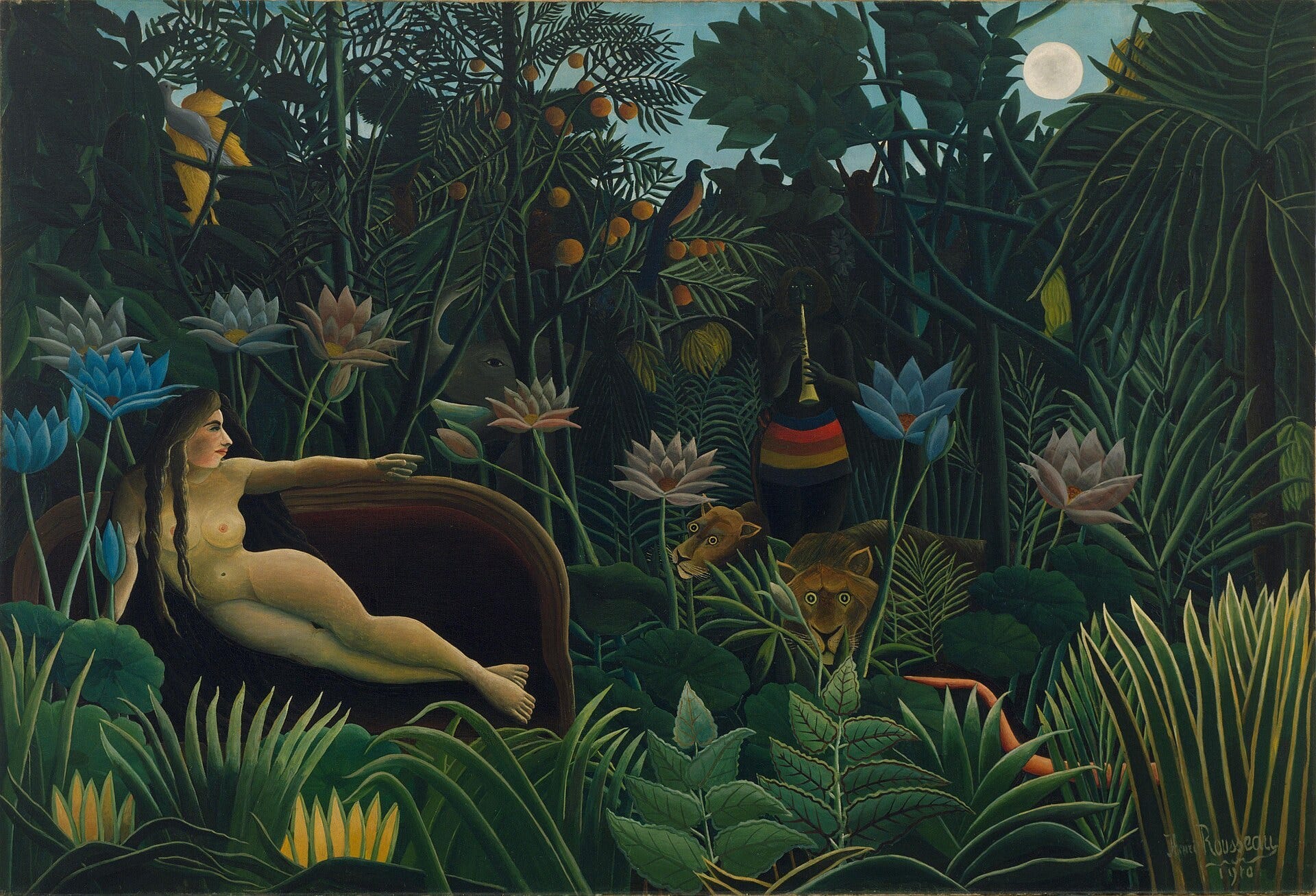
2 | The Dream, Henri Rousseau (1910)

Henri Rousseau, The Dream, 1910: a nude on a sofa in the jungle
Henri Rousseau, The Dream, 1910, MoMA

A nude on a velvet sofa in the middle of a jungle, watched by lions and a snake charmer. When critics asked what a sofa was doing there, Rousseau answered that the woman was dreaming the jungle around her.

He painted it months before his death, having never seen a jungle. The customs clerk who invented his own exotic world More of it in Henri Rousseau.

3 | The Dream of Saint Ursula, Vittore Carpaccio (1495)

Vittore Carpaccio, The Dream of Saint Ursula, 1495: an angel entering the bedroom
Vittore Carpaccio, The Dream of Saint Ursula, 1495, Venice

An angel walks into a Venetian bedroom at dawn to tell a sleeping princess she will die a martyr. The room is so precisely painted that historians use it to study Renaissance furniture.

Slippers by the bed, a dog on the floor, light through the round windows: the supernatural delivered like a domestic scene.

4 | The Dream of Constantine, Piero della Francesca (about 1460)

Piero della Francesca, The Dream of Constantine: an emperor asleep in his tent
Piero della Francesca, The Dream of Constantine, about 1460, Arezzo

An emperor asleep in his tent the night before battle, an angel diving in from the top corner with the sign that will convert him. It may be the first convincing night scene in Italian painting.

The light falls from the angel onto the tent like a lamp switched on in the dark. The geometry behind the magic The full account is in Piero della Francesca.

5 | The Knight’s Dream, Antonio de Pereda (about 1650)

Antonio de Pereda, The Knight’s Dream: a knight dreaming beside a table with a skull
Antonio de Pereda, The Knight’s Dream, about 1650, Madrid

A young Spanish gentleman dozes in a chair while an angel unrolls his dream: a table piled with gold, books, weapons, a crown, and a skull. Everything he wants, already rotting.

It is a vanitas disguised as a nap, and the motto on the banner says it plainly: time flies and pierces.

6 | Jacob’s Ladder, William Blake (about 1805)

William Blake, Jacob’s Ladder: a spiral staircase of angels
William Blake, Jacob’s Ladder, about 1805, British Museum

Jacob sleeps at the foot of a spiral staircase of light climbing into a sky full of angels. Blake replaced the Bible’s straight ladder with a spiral, endless in both directions.

Blake claimed he saw visions daily and painted what he saw. The watercolor is in the British Museum.


Salvador Dali invented his own method for painting dreams straight from the source. He would nap in a chair holding a metal spoon over a plate, and the clang of the spoon hitting the floor the instant he fell asleep would jolt him awake to sketch whatever image had just flashed through his mind, a trick he called the slumber with a key. This newsletter finds stories like that twice a week, free.


7 | Jacob’s Dream, Jusepe de Ribera (1639)

Jusepe de Ribera, Jacob’s Dream, 1639: a man asleep against a rock
Jusepe de Ribera, Jacob’s Dream, 1639, Prado

The same dream, painted like documentary: a tired man asleep against a rock in golden afternoon light, the ladder of angels reduced to a faint glow behind him.

Ribera put the miracle at the edge and the exhaustion at the center. The Spaniard of Naples I go into it in Jusepe de Ribera.

8 | Dante’s Dream, Dante Gabriel Rossetti (1871)

The poet dreams of being led to the deathbed of Beatrice, the woman he loved from a distance all his life. Rossetti painted it at full scale, his largest canvas.

The model for Beatrice was Jane Morris, married to his friend and partner William Morris, which made the dream uncomfortably autobiographical. The whole tangled circle I cover that in Dante Gabriel Rossetti.

9 | Vision After the Sermon, Paul Gauguin (1888)

Paul Gauguin, Vision After the Sermon, 1888: Breton women and a red field vision
Paul Gauguin, Vision After the Sermon, 1888, Edinburgh

Breton women in white bonnets watch Jacob wrestle the angel on a field of pure red. Not a dream exactly: a vision shared by a whole congregation, painted as fact.

Gauguin offered it to two village churches. Both refused. The man who left everything for visions More of it in Paul Gauguin.

10 | The Eye Like a Strange Balloon, Odilon Redon (1882)

A giant eyeball floats over a swamp as a hot air balloon, carrying a severed head on a saucer. Redon drew his charcoal dreams decades before Surrealism existed.

He called these works his noirs and said they put the logic of the visible at the service of the invisible. The quiet dreamer The full account is in Odilon Redon.

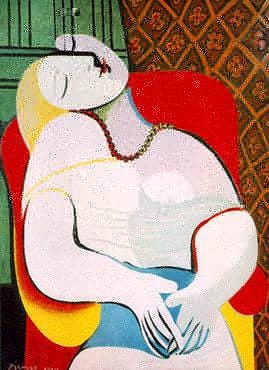
11 | The Dream, Pablo Picasso (1932)

His young lover Marie Therese Walter asleep in an armchair, painted in one afternoon in reds and lilacs, while Picasso was still married to Olga Khokhlova.

The painting later sold privately for about 155 million dollars, with a famous detour: its owner once put his elbow through it. What Picasso’s love affairs cost the women involved is in How Picasso Destroyed the 6 Women Who Loved Him.

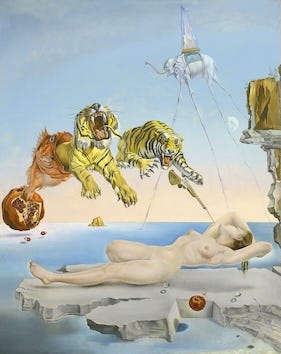
12 | Dream Caused by the Flight of a Bee, Salvador Dali (1944)

Gala floats asleep over a rock while a pomegranate, a fish, two tigers and a rifle with a bayonet leap toward her: one second of dreaming, stretched into a chain reaction.

Dali called it the first illustration of Freud’s discovery that an external stimulus can script a long dream in an instant. The showman of the unconscious I go into it in Salvador Dali.

The Met and the Rijksmuseum both let you search by subject, which is the fastest way to find more painted sleep.

What else there is to know about dreams

  • What tops the list? Fuseli’s The Nightmare, with Rousseau’s The Dream and Dali’s bee dream close behind.

  • What is sitting on the woman in The Nightmare? An incubus, the demon of medieval folklore said to crush sleepers. The horse behind is the night mare made literal.

  • Did the Surrealists invent dream painting? No. Carpaccio, Pereda and Redon painted dreams centuries and decades earlier. Surrealism gave the practice a theory: what is Surrealism.

  • Where is The Nightmare today? The Nightmare is in Detroit, The Dream at MoMA, Saint Ursula in Venice, the Knight’s Dream in Madrid.

  • What is the most expensive dream painting? Picasso’s The Dream, sold privately for about 155 million dollars in 2013.

A closing fact: when the elbow of its owner Steve Wynn tore The Dream in 2006, the repair cost about 90,000 dollars, and the painting’s value still rose by tens of millions afterward.

My own favorite here is Ribera's Jacob's Dream, not Blake's spiral staircase. Blake paints the vision, all angels and light. Ribera paints the man having it, a body slumped with exhaustion while the miracle stays a faint glow at the edge, which feels truer to what falling asleep actually looks like.

The Picasso story bothers me more than it should. A 155 million dollar painting of a woman he was cheating with, later damaged by an elbow and worth more afterward, says less about the dream itself than about what the art market decides to reward.

Redon's floating eyeball comes closest to real dream logic among the twelve. Fuseli's incubus and horse still work like stage props with a clear symbolic role, readable at a glance. Redon offers no such reading: an eye, a balloon, a severed head, tied together only because they appeared side by side, which is closer to how an actual dream strings images together.


Science only caught up with these painters in 1953, when researchers at the University of Chicago identified rapid eye movement sleep and proved for the first time that dreaming was a distinct, measurable stage of the night rather than a vague mental fog. This newsletter sends two new stories like that every week, free, straight to your inbox.


Dreams share a border with something darker. Fuseli’s own demon reappears in our list of twelve nightmares painters could not shake, one part of the darkest side of art history.

Surrealism later turned that same dream logic into a deliberate method, nowhere more plainly than in Magritte's Son of Man, the 1964 portrait with a floating green apple hiding the sitter's face.


You Might Also Like