
Edgar Allan Poe hid his horrors. A body lies under the floorboards, a wife behind a fresh brick wall, and the man telling the story is half mad with fear. Every artist who illustrated him had to settle how far into that darkness to let the reader look. The answers ranged from a single candle in a dark room to a skeleton enthroned among the stars.
Cool Stories About Art is a newsletter to learn art the fun way.
Join 200,000+ readers and get:
10 new art stories / month
The entire archive of content (140+ articles)
Comment, ask questions, and chat with other readers
What Poe Left in the Dark
Poe describes very little. His narrators speak from inside their own fear, and the worst things happen out of sight. An illustrator who takes him on has to choose what the reader is allowed to see.
That choice stayed open long after Poe died in 1849. In Paris, Baudelaire's translations had made him a classic. In London, publishers turned his tales into lavish illustrated books, and every new edition needed a new set of pictures.
The images below were chosen for something their artist added that Poe never wrote, an object in a room or a moment the text skips. Half of them illustrate a single poem, The Raven, because so many artists attempted it. The other half come from six different tales.
12. James Carling, Illustrations for The Raven (1882)
James Carling drew The Raven from inside the mourner's head. In his series the bird matters less than what the grieving man imagines, and Carling summed it up in two words when he described his drawings: "mentality and phantasm."
He had learned to draw far from any art school, on the pavements of Liverpool. Born there in 1857, the fifth son of a man who made boot blacking, he was singing and reciting Shakespeare on street corners by the age of five, covering the flagstones in chalk while passers-by threw coins into his hat.
The police put an end to it. At seven, or at eight according to another account, he was arrested for drawing on the pavement. He spent a night in a cell and a week in the workhouse, after which the court ordered him into a technical school and told his father to pay the fees. The father refused, was jailed, and died in prison.
At fourteen Carling crossed to America with his brothers. He earned his living in vaudeville, billed as "the Fastest Drawer in the World." There he heard that Harper and Brothers, a New York publisher, were preparing an edition of The Raven illustrated by the French artist Gustave Doré. Carling set out to make his own series, with more drawings than Doré's.
He stopped after forty-three drawings. "Doré's are beautiful," he wrote. "Mine are stormier, wilder and more weird."
None of them was printed in his lifetime. Carling died in 1887, at twenty-nine, and was buried in a pauper's grave in Liverpool. His brother Henry looked after the drawings for over four decades.
Henry finally showed them in 1930. In the same decade the Poe Museum in Richmond, Virginia, hung the whole series in a Raven Room with blood-red walls, more than seventy years after a Liverpool court had punished the boy for drawing on a pavement.
At a Glance
Artist: James Carling (1857 to 1887)
Made: Begun in 1882
Medium: Ink and watercolor drawings
Size: Not published
Where to see it: The Poe Museum, Richmond, Virginia
11. Dante Gabriel Rossetti, The Raven: Angel Footfalls (1847)
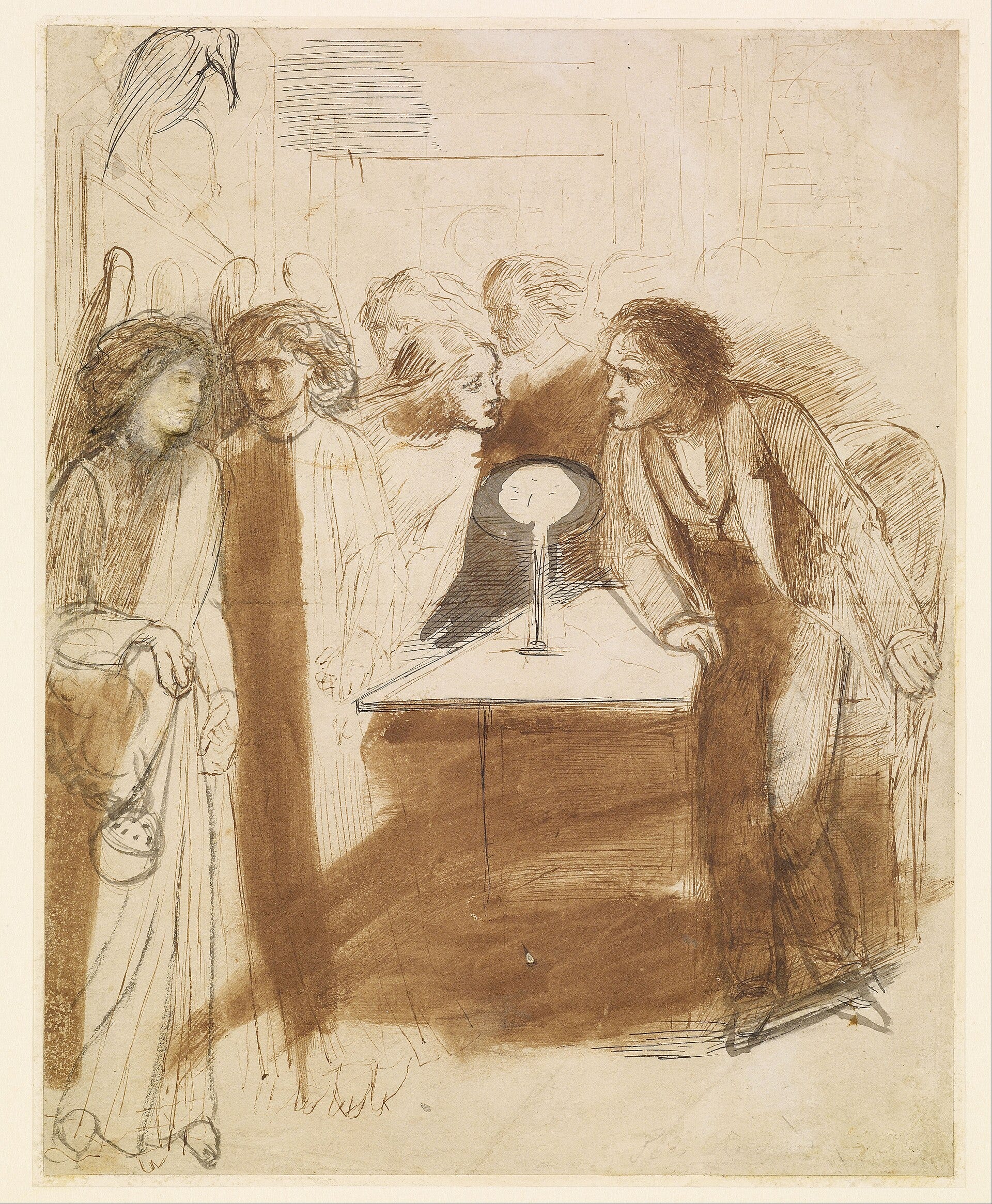
A young man leans across a table toward a single candle. Behind him a file of angels in long robes drifts past, and a raven watches from the upper corner. Dante Gabriel Rossetti drew the scene at eighteen or nineteen, while he was studying art in London, and the poem stayed with him for years, because something in it troubled him.