
Edward Burne-Jones (1833 to 1898) was an English painter and designer from Birmingham. He painted the knights, wizards and goddesses of old legends, in the manner of the Pre-Raphaelites, a group of English painters who rejected the art taught in their day.
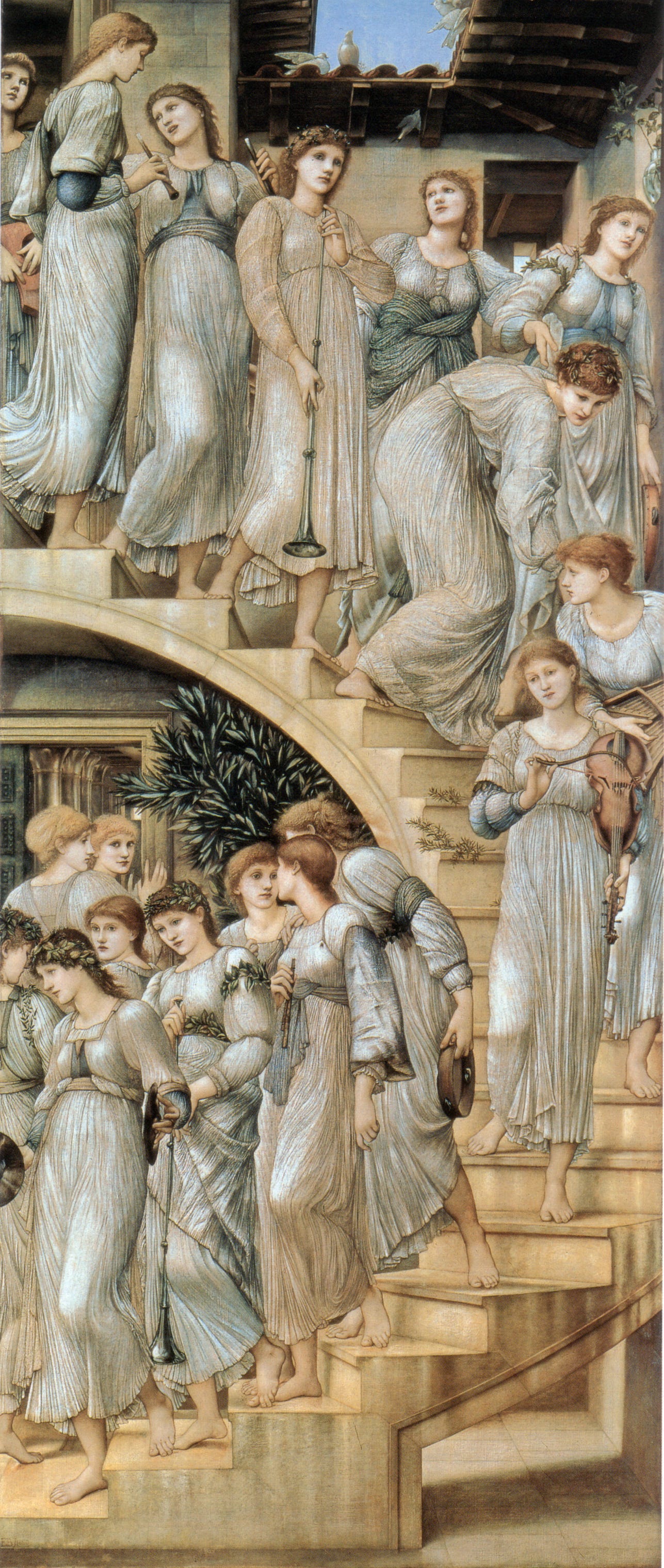
*Burne-Jones became famous for paintings such as The Golden Stairs and King Cophetua and the Beggar Maid. He also designed stained-glass windows for the firm of his best friend, the designer William Morris. In his lifetime, he was one of the most celebrated painters in England.*
Yet Burne-Jones had first gone to university to become a priest. And the largest picture of his life, a king asleep on a magic island, took him seventeen years and was never finished.
Cool Stories About Art is a newsletter to learn art the fun way.
Join 200,000+ readers and get:
10 new art stories / month
The entire archive of content (140+ articles)
Comment, ask questions, and chat with other readers
The painter was born Edward Jones, on August 28, 1833, in Birmingham, an industrial city in the middle of England. Burne was one of his middle names. Around 1885, he added it to his last name with a hyphen, so as not to be lost among all the other Joneses.
His mother died six days after his birth. Edward was raised by his father, a Welshman who made picture frames and covered them with gold leaf.
In 1853, Edward went to Oxford, the oldest university in England, to become a priest of the Church of England, the country's official church, which had broken with the Catholic Church in the 1500s. He wanted the old Catholic rituals back in that church, and he dreamed of living as a monk.
At Oxford, Edward met another future priest, William Morris, the son of a rich family. The two young men became friends for life.
In the summer of 1855, the two friends toured the cathedrals of northern France. In Paris, Morris led Edward to the Louvre, the city's great museum, to see The Coronation of the Virgin by Fra Angelico, an Italian monk and painter of the 1400s.
One August night, they walked the docks of Le Havre, a port in Normandy. That night, they decided that neither of them would become a priest. They would both be artists.
Edward had given up a safe future in the Church, and his only training was a few classes at the art school of Birmingham. How did a young man with almost no training become one of England's most celebrated painters, only to leave his largest picture unfinished?
In the rest of the story
why a London newspaper said one of his paintings could hang upside down
how a future famous author found a paradise behind his uncle's garden gate
why Burne-Jones agreed to testify against another painter in a London courtroom
how his biggest painting crossed the Atlantic to a museum in Puerto Rico