Edward Hopper: The Complete Story

Edward Hopper was the painter of American loneliness, the quiet realist behind Nighthawks and a hundred scenes of empty diners, sunlit rooms and people lost in thought.

He spent years barely selling a thing, married a fierce woman who modeled for every female figure he painted, and turned ordinary American light into the most haunting mood in modern art.

Edward Hopper, House by the Railroad, 1925

Nothing much happens in a Hopper, and that is the point. The silence is the story.


Hooked on Edward Hopper? Get more art secrets and stories in your inbox, free.


What I would hand you next

Three worth opening next:


The poet of empty rooms

Edward Hopper, Universalist Church, 1926

Hopper painted gas stations at dusk, hotel lobbies, offices at night, women sitting alone in the morning sun. His brand of Realism strips away the bustle and leaves stillness, light and distance.

When two people share a Hopper room, they almost never look at each other.

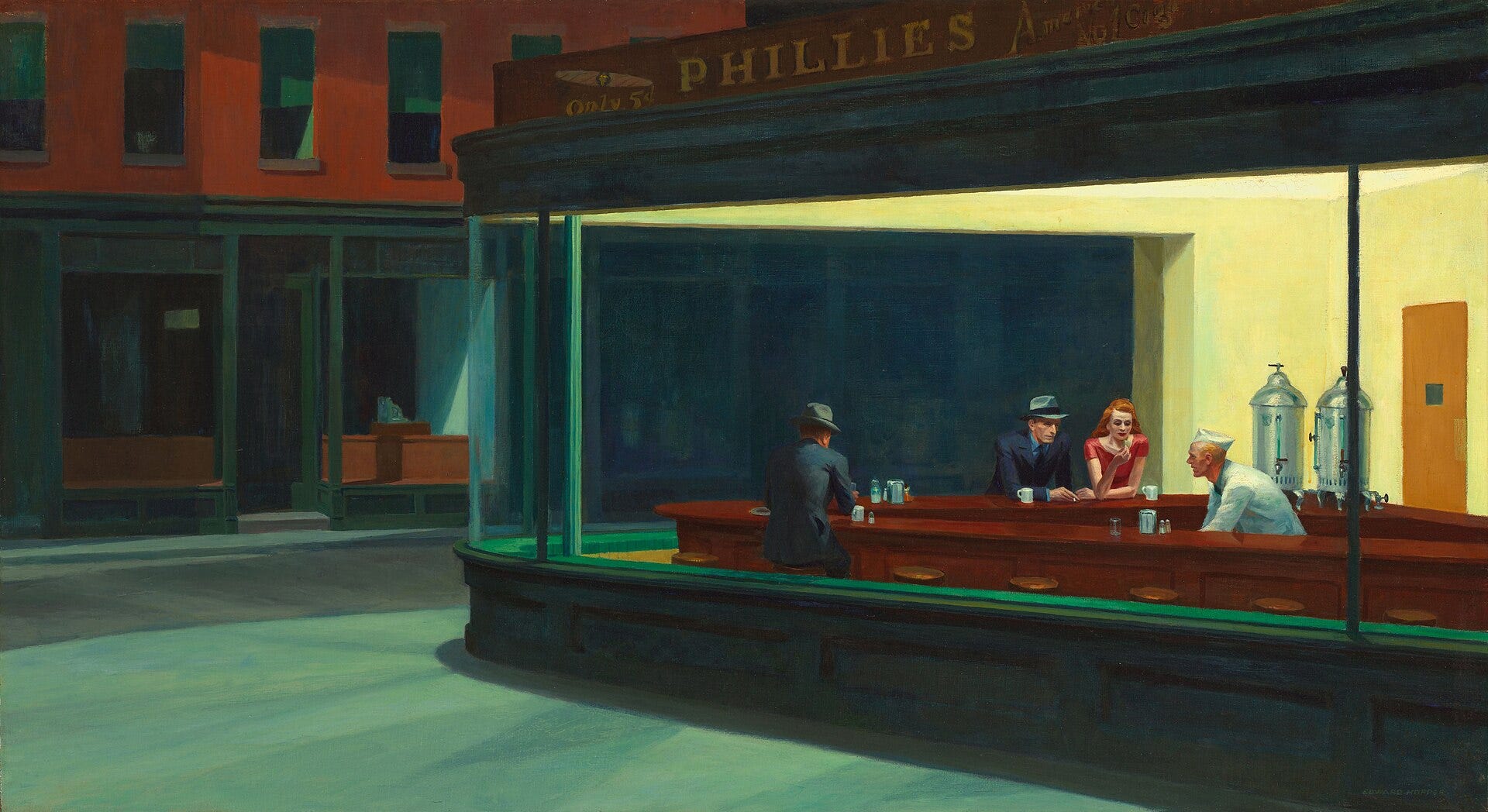
Nighthawks

Edward Hopper, Automat, 1927

His most famous picture shows four people in an all night diner, glowing against the dark empty street, with no visible door in or out.

He painted it just after the attack on Pearl Harbor, and whatever he intended, it became the definitive image of the lonely modern city, endlessly copied and parodied ever since.

Light is the real subject

Edward Hopper, Manhattan bridge loop, 1928

Hopper once said he was really only trying to paint sunlight on the side of a house. That obsession with raking light and deep shadow makes his work feel like a film still, a frozen moment loaded with suspense.

Directors noticed: his houses and moods echo through film noir, and the eerie home in Hitchcock's Psycho was modeled on a Hopper.


150,000 readers get one art story a week. No jargon, just the good parts.


Jo, the only model

Edward Hopper, Girl at a Sewing Machine, 1921

Every woman in Hopper's mature work is the same person: his wife, Josephine Nivison, known as Jo. A painter in her own right, she gave up much of her career to pose for him, manage his records and fight with him for over forty years.

Their marriage was stormy and jealous, and her own art was overshadowed, a quieter loneliness behind the famous ones on the wall.

Fame that came late

Success was painfully slow. Hopper sold a painting young, then went roughly a decade without selling another, scraping by on commercial illustration he hated.

Real recognition only arrived in his forties. By the time he died in 1967 he was a giant, and his reputation has only grown.

Quick answers about Edward Hopper

  • Who was Edward Hopper? An American realist painter of modern solitude.

  • When was he born? In Nyack, New York, in 1882.

  • When did he die? In New York City, in 1967.

  • What is he famous for? Nighthawks and his scenes of American loneliness.

  • Who modeled for his women? His wife, Jo Hopper, for every one of them.

  • Where can I see his work? Nighthawks is at the Art Institute of Chicago; the Whitney holds his archive.

Nighthawks hangs in the Art Institute of Chicago, and crowds still press up to a diner that has no way in or out. Every woman who ever sat alone in a Hopper window is Jo, the wife who set aside her own brushes so the world could feel his silence.


Learn art the fun way. One email, every week, free.