
Ancient Egyptian painters worked for clients who expected their pictures to last forever. Many still cover the walls where they were made. Others had stranger fates: a palace floor that lay buried for more than 3,000 years was smashed twenty years after it came to light, and a goose painted 4,600 years ago may show a bird that no longer exists.
Cool Stories About Art is a newsletter to learn art the fun way.
Join 200,000+ readers and get:
10 new art stories / month
The entire archive of content (140+ articles)
Comment, ask questions, and chat with other readers
Painted for the Dead
Nearly all the painting that survives from ancient Egypt was made for the dead. The walls of the tomb chapel kept in view the life its owner hoped to go on living: his fields, his hunts, his household and his meeting with the gods.
The painters did not sign their work, so most pictures are known by the name of the person they were made for. A few were painted on papyrus and buried with the dead, and one covered the floor of a royal palace.
What ties these twelve together is what happened to each one after its painters left. Several have never moved from the rock. Others were cut away, carried off or broken.
12. Unknown painters of Akhenaten's palace, The Painted Floor of the Great Palace at Amarna (about 1350 BC)
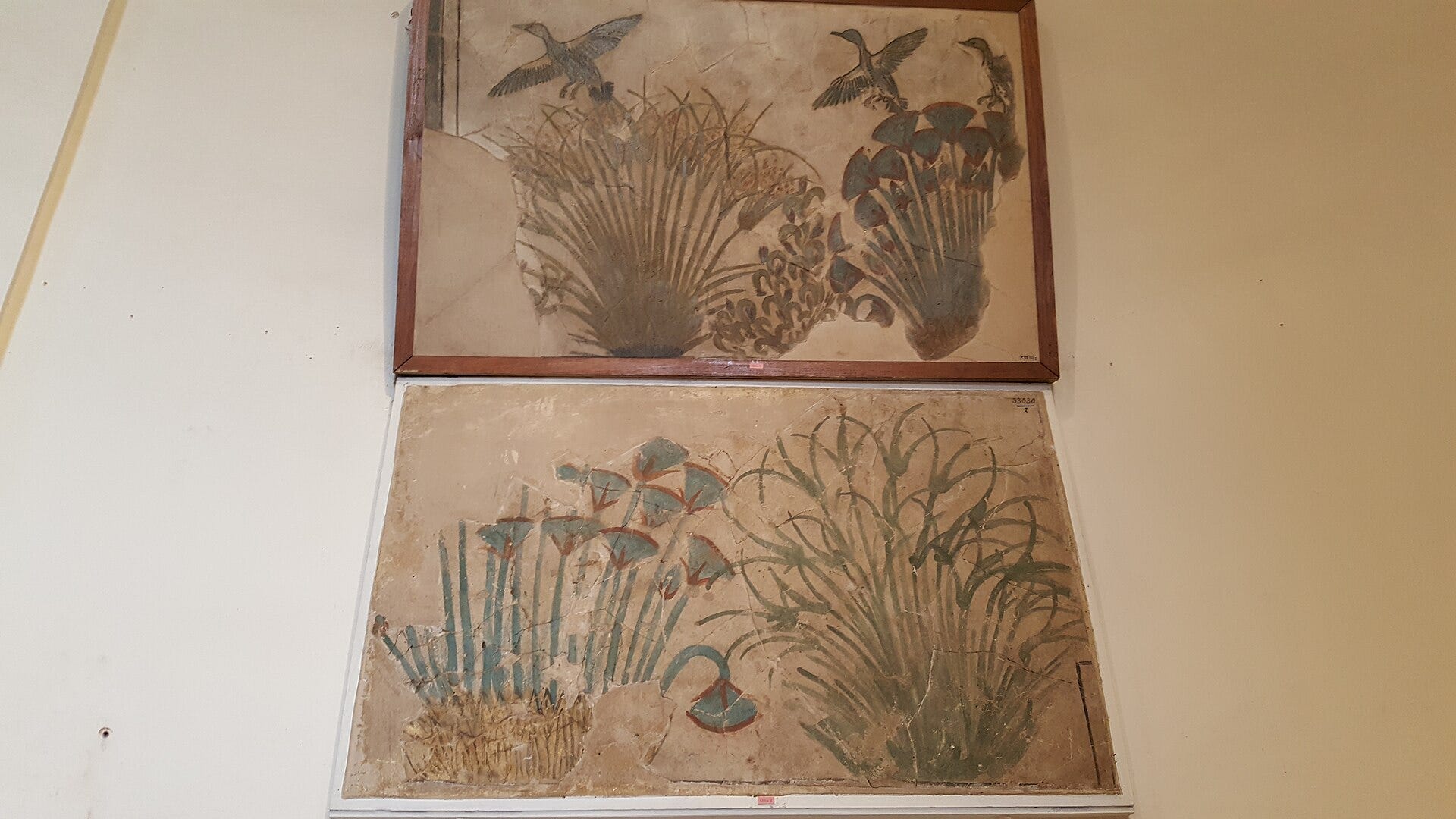
In a glass case in Cairo lie a few slabs of cracked plaster, painted with marsh plants, blue water and birds in faded green and ochre. They are the last pieces of The Painted Floor of the Great Palace at Amarna, made around 1350 BC for a palace of the pharaoh Akhenaten.
Laid out whole, the floor was a riverbank. The French Egyptologist Gaston Maspero describes the design as the mud of the Nile, with plants growing on yellow sand.
That riverbank was found in the winter of 1891 to 1892 by the British archaeologist Flinders Petrie, with a young Howard Carter as his assistant. Petrie left the floor where it lay and put a building over it, with a walkway for visitors. His journal gives a second reason: people in the area believed treasure was hidden underneath, and he wanted to keep looters out.
The shelter held for twenty years. On February 1, 1912, it was forced open and the floor was hacked to pieces. Maspero records only that the pavement was "wantonly destroyed" by a man from the neighboring village. What drove him to it has never been established.
At a Glance
Artist: Unknown painters of Akhenaten's court
Painted: About 1350 BC, reign of Akhenaten (Dynasty 18)
Medium: Paint on gypsum plaster laid over a mud floor
Size: Not published
Where to see it: Egyptian Museum, Cairo (surviving fragments)
11. Unknown painter of Hierakonpolis, The Painted Tomb, Tomb 100 (about 3500 to 3200 BC)
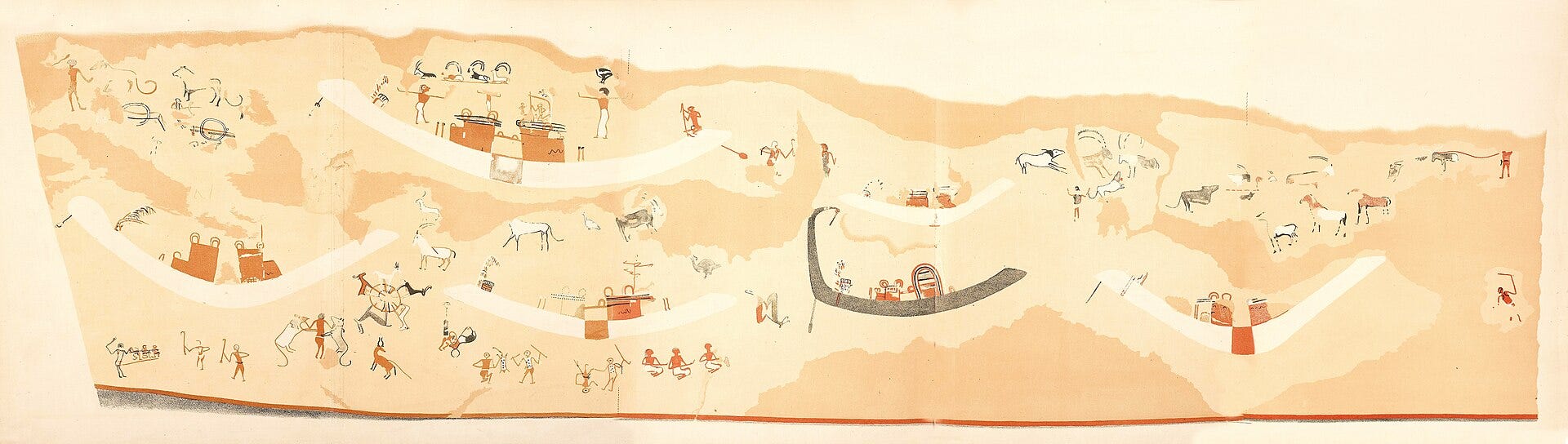
A line of pale boats with tall curved hulls runs along an ochre wall, among small human figures and animals painted in red, black and white. The wall now stands in the Egyptian Museum in Cairo. The tomb it came from lies lost under cultivated fields.