Elephants in Art: 12 Famous Works

Elephants in art range from a Dutch celebrity elephant drawn by Rembrandt to Dali’s spindle legged giants. Twelve works across five centuries, one animal, and a war machine Turner hid inside a snowstorm.

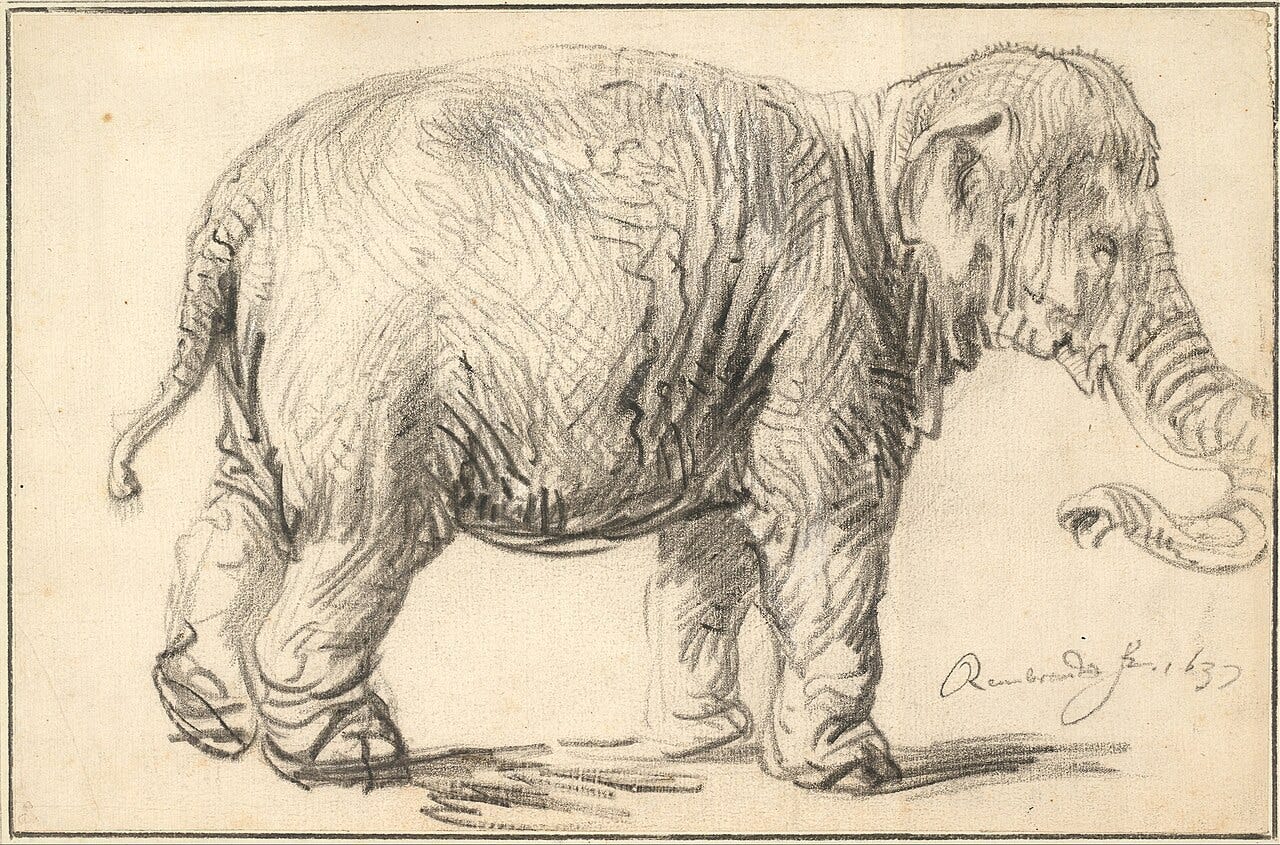
Chalk drawing of elephant
Rembrandt, An Elephant (Hansken), 1637

The herd, at a glance

  • One elephant on this list was a European celebrity with a name, a tour schedule and an obituary.

  • Turner painted Hannibal’s elephants so small you have to hunt for them.

  • A Mughal emperor employed painters specifically to portray his favorite elephants.

  • One elephant walked through a Venice carnival in 1774 and straight into a painting.

  • One painter stood a real elephant in a room and dared visitors to mention it.


Learn art the fun way. Free stories every week, no boring lectures.


1 | Hansken, drawn by Rembrandt (1637)

Hansken was a female elephant shipped from Ceylon to Amsterdam, who toured Europe doing tricks: firing a pistol, picking pockets, waving a flag.

Rembrandt sketched her in black chalk, wrinkles and all, and probably slipped her into an etching of Adam and Eve. The man who drew everything I cover that in Rembrandt.

2 | Snow Storm: Hannibal Crossing the Alps, JMW Turner (1812)

Storm vortex over army
JMW Turner, Snow Storm: Hannibal Crossing the Alps, 1812, Tate

A black vortex of storm swallows an army. Somewhere at the bottom, tiny, almost invisible, an elephant raises its trunk.

Turner made the weather the protagonist and history the casualty. The painter of storms More of it in JMW Turner.

Turner exhibited it in 1812 with a quotation from his own unfinished poem. The elephant is almost invisible in the storm, a smudge on the right, which is the joke: the famous animals are swallowed by the weather.

3 | Alexander and Porus, Charles Le Brun (1673)

Battle with war elephants
Charles Le Brun, Alexander and Porus, 1673, Louvre

War elephants crash through Le Brun’s giant battle scene, painted for Louis XIV, who liked comparisons with Alexander the Great.

The Indian king Porus fought from elephant back; Alexander won and, impressed, gave him his kingdom back. Flattery by proxy, four meters wide, at the Louvre.

4 | The Battle of Zama, after Giulio Romano (16th century)

Rome against Carthage, 202 BC: Scipio’s trumpets and torches panic Hannibal’s elephants, which trample their own lines.

The scene survives in paintings and tapestries after Giulio Romano, Raphael’s best pupil. History remembered the elephants better than the generals.

Giulio Romano designed the composition around 1530 for a tapestry series, and the elephants rear against Roman cavalry. Scipio beat Hannibal at Zama in 202 BC, and the elephants panicked and trampled their own side.

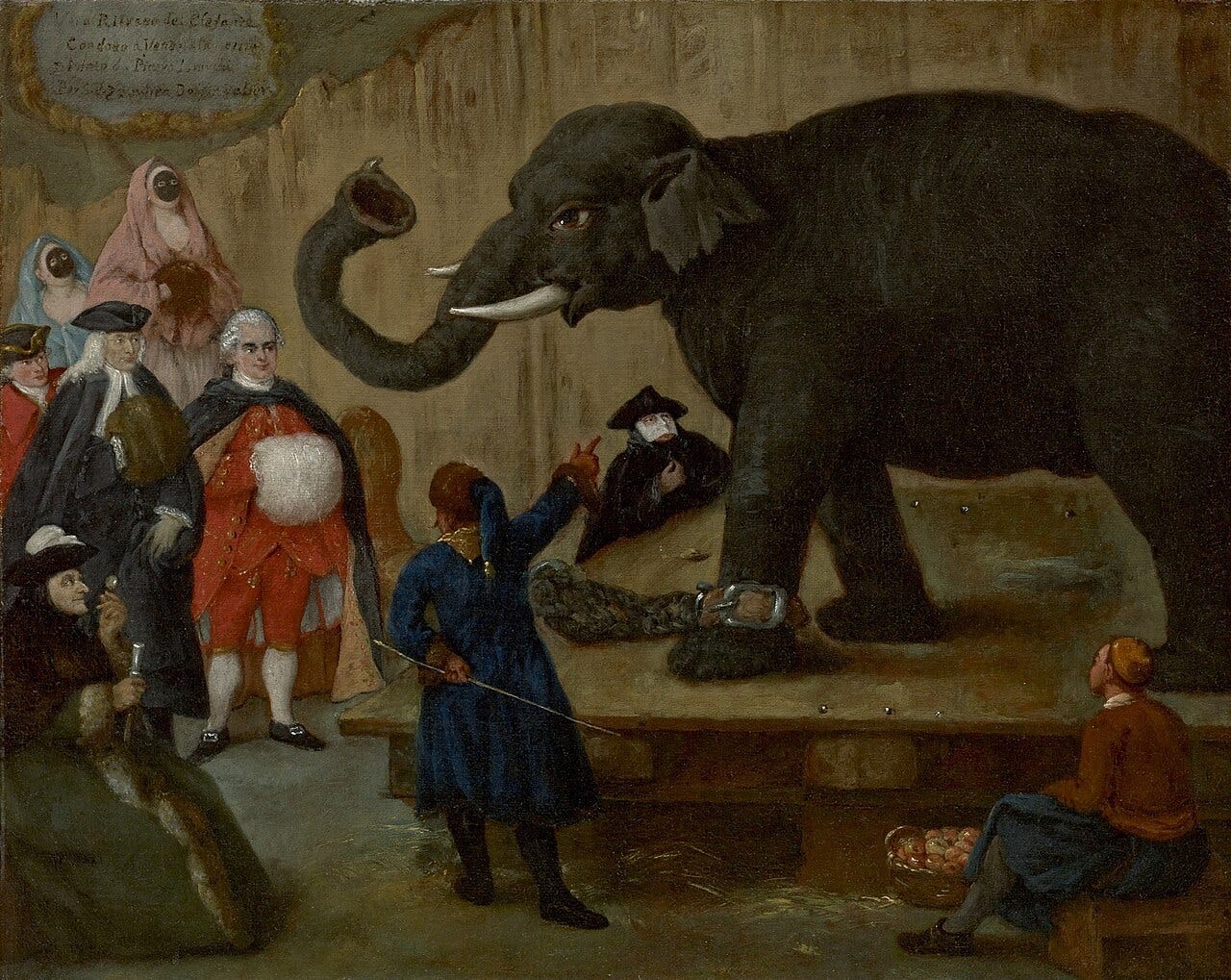
5 | The Elephant of Venice, Pietro Longhi (1774)

Venetians viewing elephant
Pietro Longhi, The Elephant, 1774

An elephant arrived for the Venice carnival of 1774, and Longhi, painter of Venetian gossip, recorded the crowd examining it in masks.

The inscription proudly dates the visit. The animal, records suggest, did not survive the tour, which the painting politely omits.

Longhi painted a real animal shown at the Venice carnival of 1774, with the crowd pressed against a wooden barrier. The elephant later broke loose and was shot in a church, which Venetian chroniclers recorded.

6 | The Mughal elephant portraits (about 1600)

Mughal miniature elephant
Mughal school, elephant portrait, about 1600

Emperor Akbar owned thousands of war elephants and loved them enough to commission individual portraits with names and pedigrees.

Painters like Ustad Mansur rendered hide, harness and temperament in miniature. That entire tradition lives in what is miniature painting.

Court painters produced individual portraits of named imperial elephants, with the animal’s name written on the sheet. The Akbarnama includes Akbar riding a famously uncontrollable elephant called Hawa’i across a bridge of boats.


Join 130,000 readers who get the secrets behind the paintings. Free.


7 | The elephants of the Hokusai Manga (1810s)

Hokusai sketch of elephant
Katsushika Hokusai, elephant from the Manga

Hokusai drew elephants he had never seen, from secondhand accounts and older prints, alongside ghosts, wrestlers and waves in his sketchbook encyclopedias.

The results are half zoology, half dream. The man who drew 30,000 images The full account is in Hokusai.

The Manga appeared in fifteen volumes from 1814, a sketchbook of everything Hokusai could draw. Japan had no elephants, so his are copied from Chinese and Dutch sources and look it.

8 | The Entry of the Animals into Noah’s Ark, Jan Brueghel the Elder (1613)

Animals streaming toward ark
Jan Brueghel the Elder, The Entry of the Animals into Noah’s Ark, 1613, Getty

A paradise inventory of creatures streaming toward the ark, with a pair of elephants anchoring the middle distance.

Brueghel painted animals from the archduke’s menagerie in Brussels, one of the few places in Europe a painter could study an elephant alive. The Getty owns it.

9 | The Elephants, Salvador Dali (1948)

Dali stretched his elephants onto legs like stilts of bone, carrying obelisks across empty deserts: weight made weightless, his favorite contradiction.

They first appeared in his Temptation of Saint Anthony and never left his vocabulary. The showman I go into it in Salvador Dali.

Dali painted the stilt legged elephants in 1948, borrowing the idea from Bernini’s elephant obelisk in Rome, which he had seen. The weight on the back and the impossible legs are the whole point.

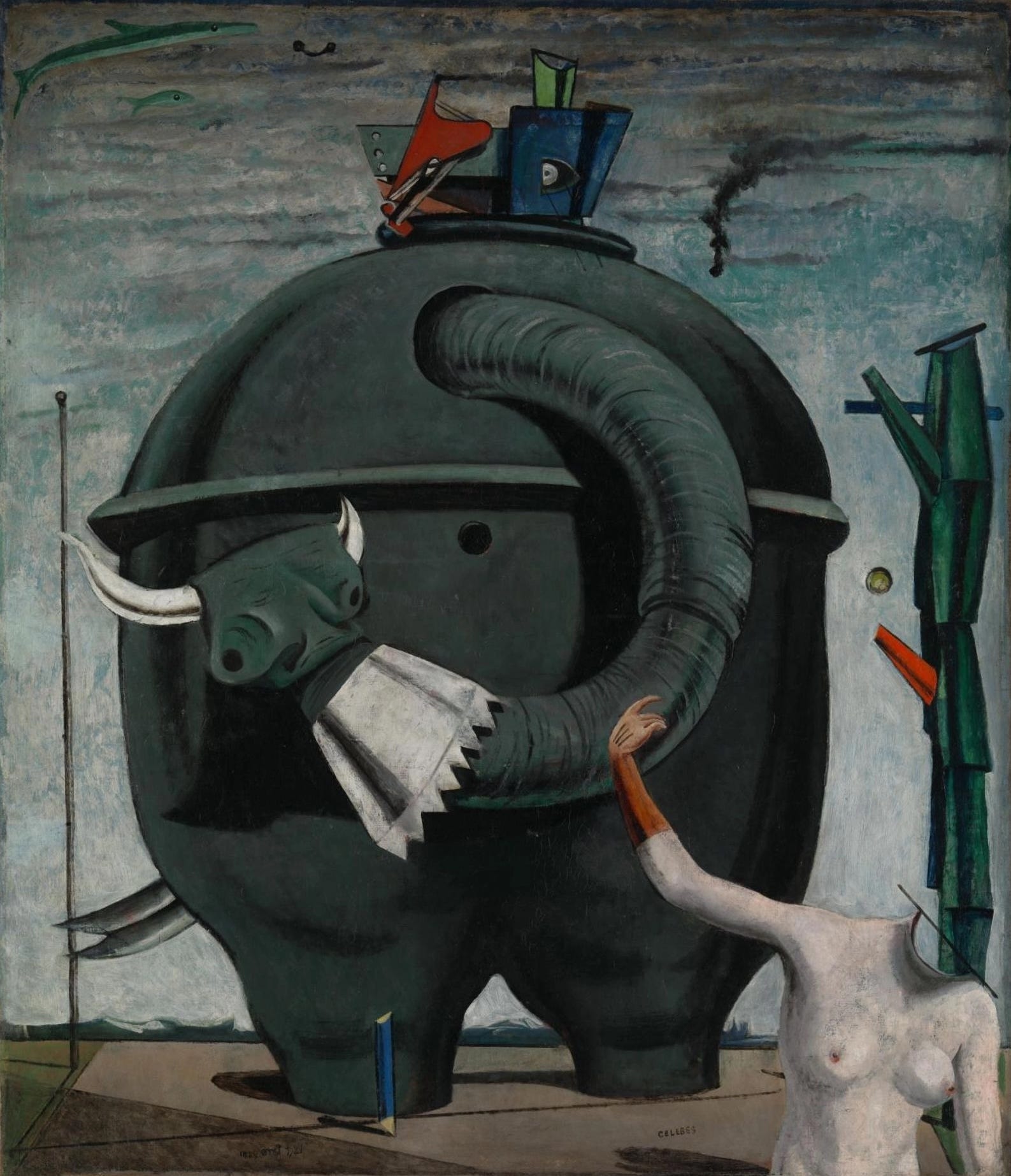
10 | The Elephant Celebes, Max Ernst (1921)

A boiler tank on legs with a trunk of pipes, part machine, part idol. Ernst built his elephant from a photograph of a Sudanese corn bin.

It became one of Surrealism’s founding images before Surrealism officially existed. The collage mind behind it I cover that in Max Ernst.

11 | The Elephant in the Room, Banksy (2006)

For a Los Angeles show, Banksy placed a live elephant painted to match the wallpaper in a furnished living room, as a statement about ignored poverty.

Animal welfare authorities objected, and the elephant appeared unpainted on the final day. The anonymous provocateur is in who is Banksy.

12 | Noah’s Ark, Edward Hicks (1846)

The American folk painter of the Peaceable Kingdom sent his animals to the ark two by two, elephants at the rear, under a storm about to break.

Hicks was a Quaker preacher who painted the same hopes over and over. His ark hangs in Philadelphia.

Rembrandt’s elephant drawings sit alongside his prints at the Rijksmuseum, and the Met holds the Mughal side.

Hansken, Dali and the questions that follow

  • Which of these is the icon? Dali’s stilt legged elephants by recognition, Rembrandt’s Hansken by story.

  • Who was Hansken? A touring celebrity elephant of the 1630s, drawn by Rembrandt and mourned across Europe when she died in Florence in 1655.

  • Did old master painters ever see real elephants? Rarely. Menageries in Brussels, Vienna and Lisbon gave a lucky few painters a live model; the rest copied prints.

  • Are there elephants in Turner’s Hannibal painting? Yes, minuscule ones at the bottom of the storm. The weather got top billing.

  • Where is Snow Storm: Hannibal Crossing the Alps today? The Louvre for Le Brun, the Getty for Brueghel, and Hansken’s sketch in the British Museum.

A final note from the archives: when Hansken died in Florence in 1655, her skeleton was preserved and can still be seen in the city’s natural history museum, four centuries after Rembrandt drew her wrinkles.


Two new stories a week, 130+ secrets unlocked. Start free.