
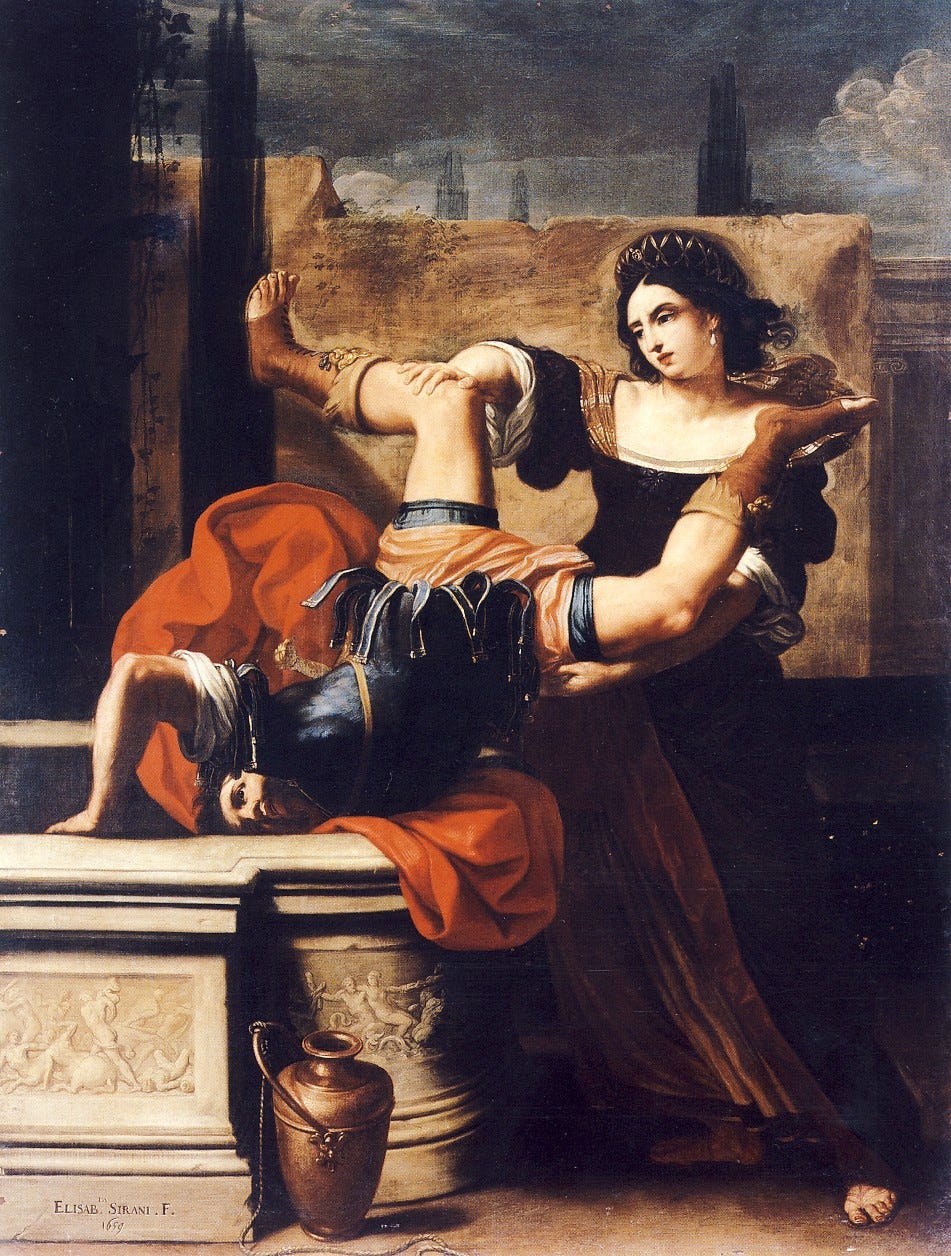
Elisabetta Sirani (1638 to 1665) was an Italian painter from Bologna. She was famous for her heroines from history, like Timoclea, a woman who pushes an enemy captain into a well, in a canvas now at the Capodimonte museum in Naples.
Cool Stories About Art is a newsletter to learn art the fun way.
Join 200,000+ readers and get:
10 new art stories / month
The entire archive of content (140+ articles)
Comment, ask questions, and chat with other readers
In about ten years, Elisabetta Sirani painted some two hundred pictures, for clients as grand as the princes of Florence. Yet in Bologna, a rumor went around that her father did the painting and she simply put her name on it. When she died suddenly at twenty-seven, the city buried her beside Guido Reni, its most admired painter of the century.
Elisabetta Sirani was born on January 8, 1638, in Bologna, a large university city in northern Italy, then ruled by the pope. Her father, Giovanni Andrea Sirani, was a painter and an art dealer.
Giovanni Andrea had trained under Guido Reni, famous for his gentle faces and clear colors, and became one of his favorite assistants. Reni died in 1642, when Elisabetta was four. Her father then opened his own workshop, a family business that made paintings to order.
Elisabetta, the eldest of the children, learned her trade in that workshop. Her father taught her to draw, to paint and to etch, and by eighteen she had mastered etching. In etching, a needle draws through a waxy coating on a copper plate, and acid bites the lines into the metal, ready for printing.
In her father's library, the girl also read Plutarch, a Greek writer who told the lives of the famous men of Greece and Rome, and who would give her two of her best-known heroines.
By seventeen, Elisabetta Sirani was a professional painter. In 1655 she began a notebook in which she wrote down every picture she made, with its subject and its buyer, until the end of her life.
She gave the notebook a plain title: Nota delle pitture fatte da me Elisabetta Sirani, "List of the paintings made by me, Elisabetta Sirani." She signed most of her canvases too, which was rare among the male painters of her time.
But a signature was exactly what the gossip said she added to her father's work.
How could a young woman prove, to a whole city, that the pictures signed with her name came from her own hand?
In the rest of the story
The treasure a prince of Florence sent her for one painting.
What she opened for the young women of Bologna.
Why a maid of the house went on trial after her death.
What Bologna placed at the center of her funeral.