
Elizabeth Thompson (1846 to 1933), later Lady Butler, was a British painter of soldiers. The Roll Call made her famous overnight in 1874 and entered Queen Victoria's collection. Another of her paintings, The Remnants of an Army, belongs to Tate Britain in London.
Cool Stories About Art is a newsletter to learn art the fun way.
Join 200,000+ readers and get:
10 new art stories / month
The entire archive of content (140+ articles)
Comment, ask questions, and chat with other readers
In the 1870s, crowds packed the galleries of London to see Elizabeth Thompson's soldiers. Few of those soldiers are winning. They count the missing after a battle, hold their ground under attack, or drag themselves home.
Elizabeth Thompson was born on November 3, 1846, in Lausanne, Switzerland. Her English parents moved often between Italy and England.
Elizabeth and her younger sister, Alice, never went to school. Their father, Thomas James Thompson, taught them himself, two hours every morning. Having no sons, she wrote later, he gave his daughters the lessons of boys as well as girls.
During a trip to Belgium, her father took Elizabeth to Waterloo, where the Duke of Wellington, the commander of the British army, defeated Napoleon, the French emperor, for good in 1815.
There her father told Elizabeth that Wellington had wept as he rode off the field, for the many friends he had lost, and repeated the duke's words: "A defeat is the only thing sadder than a victory."
In 1866, Elizabeth Thompson entered the Female School of Art in South Kensington, London, then studied painting in Florence, Italy.
In 1872, she watched the British army's maneuvers, practice battles, near Southampton, on the south coast of England. A general there hoped she would paint the British soldiers. She did, she wrote, "with alacrity," a formal word for eagerness.
Her goal was the Royal Academy, the society of the leading artists in Britain, whose summer exhibition in London could make a name. The Academy turned down her first two pictures, then hung the third near the ceiling, where hardly anyone could see it.
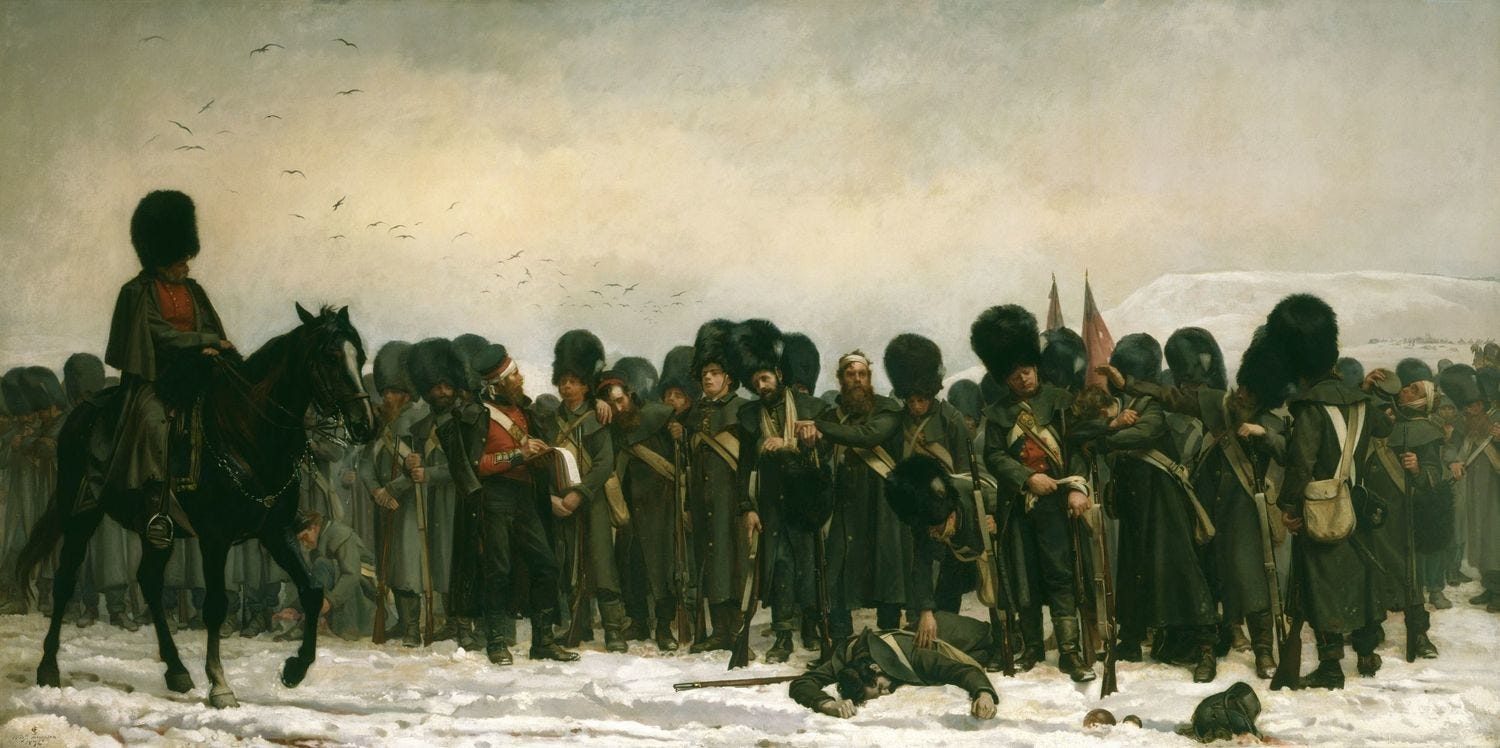
For her fourth try, Elizabeth Thompson chose the Crimean War, fought in the 1850s by Britain and France against Russia, around the Black Sea. Her picture, The Roll Call, shows no fighting at all.
A line of exhausted soldiers stands in the snow after a battle. A sergeant reads out their names to find out who is missing.
Why would an unknown young painter pick soldiers counting their missing, when she could have painted a victory?
In the rest of the story
Why Queen Victoria had The Roll Call taken away one night.
Why the painter bought a field, then had children trample it.
What the Royal Academy did when her name came up for a vote.
Why she rushed to a cottage still smoking after an eviction.