Emily Carr: The Complete Story
Deep green forests that seem to surge and breathe, and tall totem poles standing in abandoned villages on the wild coast of British Columbia.
Emily Carr painted the woods and the Indigenous heritage of western Canada with a force that few had brought to that landscape, and did most of it after the age of fifty.
She was a Canadian artist famous for her sweeping paintings of West Coast forests and Indigenous totem poles, and for a late, hard won burst of greatness.
The stories behind these stories
If this is the kind of art history you want more of:
The Ambassadors, detail by detail, the object at the bottom that only works from one side
Luncheon of the Boating Party, detail by detail, who everybody at that table actually was
Lady with an Ermine, detail by detail, why she is holding that animal
The living forest
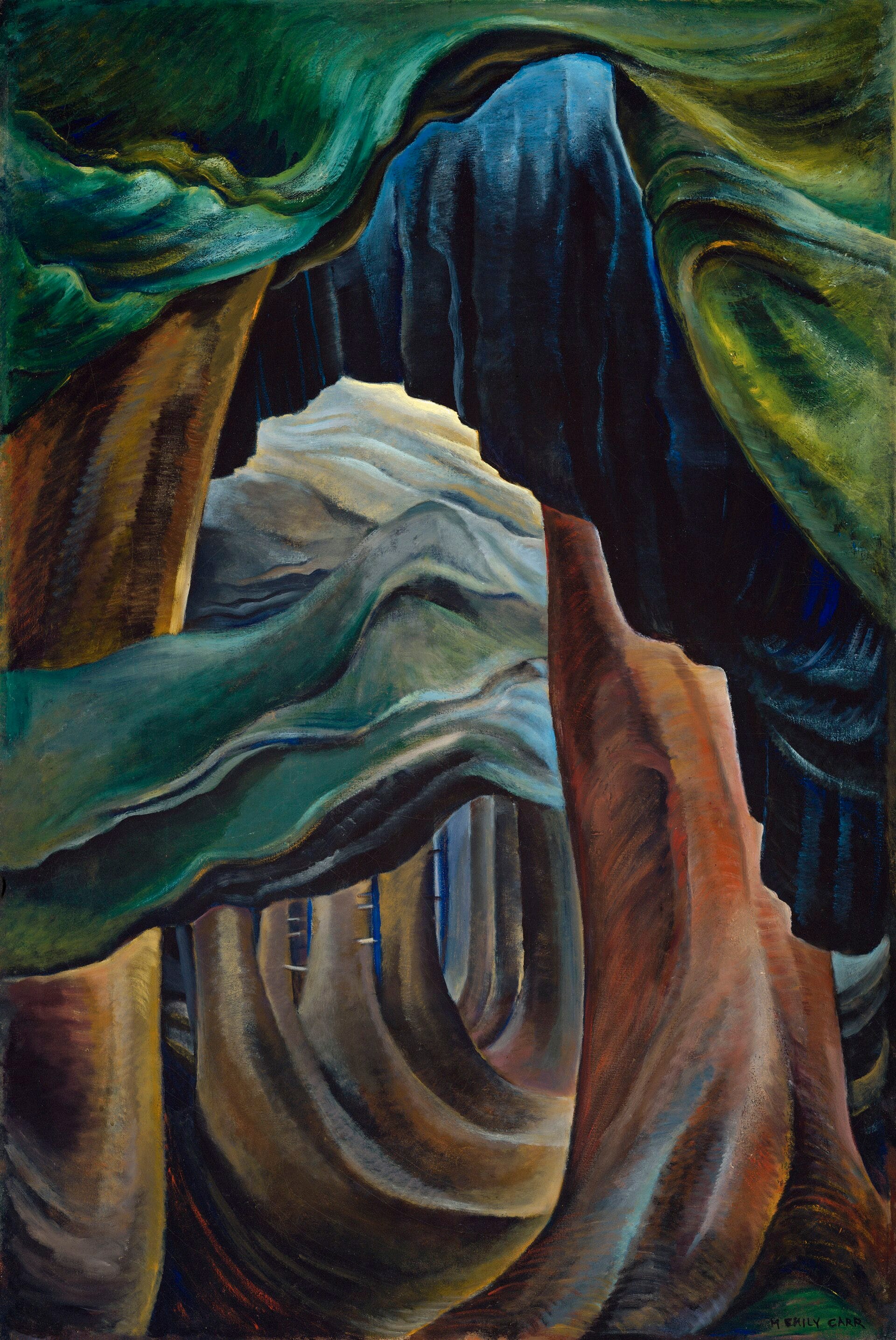
Carr painted the dense rainforests of British Columbia as swirling, almost moving masses of green, with the trees and sky caught up in a single rolling rhythm.
Her sweeping landscape painting made the forest feel alive, a vast breathing presence rather than a quiet backdrop.
The totem villages
For years she travelled to remote Indigenous villages on the coast to paint their great totem poles, often in places already being abandoned.
She meant the work partly as a record of a heritage she feared was vanishing, and the paintings remain a powerful, if complicated, document of those communities and their art.
The long wait
Carr struggled for recognition for most of her life, running a boarding house and nearly giving up painting altogether in her middle years.
Her work only found real acclaim after she met the Group of Seven, the famous Canadian landscape painters, in her late fifties, which reignited her ambition.
The painter who wrote
In her final years, with her health failing, Carr turned to writing and won Canada top literary prize for a book of stories about her life and travels.
Her loose, energetic late style, full of movement and light, belongs to the world of post Impressionism, modern and personal at once.
Common questions about Emily Carr
What is she known for?
Paintings of West Coast forests and Indigenous totem poles.
When did she succeed?
Late in life, after meeting the Group of Seven.
Did she write too?
Yes, she won a major Canadian literary prize.
When did she die?
In 1945.
Why her forests still surge
Carr proved that an artist can find her full power late, after decades of doubt, and pour a lifetime of feeling into a sudden flowering.
Her swirling green forests are now national treasures in Canada, and a major gallery in Vancouver holds the heart of her work, where her trees still seem to move.
She kept a menagerie of animals, including a monkey she dressed and treated almost as a child, and travelled the wild coast with her caravan and pets to reach the villages she wanted to paint.
Long overlooked as an eccentric outsider far from the art centres of the world, she is now regarded as one of the most original artists Canada has ever produced.
She is now seen as one of the first artists to take the West Coast forest and its Indigenous art seriously as great subjects, and her reputation has only grown since her death.
Her swirling green canvases hang in the leading Canadian galleries, and her books remain in print, so that both the painter and the writer continue to find new admirers generation after generation.
She found her truest voice only in her sixties, a reminder that the deepest work sometimes comes after a lifetime of looking, and her forests remain among the most loved images in Canadian art.
Her caravan and the wild coast she painted have become part of the national story, and visitors still seek out the British Columbia forests that she taught a whole country to see anew.