
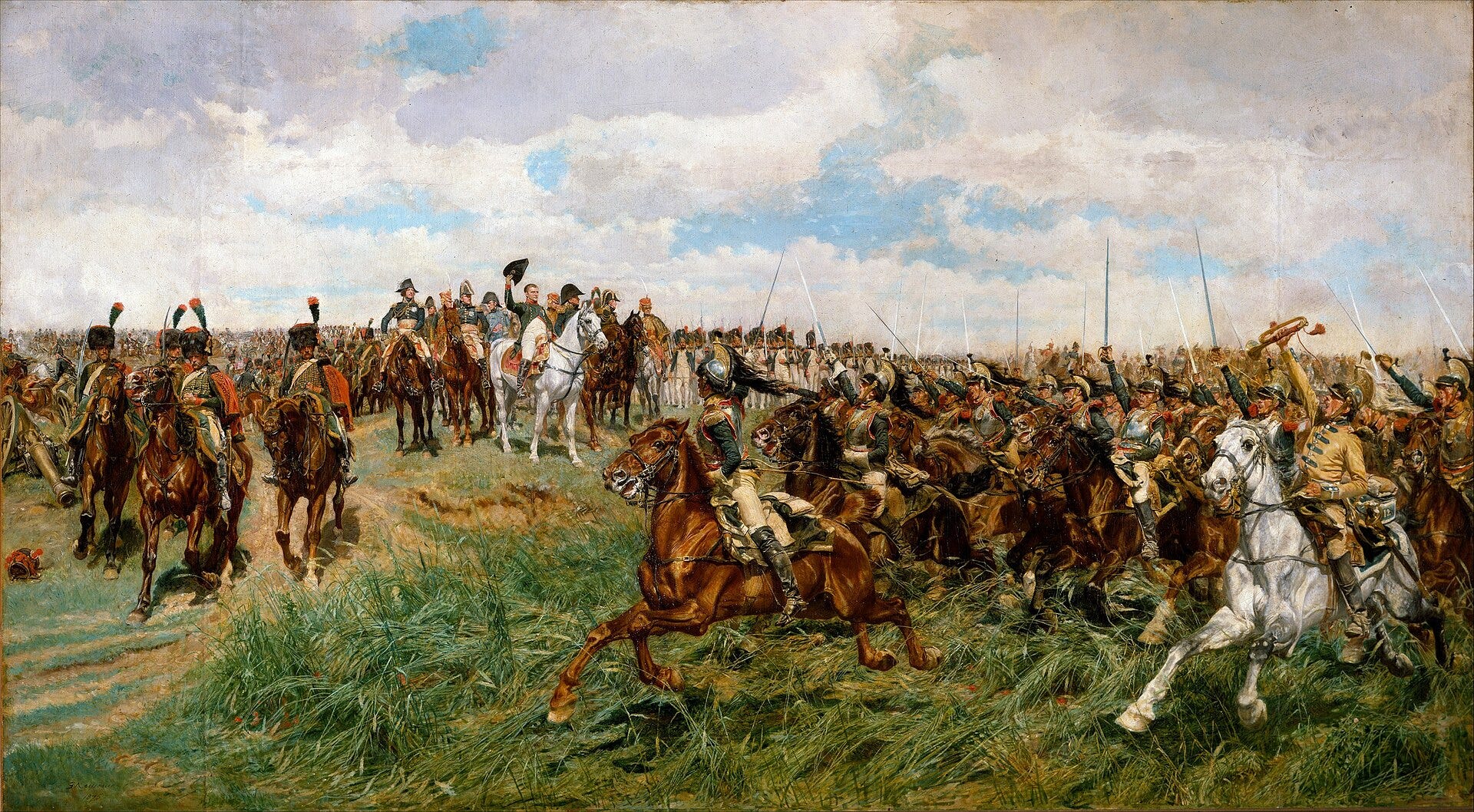
Ernest Meissonier (1815 to 1891) was a French painter of small, very precise pictures, famous for scenes of Napoleon's wars, like The Campaign of France, 1814, at the Musée d'Orsay in Paris, and 1807, Friedland, at the Metropolitan Museum of Art in New York.
Cool Stories About Art is a newsletter to learn art the fun way.
Join 200,000+ readers and get:
10 new art stories / month
The entire archive of content (140+ articles)
Comment, ask questions, and chat with other readers
Ernest Meissonier painted the wars of the first Napoleon down to the stubble on the emperor's chin, yet he never once saw him. Meissonier was a baby of four months when Napoleon lost his last battle, at Waterloo, in Belgium.
Ernest Meissonier was born in Lyon, a big city in southeastern France, in 1815. His father, Charles, ran a factory at Saint-Denis, just north of Paris, that made dyes for fabric, and he expected his eldest son to join the business.
Yet sketches Ernest made at eight already show a boy who loved to draw. At about seventeen, he was placed with a Paris druggist, a merchant who sold chemicals and remedies, and before long he won his parents' permission to become an artist.
Meissonier trained in the studio of Léon Cogniet, a Paris painter of history scenes who taught young artists. At the Louvre, the great museum of Paris, he studied the Dutch painters of the 1600s, who painted small scenes of everyday life with patient, minute care, and he made their way of painting his own.
To earn a living, he drew illustrations for books. In 1834, at nineteen, he first showed a painting at the Salon, the official art exhibition of Paris, whose jury chose every picture on its walls.
By the early 1840s, Meissonier's small pictures showed men in the clothes of the 1600s and 1700s, bent over a game of chess or cards, or playing the cello. Collectors bought them, and in 1846 the painter could afford a large house with two studios in Poissy, a town on the Seine River west of Paris.
In Poissy, Meissonier went on painting chess players and card players. The wars of Napoleon, the subject that would make his name, had not yet entered his pictures.
How could a painter born four months before Waterloo show the first Napoleon's wars as if he had ridden at his side?
In the rest of the story
What Meissonier tried and failed to borrow for his painting of Napoleon.
Which side Meissonier fought on in the streets of Paris in 1848.
Who bought Meissonier's largest painting without ever seeing it.
Why Meissonier invited two hundred guests to meet a photographer.