
The fairy tales that families gave each other as Christmas books were rarely gentle. In them, an ogre cuts his own daughters' throats and a mother follows Death to take back her child.
The artists who drew these scenes seldom looked away, and several of them lived through stories nearly as dark as the ones they illustrated.
Cool Stories About Art is a newsletter to learn art the fun way.
Join 200,000+ readers and get:
10 new art stories / month
The entire archive of content (140+ articles)
Comment, ask questions, and chat with other readers
How Fairy Tales Found Their Pictures
For centuries, fairy tales were passed on by word of mouth. In the 1800s, collectors in Germany, Norway and Russia wrote them down, writers such as the Dane Hans Christian Andersen added new ones, and publishers suddenly needed pictures. For illustrators, these stories offered a rare subject that let them draw the impossible.
What they could show depended on printing. The early editions carried little black engravings, cut into wood or metal. Color printing from carved woodblocks then brought bright, flat pages, and in the early 1900s a photographic process could copy a watercolor almost exactly, down to its softest wash.
That last step made possible the luxury gift books sold at Christmas, and with them the golden age of illustration. The most famous illustrator of that age, Arthur Rackham, drew both Cinderella and Little Red Riding Hood.
12. George Cruikshank, Rumpelstiltskin, from German Popular Stories (1823)
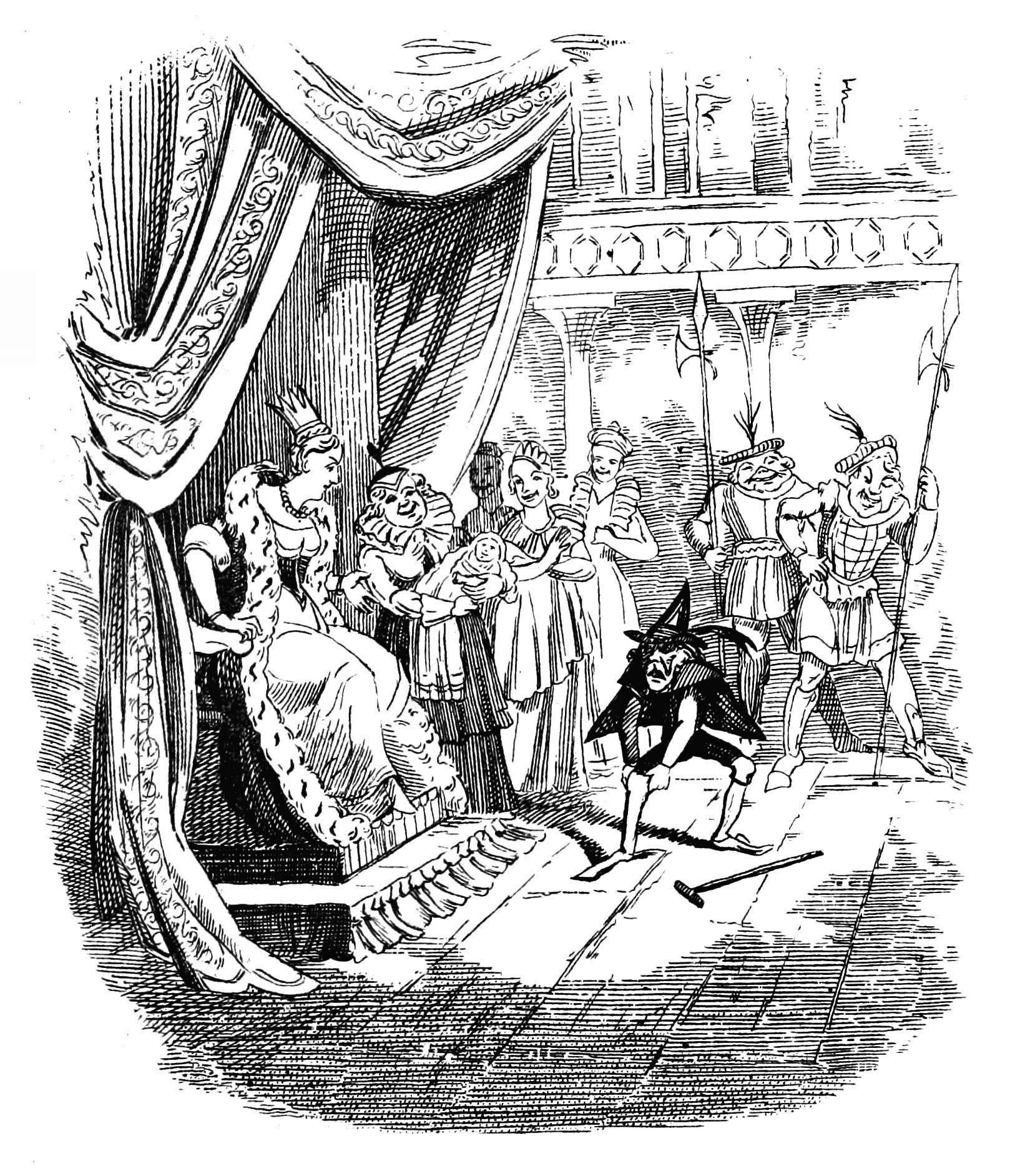
George Cruikshank's Rumpelstiltskin catches the tiny man at the moment he hears his own name. Long beard, pointed cap, he stamps in fury on the floor of a royal hall, while a queen on her throne and her courtiers look on.
The German tale explains his rage. A miller's daughter, ordered by a king to spin straw into gold, was saved by a little man who did the spinning for her, at the price of her first child. Once she became queen, he came to collect, and guessing his name was her only way to keep the baby.
In 1823, English readers had never read this story in their own language. The plate comes from the first English translation of the tales collected by the Grimm brothers, published in London that year as German Popular Stories.
The translator, Edgar Taylor, kept only part of their collection, and Cruikshank, a London illustrator, etched the pictures. He leaned on the comic side of the tales, as his furious little man shows, and his plates did much to make the book a success.
That success then crossed back to Germany. It pushed the Grimm brothers to publish a little illustrated selection of their own in 1825, and that pocket edition became a bestseller there.
The glory did not last. Thirty years later, his career was slipping, and he had become a fierce campaigner against alcohol. He came back to fairy tales to serve that cause. His Fairy Library, four books published between 1853 and 1864, rewrote each story as a lesson against drink.
In his Cinderella, the king has all the wine, beer and spirits in the kingdom burned. His friend the novelist Charles Dickens answered in public. On October 1, 1853, in his weekly magazine Household Words, he published an essay called Frauds on the Fairies, which accused Cruikshank of tampering with the old tales to preach.
Dickens wrote there that Cruikshank was "of all men, the last who should lay his exquisite hand on fairy text." The reply came the following year, in a pamphlet written as if by a fairy-tale character: A Letter from Hop-o'-My-Thumb to Charles Dickens. Hop-o'-My-Thumb is the tiny boy who outwits an ogre in a tale by the Frenchman Charles Perrault.
At a Glance
Artist: George Cruikshank (1792 to 1878)
Made: 1823 (design), this printing 1876
Medium: Etching, here reproduced as a printed book plate
Size: Not published
Where to see it: In the book German Popular Stories (London, C. Baldwyn, 1823) and its reprints, including a later edition in the National Art Library, Victoria and Albert Museum, London
About This Print
What is the original version of Rumpelstiltskin?
The Brothers Grimm printed the tale in their 1812 collection, where the little man simply ran away in anger and never came back. Their 1857 edition gave it the grisly ending now best known, in which he stamps his foot into the ground and tears himself in two.
11. Virginia Frances Sterrett, "Ah, ha! you are at last in my domain, little fool!", from Old French Fairy Tales (1920)
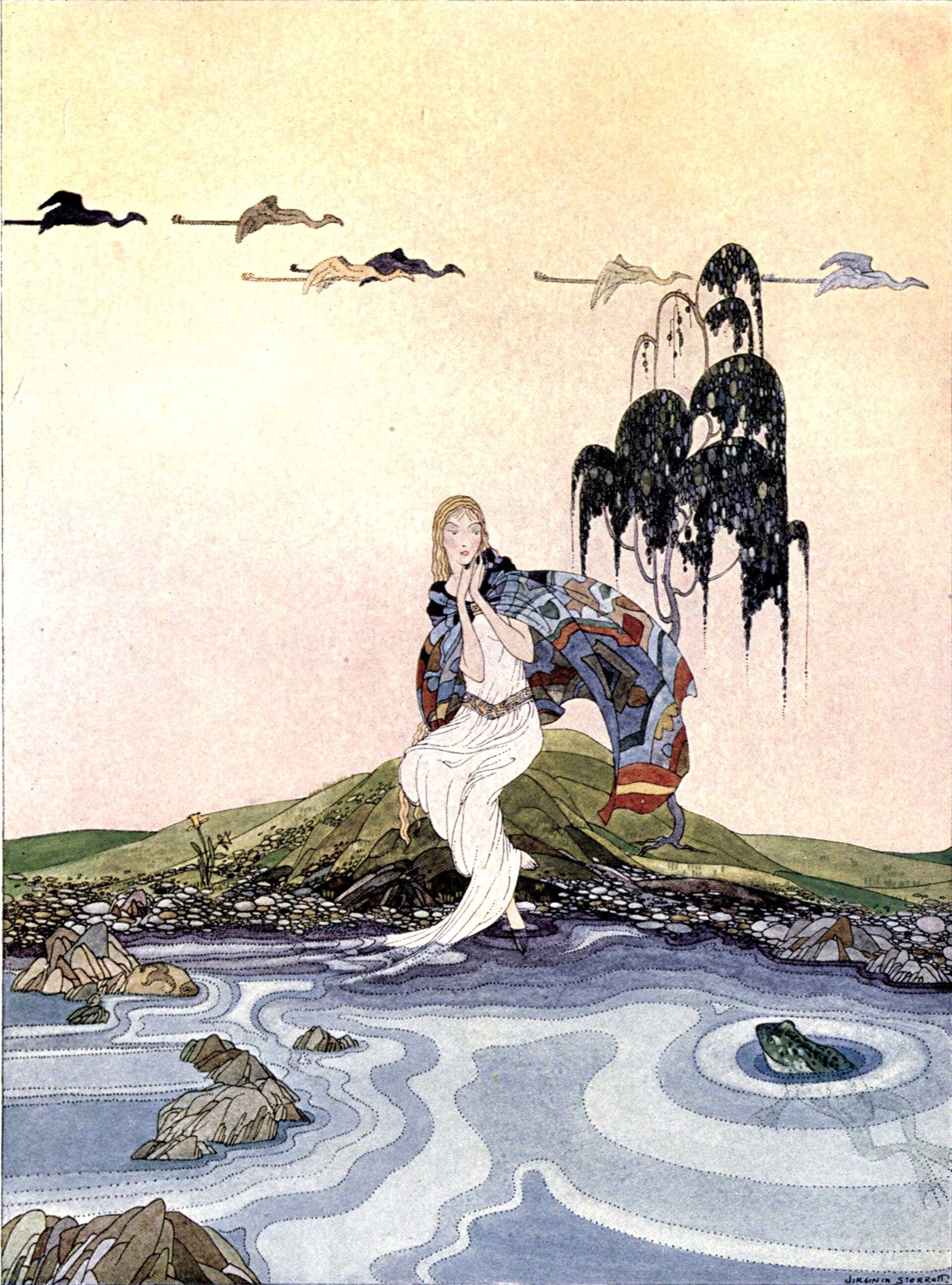
A large toad rises out of a dark pool toward a girl sitting alone on a rock, in a plate by Virginia Frances Sterrett for Old French Fairy Tales. She painted it at nineteen, with almost no training, while supporting her family with her brushes because her mother was ill. Soon after she finished the book, she learned that she had tuberculosis.