
The fall of the angels fills only a few lines of the Bible, and nobody claimed to have seen it. What it looked like was for painters to decide: the moment an angel stops being an angel, the face of a rebel who has just lost a war in heaven. Over five centuries their answer kept shifting, until the villain became the most beautiful figure on the canvas.
Cool Stories About Art is a newsletter to learn art the fun way.
Join 200,000+ readers and get:
10 new art stories / month
The entire archive of content (140+ articles)
Comment, ask questions, and chat with other readers
Why Painters Had to Invent the Fall
The story these works illustrate is a short one. In the Book of Isaiah, the prophet mourns a morning star fallen from heaven, a star that Latin translators called Lucifer. The Book of Revelation adds a war in heaven, in which the archangel Michael hurls a dragon and its angels down to earth.
Everything else was left to painters: a body that is still an angel's and already something else, a face for defeat. For centuries they answered with crowds of rebels sprouting animal heads. Then, in 1667, the English poet Milton published Paradise Lost, and the fallen angel became a character, alone and often beautiful.
All twelve works show the fall or the angel just after it. The earliest is a page from a prayer book of the 1410s, the latest a canvas of 1902, and one marble statue earns its place through its story.
12. Antonio María Esquivel, The Fall of Lucifer (1840)
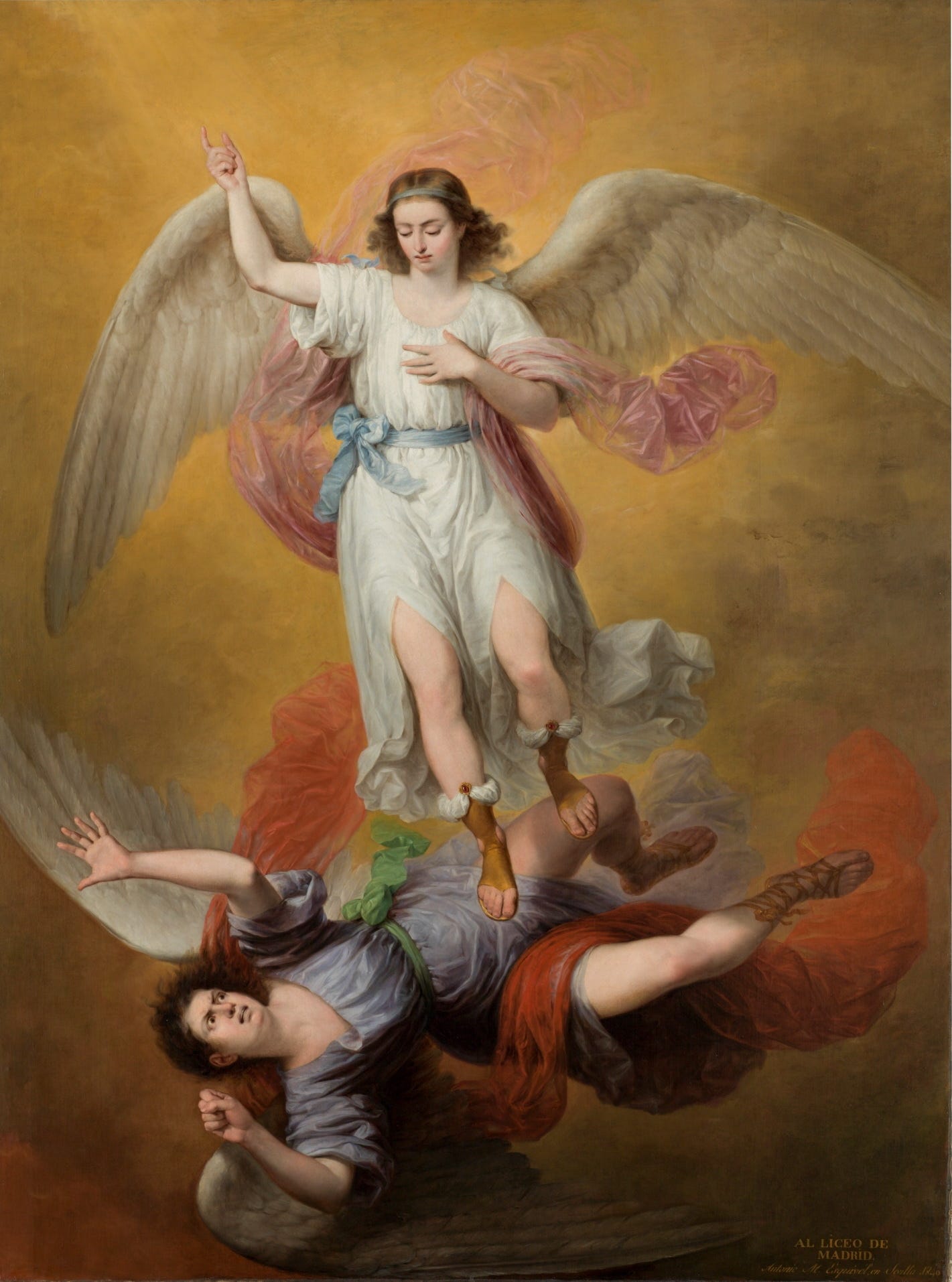
The angel falling backwards through the clouds keeps his face turned up toward the one who has just thrown him out. That face is furious, and the eye goes to it before anything else. Antonio María Esquivel painted it in Madrid in 1840, the year he recovered his sight.
The story behind that date starts three years earlier. In 1837 Esquivel helped found the Liceo Artístico y Literario, a club where the painters and writers of Madrid met and showed their work. Then, in 1839, he went blind.
His friends at the Liceo refused to let his career stop there. Painters and writers gathered the help he needed to travel abroad for treatment, and in June 1840 he was cured.
The canvas was his way of thanking them. An inscription painted on it says that the artist gave the work to the Liceo of Madrid in gratitude, and the members saw it in April 1841.
For a picture of this size, Esquivel made an unusual choice. For centuries painters had given Michael a helmet and a sword, and this archangel has neither. Without weapons, the fight comes down to two faces, one calm and one enraged, and the critics of the day praised the color and the truth of the figures.
The subject seems to me hard to separate from the man. Lucifer means light bearer in Latin, and the first large picture by a painter who had just been given back his sight tells of the angel who lost the light.
At a Glance
Artist: Antonio María Esquivel (1806 to 1857)
Painted: 1840
Medium: Oil on canvas
Size: 275 × 205 cm (108 × 81 in)
Where to see it: Museo del Prado, Madrid
11. Guillaume Geefs, Le Génie du Mal (1848)
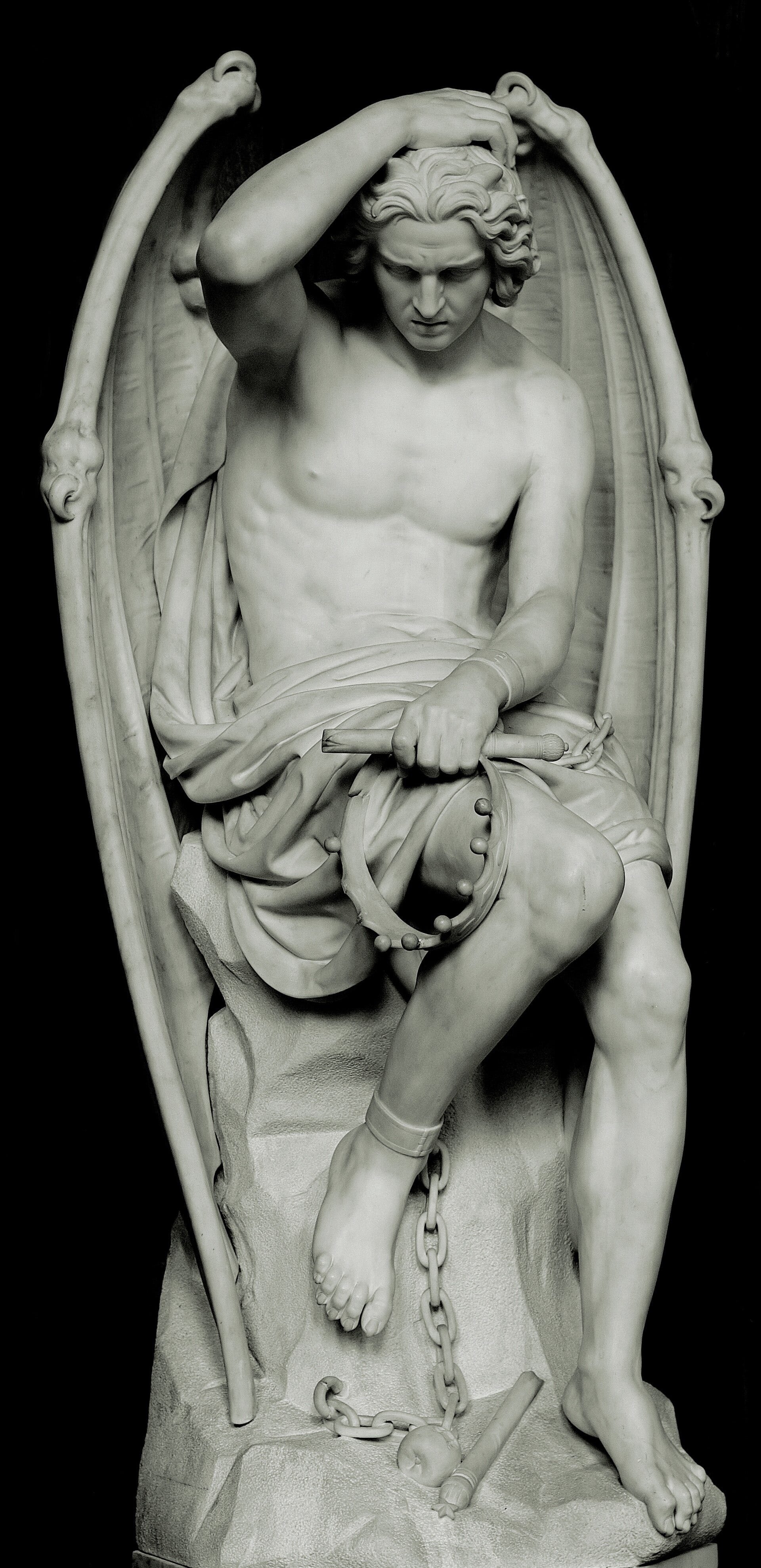
At the back of the pulpit in St Paul's Cathedral in Liège, Belgium, a young man with wings sits chained to a rock, his head bowed. He is Lucifer, and he is the second Lucifer to sit there. His predecessor lasted only a few years before the bishop had him removed, and the charge against him was an odd one for a devil. He was too handsome.