Family and the Stages of Life in Painting

Painting follows a human life from cradle to grave. Artists have returned again and again to five moments: childhood, motherhood and pregnancy, marriage, old age, and death. This pillar gathers nine guides that trace those stages, painting by painting.

Velazquez's Las Meninas, the young Infanta Margarita surrounded by her attendants
Diego Velazquez, Las Meninas, 1656, Museo del Prado, Madrid

These subjects recur because patrons kept commissioning them. Families wanted portraits of their children, churches wanted Madonnas, couples wanted wedding records, and towns wanted funerals remembered.

The result is a visual record of ordinary life stretching back centuries.

Childhood

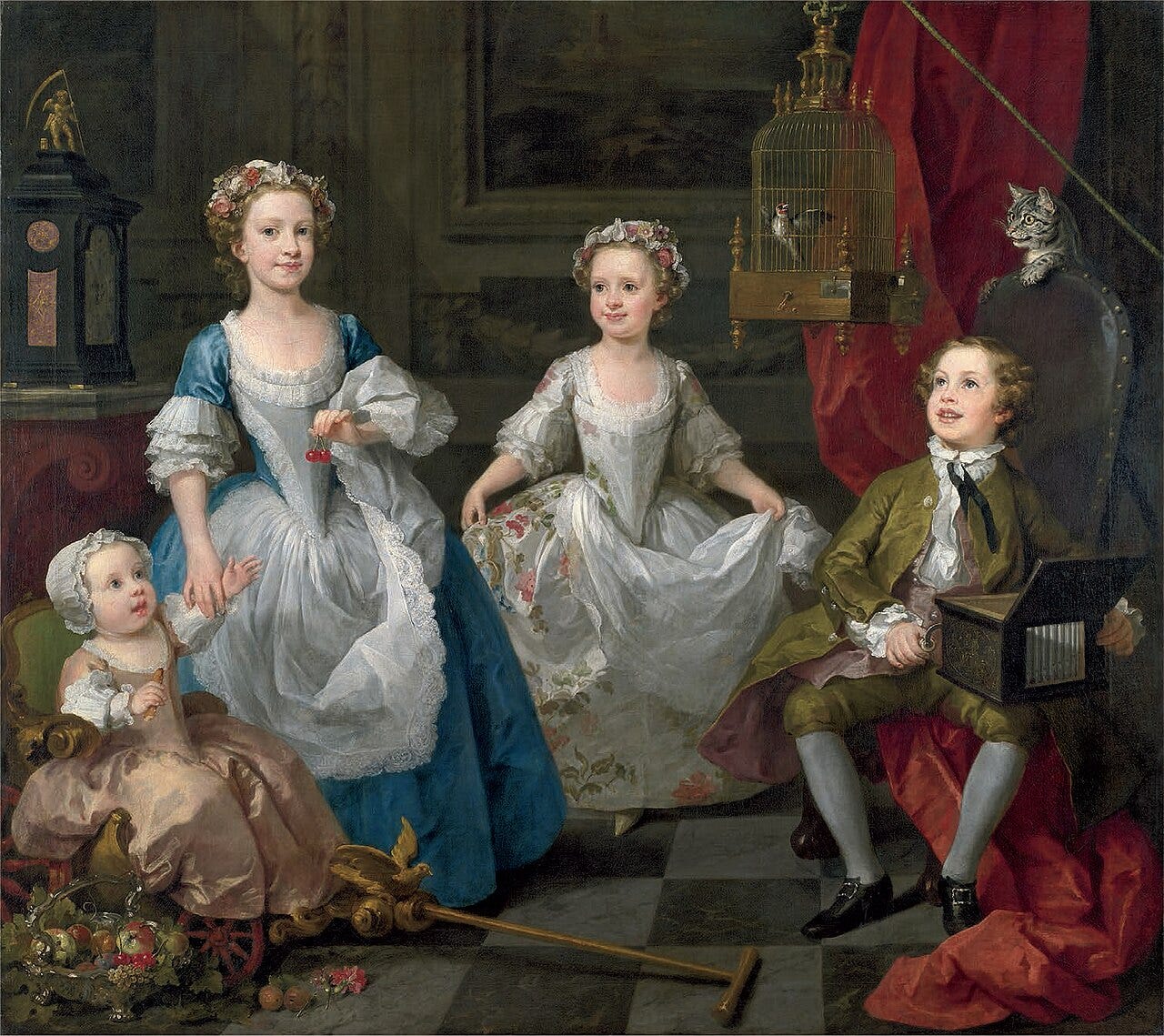
Hogarth's Graham Children, four siblings posed with a caged bird and a cat
William Hogarth, The Graham Children, 1742, Tate Britain, London

Children were painted long before childhood was taken seriously as a subject.

Our guide to famous paintings of children covers 12 portraits, from Velazquez's Infanta Margarita to Runge's Hulsenbeck Children. It includes Hogarth's The Graham Children, where the youngest child in the picture had already died before Hogarth finished the painting.

A companion list of children in art adds 12 more works to know, including Velazquez's Las Meninas and Millais's Bubbles, a portrait later used in a Pears soap advertisement.

There is also the reverse angle: what the artists themselves painted as children. Our page on how famous artists started includes Edward Hopper's Little Boy Looking at the Sea, painted at age 9 in Nyack, New York, in 1891.

It also covers the Schongauer copy Michelangelo made at 12, a panel that disappeared for centuries, resurfaced in a private collection in 2008, and was bought by the Kimbell Art Museum for around 6 million dollars.

Motherhood and pregnancy

Cassatt's Child's Bath, a mother washing a young child's feet in a basin
Mary Cassatt, The Child's Bath, 1893, Art Institute of Chicago
Whistler's seated mother in profile, dressed in gray and black
James McNeill Whistler, Arrangement in Grey and Black No. 1, 1871, Musee d'Orsay, Paris

The mother and child is the most repeated image in Western art, and it did not stop with the Madonna.

Our guide to famous mother and child paintings includes Whistler's Mother, whose real title is Arrangement in Grey and Black No 1, bought by France in 1891.

A second list of famous paintings of mothers features Mary Cassatt's The Child's Bath from 1893. Cassatt painted mothers and children for decades, though she never married or had children herself.

Pregnancy itself was rarely shown, which is what makes the exceptions worth a separate guide.

Our page on pregnancy in painting covers Piero della Francesca's Madonna del Parto from about 1460, a visibly pregnant Virgin that became a pilgrimage site for expectant mothers in Monterchi, Italy. It also covers Frida Kahlo's painting of her own miscarriage, made in a Detroit hospital in 1932.

New here? Learn art the fun way. Free stories every week, no boring lectures.

Marriage

Hogarth's Marriage A la Mode, a series showing an arranged marriage ending in ruin
William Hogarth, Marriage A la Mode, 1743 to 1745, National Gallery, London
Van Eyck's Arnolfini Portrait, a couple joining hands in a signed marriage scene
Jan van Eyck, Arnolfini Portrait, 1434, National Gallery, London

Marriage gave painters two very different jobs: recording a union and commenting on it.

Both appear in our guide to wedding paintings in art history. Jan van Eyck's Arnolfini Portrait of 1434, now in the National Gallery in London, sits at one end.

Van Eyck wrote "Jan van Eyck was here" above the mirror, turning the painting into something close to a signed witness statement.

William Hogarth sits at the other end. His Marriage A la Mode series turned an arranged marriage into a six painting story that ends in ruin.

Old age

Rembrandt's late self portrait, an aging face with two circles on the wall behind him
Rembrandt van Rijn, Self Portrait with Two Circles, about 1665, Kenwood House, London

Few subjects test a painter's honesty like an aging face.

Our guide to old age in art gathers 12 paintings that pass the test.

Rembrandt's Self Portrait with Two Circles, painted around 1665 and now at Kenwood House in London, was made just a few years before his death. Ghirlandaio's An Old Man and his Grandson, from about 1490 and now in the Louvre, keeps the old man's disfigured nose exactly as it was, with no attempt to soften it.

Death and farewell

El Greco's Burial of the Count of Orgaz, saints lowering the body while heaven opens above
El Greco, The Burial of the Count of Orgaz, 1586, Santo Tome, Toledo
Courbet's Burial at Ornans, a large crowd gathered around a small town funeral
Gustave Courbet, A Burial at Ornans, 1850, Musee d'Orsay, Paris

The last stage got some of the largest canvases in art history.

Our guide to famous funeral paintings collects 12 farewells.

Gustave Courbet's A Burial at Ornans, painted in 1850 and now at the Musee d'Orsay, is seven meters wide, a scale usually reserved for history painting. He spent it instead on an ordinary funeral in a small French town.

El Greco's The Burial of the Count of Orgaz, from 1586, still hangs in the Toledo church it was painted for.

Family and life stages in painting, common questions

  • Why do the same life stages appear so often in painting? Because they were the moments people paid to have recorded. Child portraits, Madonnas, wedding pictures, and funeral scenes were all commissioned by families, churches, and communities who wanted those events remembered.

  • What is the most repeated image in Western art? The Madonna and child. The mother and child motif has been painted more often than any other subject in the Western tradition.

  • When did ordinary family life become a subject in its own right? Scenes of everyday domestic life rose to prominence as a genre during the Dutch Golden Age of the seventeenth century, when middle class buyers wanted paintings of their own world.

  • Why was pregnancy so rarely painted? Visible pregnancy was long considered an unsuitable subject for portraiture, which makes exceptions like Piero della Francesca's Madonna del Parto, from about 1460, so unusual.

  • Did artists paint these stages from their own lives? Sometimes very directly. Rembrandt recorded his own old age in self portraits, and Frida Kahlo painted her own miscarriage in a Detroit hospital in 1932.

Nine guides, five stages, one arc that painters have traced for centuries.

Enjoyed this? Join the readers who learn art the fun way, free every week.

A few of them compressed the whole journey into a single frame. Gustav Klimt's The Three Ages of Woman, from 1905, shows an infant, a young mother, and an old woman in one composition, and it won a gold medal at the 1911 international art exhibition in Rome, where the Italian state bought it on the spot.

Related reading