
The dotted canvases that made Aboriginal art famous only appeared in 1971, yet the images behind them are many thousands of years old. Across that whole span, a picture has rarely been made for decoration. It records a place and the Law that goes with it, and once, painted on bark, it was sent to a parliament as a protest.
Cool Stories About Art is a newsletter to learn art the fun way.
Join 170,000+ readers and get:
10 new art stories / month
The entire archive of content (1,000+ articles)
Comment, ask questions, and chat with other readers
What Country Asks of an Artist
Aboriginal and Torres Strait Islander readers are advised that this page contains the names of people who have died.
The term Aboriginal art covers the work of the First Nations peoples of mainland Australia and many of its islands, while Torres Strait Islanders have traditions of their own. It covers many peoples, each with its own language, so there is no single Aboriginal style.
What these peoples share is a way of thinking about images, and two words carry it. Country, with a capital C, means a place together with its water, its sky, its plants and animals, and the knowledge and the Law that belong to it. The Dreaming, sometimes called the Dreamtime, is the age when ancestral beings shaped that Country and laid down the Law.
This changes what an artist is asked to do. An Aboriginal painter rarely invents a subject. The task is to set down a piece of Country and its story correctly, and only with the right to do so. That is why a painting can often be read from above, like a map, where a circle marks a waterhole and a line marks a journey. Sacred details stay out of the works made for the public, which is why many of them look simpler than the stories they hold.
The twelve works below go from rock to canvas, and each stands at a point where Aboriginal art met the outside world: a mission, a cattle station, a mine, a gas plant, a school, a national gallery. Works by artists who died after 1955 are still under copyright in Australia, so half of the entries appear without a picture.
12. Murujuga, Engraved Rocks of the Burrup Peninsula (over thousands of years)
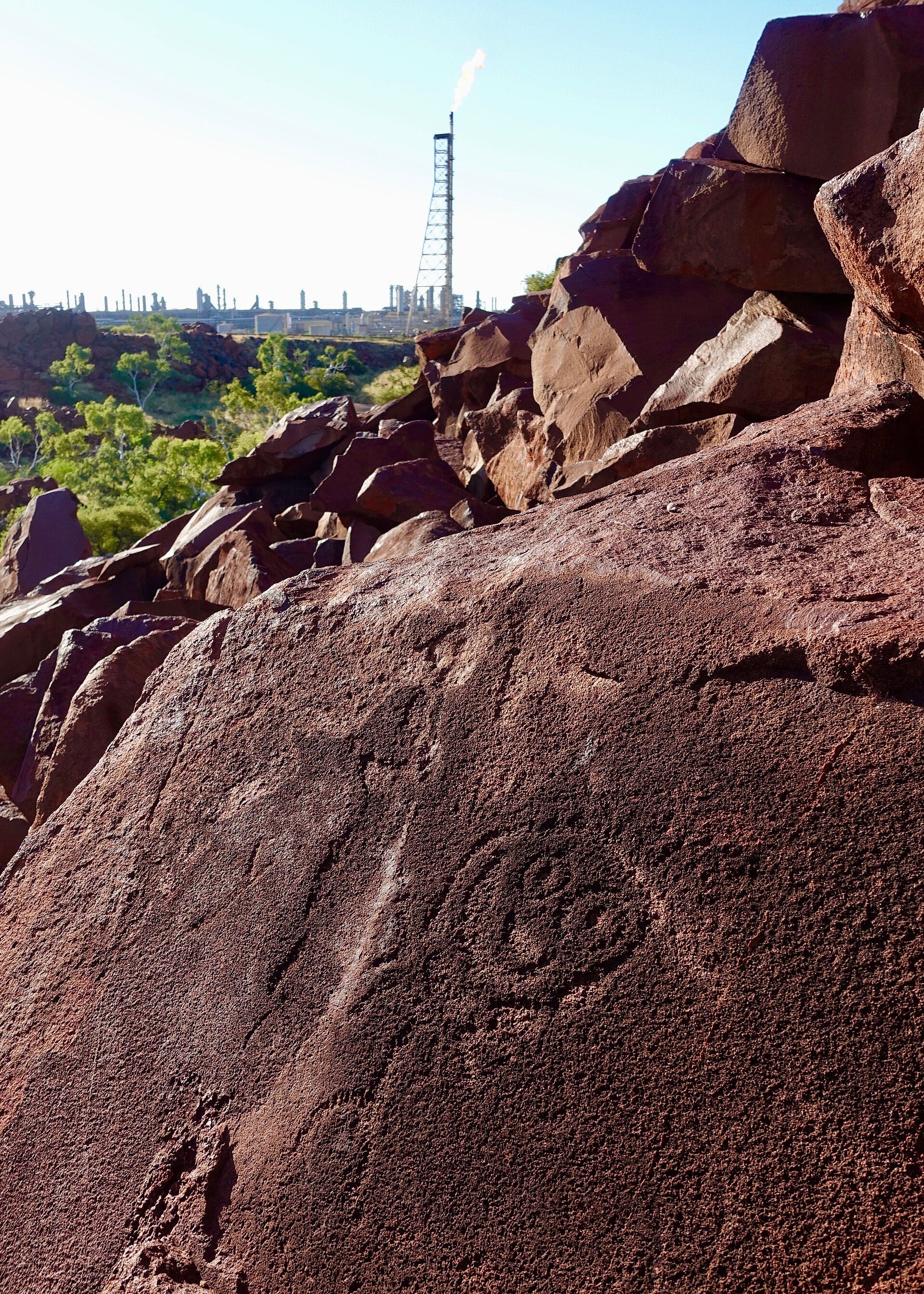
Pecked into a dark red boulder, a spiral stands out in grooves paler than the rock around it. Behind it, a steel flare tower rises into a pale sky. The photograph was taken on the Burrup Peninsula, in the Pilbara region of Western Australia, a place its traditional owners call Murujuga.
The spiral was made the way all the images here were made, by pecking at the dark surface of the rock until the paler stone beneath showed through. Over many thousands of years, the ancestors of the Ngarda-Ngarli, the five peoples who care for the peninsula today, made up to two million of these engravings here and on the nearby islands. Among them are some of the earliest known images of people.
The flare tower belongs to the other half of the story. Right beside the engravings, an industrial zone ships out gas, iron ore, fertilizer and salt. The danger lies in the air. In May 2025, ICOMOS, the body that advises UNESCO, sent the World Heritage nomination back to Australia, citing the risk that industrial emissions, acid ones in particular, pose to the rock.
The government, backed by the Murujuga Aboriginal Corporation, disputed the science, and in July 2025 Murujuga was inscribed on the World Heritage List. "There were tears of joy," said the corporation's chairman, Peter Hicks.
Not everyone celebrated on the same terms. A former chair, Raelene Cooper, had asked for firmer limits on emissions, and none were written into the listing. "Global scrutiny will now be applied to what is happening at Murujuga," she said.
At a Glance
Artist: Ancestors of the Ngarda-Ngarli (Ngarluma, Mardudhunera, Yaburara, Yindjibarndi and Wong-Goo-Tt-Oo peoples)
Made: Over many thousands of years
Medium: Engravings pecked into the rock surface
Size: Engraved across many boulders (no single size in cm or in)
Where to see it: Murujuga National Park, Burrup Peninsula, Western Australia
11. Ku-ring-gai, The Emu Engraving (date unknown)
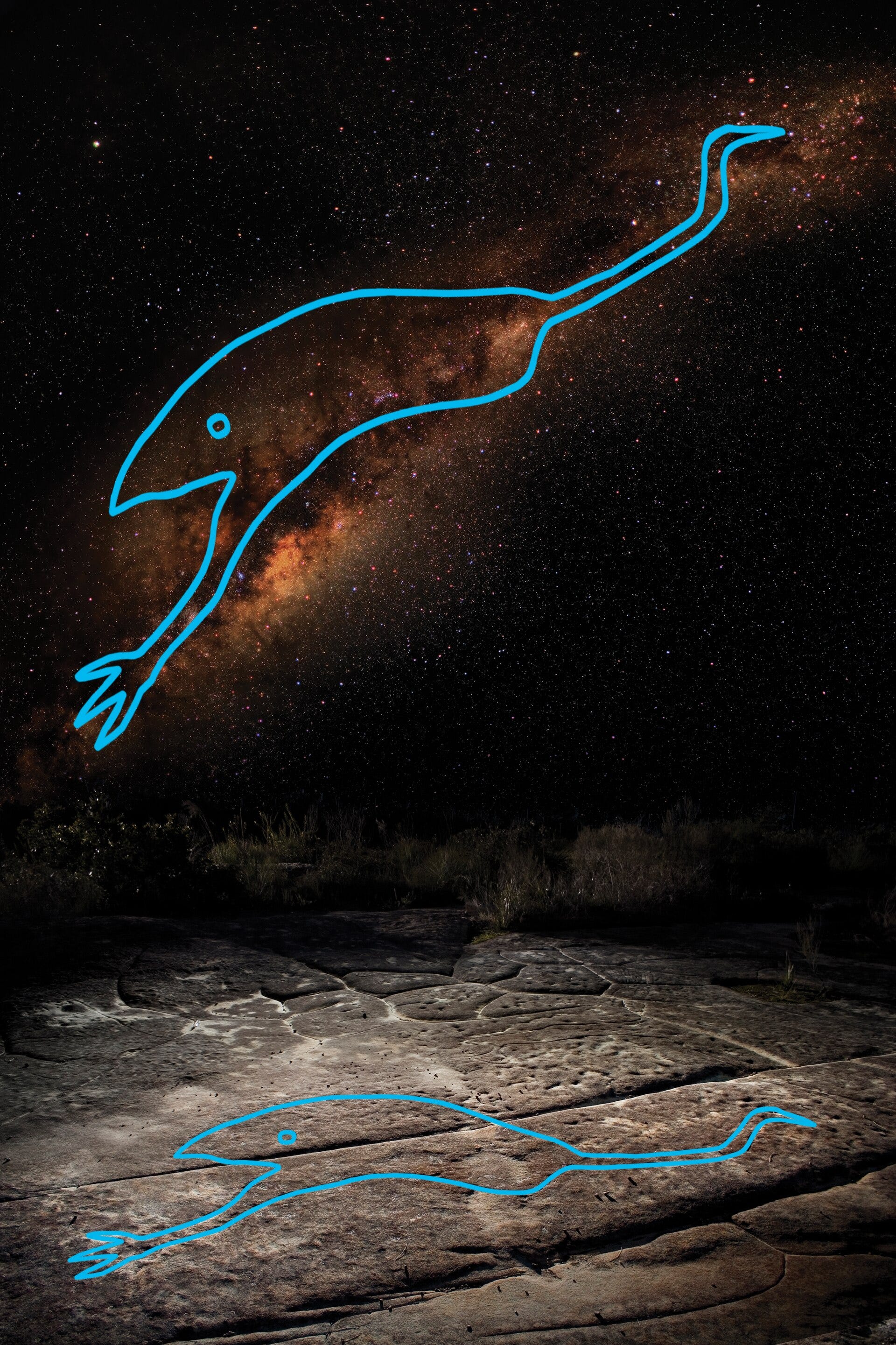
On a dark night in the Southern Hemisphere, the Milky Way holds a figure made of darkness. Its head is a black cloud of dust just below the Southern Cross, its neck and body run along the dark lanes of the galaxy, and many Aboriginal peoples know it as an emu. North of Sydney, someone once carved a large emu into a flat sheet of sandstone. In autumn, the bird in the sky comes to lie right above it.