Famous Abstract Paintings: 12 That Left the Real World
The most famous abstract paintings threw out the visible world and painted pure color, line and feeling instead, from Kandinsky's storms to Malevich's black square. In barely twenty years a handful of artists changed what a painting could even be.
These pioneers believed a picture did not need a face, a saint or a bowl of fruit to move you. I have picked twelve early abstractions, all now out of copyright, that show art letting go of the real world one brave step at a time.
How art let go of the real world:
The spiritual. Many pioneers believed pure color and shape could reach the soul directly.
The music. If music moves us with no story, painters asked, why not painting too.
The zero. Some pushed all the way to a single black or white square, art stripped to nothing.
The grid. Others rebuilt from scratch with straight lines and primary colors, order out of chaos.
For the long version
If you like knowing what is actually going on inside a picture, start with these three:
Lady with an Ermine, detail by detail, why she is holding that animal
The secret behind Hopper Soir Bleu, the clown picture that went wrong
Titian, Sacred and Profane Love, which of the two women is which
1. Hilma af Klint, The Ten Largest (1907)
Years before any man is credited with inventing abstract art, a Swedish woman was already painting it in secret. Her huge, glowing canvases, like The Ten Largest from 1907, swarm with spirals, flowers and symbols that stand for nothing you can name.
She believed her pictures were guided by spirits and messages from beyond, and she told almost no one, ordering that they stay hidden for twenty years after her death. Only in this century has the world realized she got there first.
2. Liubov Popova, Painterly Architectonic (1916)
Flat planes of red, black and white slide over one another like sheets of colored glass, tilting as if about to slip off the canvas.
This is one of Liubov Popova's Painterly Architectonic works, made around 1916 in the thick of the Russian avant garde.
There is no table, no window, no figure, only shapes claiming their own weight and space.
Popova had studied in Paris and worked beside Vladimir Tatlin in Moscow, and she wanted a picture built like architecture, every plane doing a job. Soon she pushed past canvas into fabric and stage sets, certain that art should shape ordinary life.
She died of scarlet fever in 1924 at thirty five, two days after the same illness killed her young son, and her name was rescued from the footnotes only decades later.
3. Robert Delaunay, Simultaneous Windows (1912)
A city dissolves into shards of transparent color, a hint of the Eiffel Tower still glinting through. This is Robert Delaunay's Simultaneous Windows from 1912, where pure color, rather than drawing, builds the whole picture.
His style was dubbed Orphism, after the musician Orpheus, chasing harmony out of clashing tones. Delaunay was certain color alone could carry light, movement and life, and he spent the rest of his career proving it across Paris.
4. Wassily Kandinsky, Composition VII (1913)
It looks like the world exploding into color, a chaos of lines, blobs and half shapes with no up or down. Dozens of studies fed into Composition VII before Kandinsky finished it in 1913, the wildest and most complex of all his early works.
Hidden inside the storm are traces of a flood, a resurrection and the end of the world, dissolved almost past recognition. For Kandinsky color was a spiritual force, and this was his attempt to paint the soul itself, a leap I unpack in what abstract art is.
5. Olga Rozanova, Non Objective Composition (1916)
Bands of color hang in an empty field, weightless, answering to nothing outside themselves. Around 1916, working close to Malevich just as Suprematism was taking shape, Olga Rozanova was making non objective work like this.
She was not simply trailing him though, she was after something of her own.
Rozanova called her idea color painting, letting the color itself be the entire subject, and her later Green Stripe is little more than one glowing band on white.
She died of diphtheria in 1918, only thirty two, with her furthest work barely seen. For years she was filed as a footnote to the men around her.
6. Marsden Hartley, Portrait of a German Officer (1914)
At first it looks like a proud arrangement of flags, badges, numbers and medals, and not one face appears anywhere. Marsden Hartley gave this 1914 canvas the title Portrait of a German Officer, and painted it while living in Berlin.
The whole picture is a coded portrait of a young German officer Hartley loved, killed early in the First World War, his initials and regiment woven into the design. An American in Berlin turned private heartbreak into flat, brilliant abstraction.
7. Kazimir Malevich, Black Square (1915)
A black square on a white ground, and nothing else. When Kazimir Malevich hung Black Square high in the corner of a room in 1915, exactly where a Russian home would place a holy icon, he was announcing the end of the old art.
He called his new style Suprematism, the supremacy of pure feeling over things, and this was its zero point. Simple as it looks, it may be the most radical painting of the whole twentieth century.
8. Kazimir Malevich, White on White (1918)
A pale white square tilts inside a slightly whiter field, almost impossible to see. Malevich pushed even further in 1918 with White on White, draining out nearly all color and form.
Having reached black, he now reached for infinity, a picture that seems to dissolve as you look at it. There was almost nowhere left to go, and for a while he stopped painting altogether.
9. Piet Mondrian, Composition with Grid (about 1921)
Black lines cross a white field into rectangles, a few of them filled with flat red, blue and yellow. Around 1921 Piet Mondrian arrived at the style he would refine for the rest of his life, stripping the world down to straight lines and primary colors.
He called it Neoplasticism and believed it revealed a hidden universal order beneath the mess of nature. Those simple grids went on to shape modern design, from buildings to dresses to album covers.
10. Wassily Kandinsky, Composition VIII (1923)
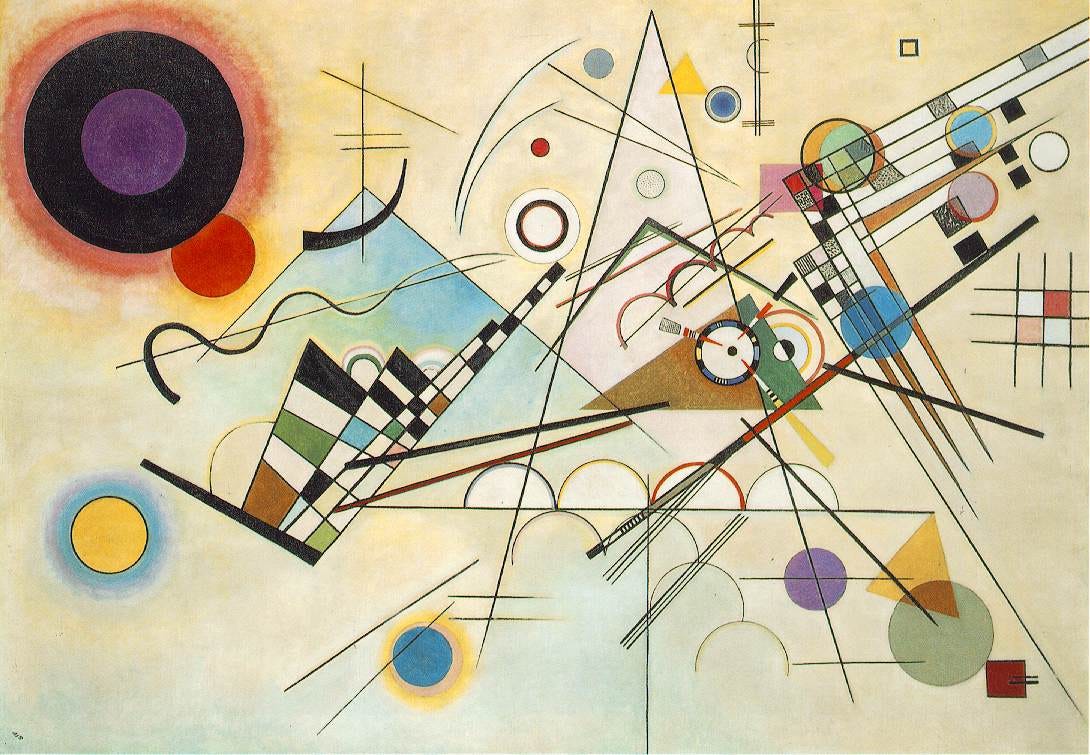
Gone are the storms, replaced by crisp circles, triangles and floating lines on a pale ground. By 1923, teaching at the Bauhaus, Kandinsky had cooled his abstraction into clean geometry in Composition VIII.
He now treated shapes almost like a language, each circle and angle carrying its own feeling and sound. It is calm where his earlier work was wild, the same spiritual quest in a colder, sharper key.
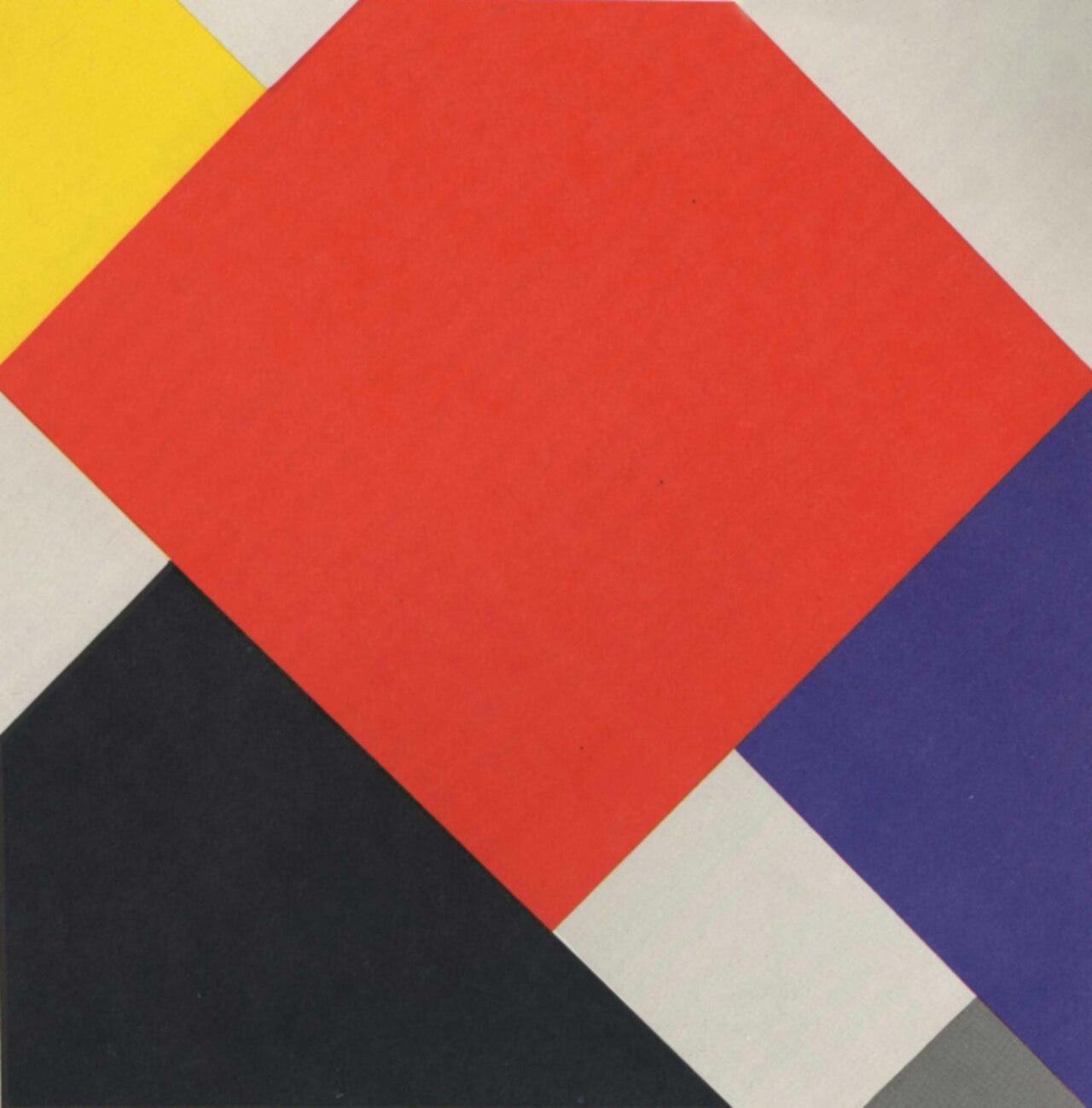
11. Theo van Doesburg, Counter Composition (1924)
Mondrian used only horizontals and verticals, so when his friend tilted the grid onto a diagonal, it started a real quarrel. Around 1924 Theo van Doesburg began setting his colored planes on a defiant slant, a series he called Counter Compositions.
He argued the diagonal gave a picture the energy and tension the strict grid lacked. The two men fell out over it for good, proof of how seriously these pioneers took a single line.
12. Wassily Kandinsky, Several Circles (1926)
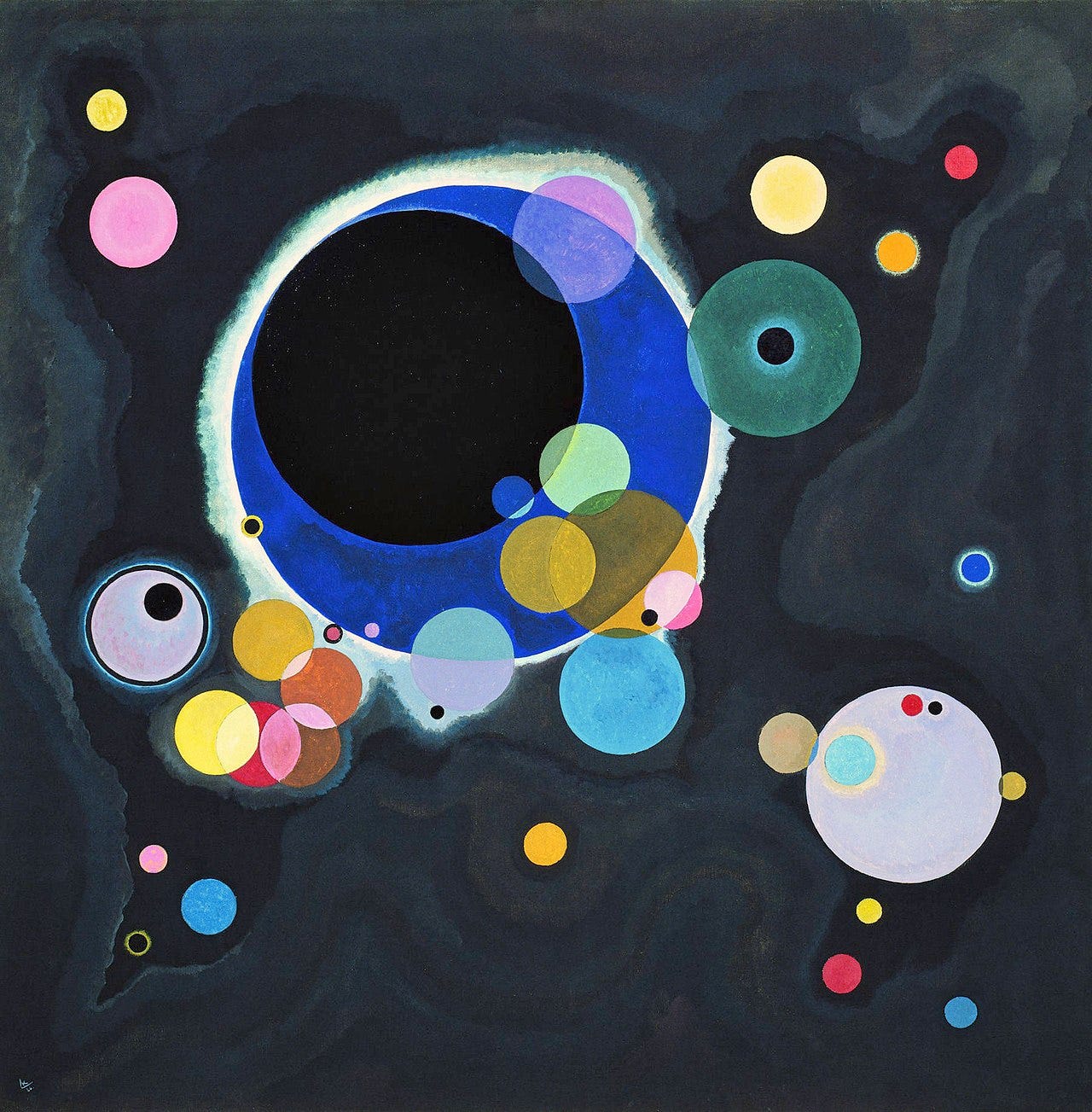
Dozens of circles of every color float in a deep black space, glowing softly like planets. By 1926 Kandinsky had come to call the circle the most peaceful and the richest form he knew, and he gave it a canvas of its own in Several Circles.
After the chaos of his early storms and the sharp angles of the Bauhaus, he settled into this quiet cosmos of pure color. Abstract art had begun as a shock, and this one now hangs in the Guggenheim in New York, calm as a night sky.
The collections that took them in
Hilma af Klint, The Ten Largest: the Hilma af Klint Foundation, Stockholm.
Kandinsky, Composition VII, and Malevich, Black Square: the Tretyakov Gallery, Moscow.
Robert Delaunay, Simultaneous Windows: the Hamburger Kunsthalle.
Mondrian, his grids: the Gemeentemuseum, The Hague.
Kandinsky, Several Circles: the Guggenheim, New York.
If pure color and shape drew you in, keep going:
Twelve famous portraits and the real people, the faces behind the paintings
The Last Supper, detail by detail, the detail hiding at that table
Six women, one monster, what Picasso did to the women who loved him
Abstract art, a few quick questions
What is the most famous abstract painting? Malevich's Black Square and Mondrian's grids are the most famous early ones, with Jackson Pollock's drips the most famous of the modern age.
Who invented abstract art? Kandinsky is usually credited, but the Swedish painter Hilma af Klint was making abstract pictures a few years earlier, in secret.
What is Suprematism? Malevich's movement, built on pure geometric shapes and the idea that feeling matters more than any object.
Why does abstract art have no subject? Its pioneers believed color, line and shape could move us directly, the way music does, without needing to show a thing.
What about Pollock and Rothko? The great American abstract painters, Jackson Pollock and Mark Rothko, came later and remain under copyright, but they built on these European pioneers.
The moment art let go
Line them up and you can watch painting jump off a cliff. For five hundred years art had tried to show the world, a face, a saint, a bowl of fruit.
Then, in barely twenty years, a scatter of artists across Europe decided it did not have to show anything at all.
A woman painted spirits in secret, a Russian hung a black square where an icon should go, and a Dutchman fell out with his best friend over a tilted line.
Hilma af Klint was so sure the world was not ready that she kept her abstractions from being shown for at least twenty years after her death, and in fact they stayed largely unseen for decades.