
Academic painting was the official art of the 1800s, taught by state schools and rewarded by state juries. In Paris, the Salon jury decided what the public would see.
The winners painted Bible stories, myths and history, so smooth that no brushstroke showed. In 1874, nearly half a million people visited the Salon. The first Impressionist show drew about 3,500.
In the 1900s, “academic” became an insult. In 1986, the Musée d'Orsay hung the Salon painters beside the Impressionists.
Cool Stories About Art is a newsletter to learn art the fun way.
Join 200,000+ readers and get:
10 new art stories / month
The entire archive of content (1,000+ articles)
Comment, ask questions, and chat with other readers
How These Were Chosen
The test was whether a painting had a life after the studio. It made news in its day, with a medal, a crowd, a review still quoted or a purchase by the state or a ruler.
Or it sold to rich collectors in London and New York. Or it was rediscovered, reproduced or used in ways its painter never planned.
12. Frederic Leighton, Flaming June (1895)
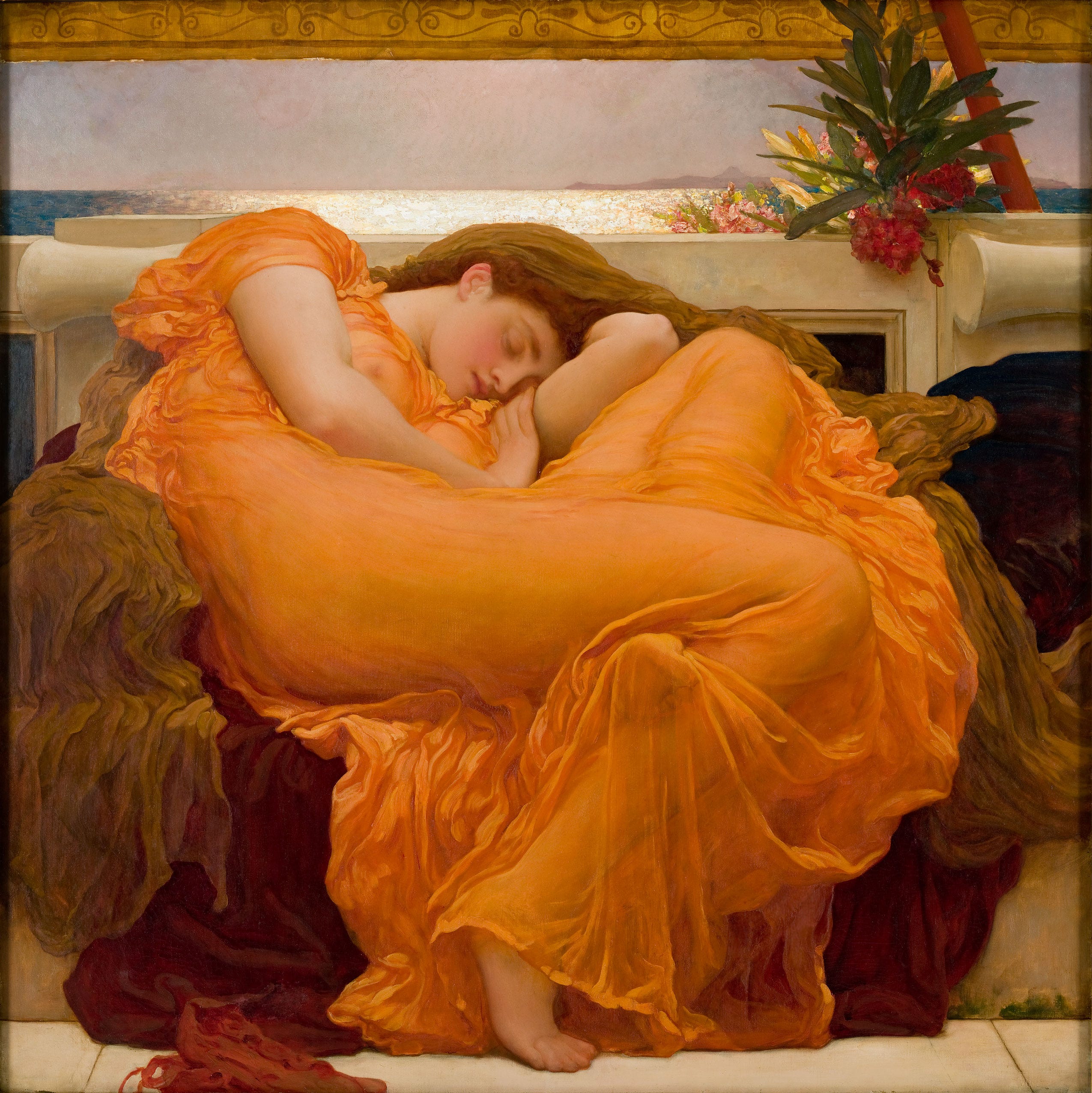
A young woman sleeps curled up on a marble bench, wrapped in a thin orange dress. Behind her, the sun blazes on a strip of sea. At the top right, a branch of oleander leans over the parapet.
Frederic Leighton painted her in London in 1895. Leighton was English, and his Salon was the Royal Academy of Arts, whose yearly Summer Exhibition could make a London career the way the Salon made a Paris one. He had been its President since 1878.
Leighton had trained on the continent, in Frankfurt, Rome and Paris, and he prepared a picture the academic way, in stages. For Flaming June he made a tracing of the whole composition and squared it up with a grid, to transfer it to the canvas. He also painted a color sketch only 11 centimeters wide.
It shows a canvas awning and a small island on the horizon. Both are gone from the final picture, which keeps only the sleeper, the bench and the sea.
On 7 April 1895, Leighton opened his studio to visitors for Show Sunday. Painters held these open days just before sending their work to the Academy. Flaming June was one of six pictures he sent to that year's Summer Exhibition.
The Times praised his drawing and his command of the "complicated line." Other critics said the pose was impossible and the body out of proportion. Leighton said it came from a tired model who had curled up in a chair for a nap.
It is also loosely based on Night, a marble figure Michelangelo carved for the Medici tombs in Florence. What I like best is the bare foot that slips out under the hem, at the bottom of the canvas. After all that orange silk, it is the one plain, ordinary thing in the picture, and it turns a studio pose into someone actually asleep.
The President of the Royal Academy sold the picture to a newspaper. William Luson Thomas paid just over £1,000 for it. He owned The Graphic, a London illustrated weekly, and wanted the image for a color plate.
The plate went out with the Christmas 1896 issue, and readers could have it framed for 10 extra shillings. By then Leighton was dead. He died of heart disease in January 1896.
The finished Academy style soon fell out of fashion, and the painting went with it. It spent 1915 to 1930 on loan to the Ashmolean Museum in Oxford. Nobody knows where it was from 1930 until 1962.
That year it turned up in a house being demolished on Clapham Common, in south London, and sold for £60. The London dealer Jeremy Maas later acquired it.
In 1963 Luis A. Ferré, a Puerto Rican industrialist and politician, bought it for the museum he had founded in Ponce in 1959. He paid £2,000, about twice what The Graphic had paid for it.
At a Glance
Artist: Frederic Leighton (1830 to 1896)
Painted: 1895
Medium: Oil on canvas
Dimensions: 119.1 x 119.1 cm (46 7/8 x 46 7/8 in)
Where to see it: Museo de Arte de Ponce, Ponce, Puerto Rico
About This Painting
Is the oleander in the painting poisonous?
Yes. Every part of the oleander plant is toxic. It also blooms most heavily in May and June, which fits the title.
Who was the model for Flaming June?
Leighton's two favorite models of the 1890s were Dorothy Dene and Mary Lloyd. Either of them, or both, may have posed for it.
Is the frame original?
No. Leighton designed a gilded frame for it, and that frame is lost. The one in Ponce is a reproduction that weighs about 61 kilograms, or 134 pounds.
Has Flaming June been shown in the mainland United States?
Yes. Ponce lent it to the Metropolitan Museum of Art in New York, where it hung until February 2024.
11. Franz Xaver Winterhalter, The Empress Eugénie Surrounded by Her Ladies in Waiting (1855)
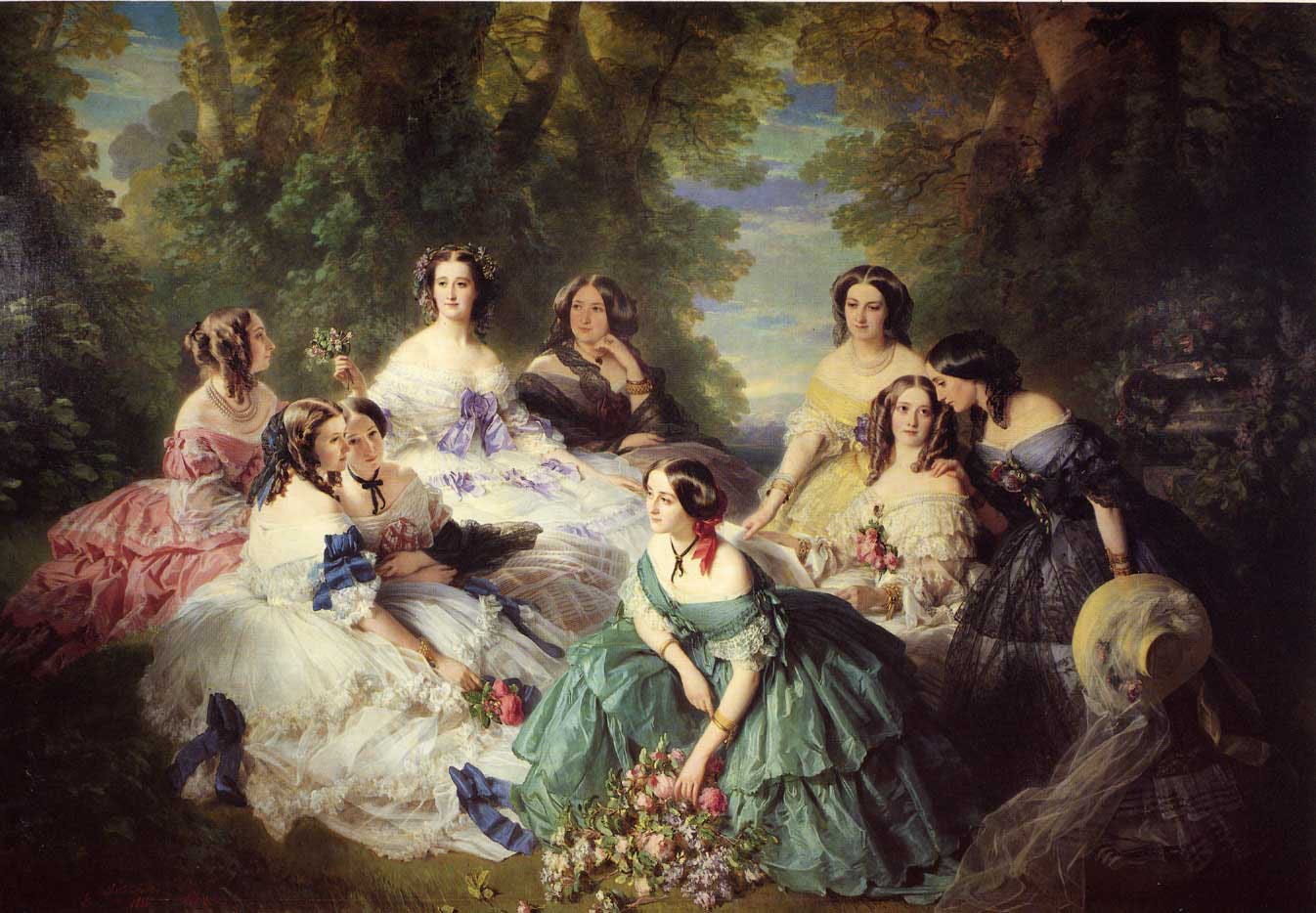
Nine women in wide crinoline skirts sit on the grass of a clearing, shaded by tall trees. The one slightly off center, with flowers in her hair and violet bows on her white dress, is Eugénie, Empress of the French. Franz Xaver Winterhalter painted the group in Paris in 1855.
Eugénie was born in Spain as Eugénie de Montijo. Two years earlier she had married Napoleon III, a nephew of Napoleon Bonaparte, who had made himself emperor in 1852.
The French call his reign the Second Empire. The eight women around her ran her household and kept her company at court.